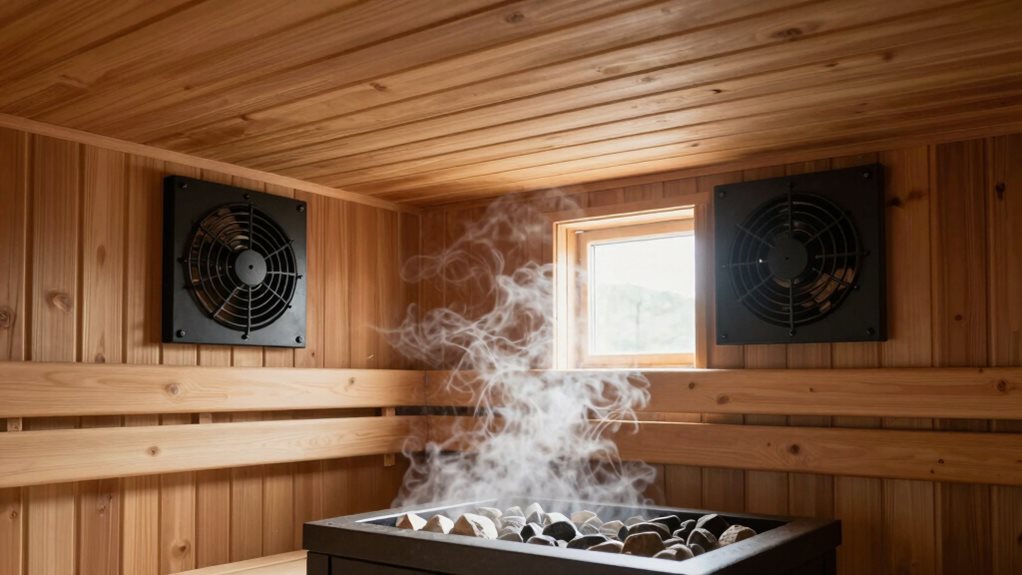

For faster sauna heat-up, place your intake vent near the heater at two-thirds height and your exhaust vent on the opposite wall. This creates a strong convection current that distributes heat evenly. A mechanical downdraft system will heat your sauna 30-40% faster than passive ventilation. Aim for 6-7 air changes per hour using a variable-speed fan. Your feet will thank you when the lower bench areas warm up quickly too.
Mechanical Downdraft Systems: The Quickest Heat-Up Solution
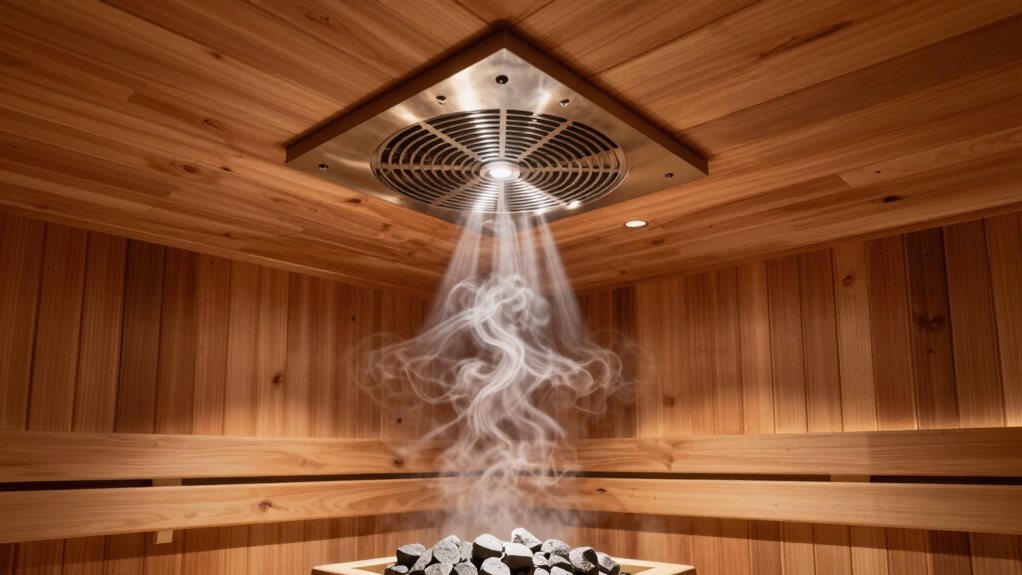
When it comes to warming up your sauna quickly, mechanical downdraft systems stand out as the most efficient solution.
These systems draw supply air above the heater and force exhaust below the bench, creating a convective loop that pulls warm air downward. This clever design reduces temperature stratification, meaning you’ll feel more consistent warmth from head to toe.
Unlike traditional systems that trap heat at the ceiling, mechanical downdraft distributes heat more evenly throughout the space.
You’ll notice lower maximum temperatures at the ceiling but better warmth where it matters—around your body. The controlled airflow also improves air quality by removing CO2 and particulates from your breathing zone.
Properly sealing the sauna against air leaks is crucial for maintaining the intended airflow patterns and temperature distribution.
With variable-speed blowers, you can optimize for fast heat-up initially, then adjust for comfort during use. This method achieves the recommended 6 ACH ventilation rate more reliably than passive systems, ensuring both comfort and safety.
Optimizing Inlet Placement for Maximum Heating Efficiency
Your inlet placement can make or break your sauna’s heat-up efficiency.
While many traditional designs place the inlet low near the heater to maximize natural convection, some modern systems like HUUM heaters actually benefit from a higher inlet position about two-thirds up between the stones and ceiling.
You’ll need to evaluate your specific heater type and room configuration when deciding whether to go with a low floor-level inlet that draws in cool air directly to the heat source or a higher placement that works with your heater’s design principles. For optimal performance, ensure that the total vent area equals at least one square inch per cubic foot of sauna volume. Proper ventilation contributes significantly to overall sauna efficiency by helping heaters operate consistently and preventing safety risks.
Above Heater Position
Positioning your ventilation inlet above the sauna heater creates a strategic airflow pattern that dramatically improves heat-up efficiency. When placed about two-thirds up from the floor, fresh air enters directly into the hottest zone, creating better mixing and quicker warming throughout your sauna room.
- Reduces cold spots and prevents uncomfortable cold-air jetting across lower benches
- Creates more even temperature distribution from top to bottom on your upper bench
- Shortens the warm-air path to where you’ll be sitting, speeding up perceived heat-up time
- Aligns perfectly with manufacturer recommendations for open, net-style heaters
- Prevents ceiling-layer stagnation, especially when paired with a small fan
This setup supports the recommended 6-8 air changes per hour needed for maintaining optimal air quality during your sauna session. For best results, make sure your exhaust is positioned opposite the heater to maximize this circulation effect and avoid hot-air short-circuits. Closing the upper vent during the initial heating phase can speed up warm-up time significantly.
Low Inlet Benefits
Placing your ventilation inlet low in the sauna creates remarkable improvements in overall warm-up efficiency. When fresh air enters just 4-12 inches above the floor, it immediately passes through your heater’s warming zone, creating a diagonal airflow pattern that heats the entire cabin faster.
This smart placement encourages warm air to rise through the bench area rather than getting trapped at the ceiling, greatly reducing the time needed to reach comfortable seating temperatures. The diagonal air movement from low inlet to high outlet ensures even heat distribution throughout the sauna space.
You’ll enjoy quicker heat-up times and lower energy bills since your heater won’t need to run as long. The low inlet also guarantees proper oxygen flow during warm-up, preventing CO2 buildup and maintaining air quality. This configuration effectively leverages the natural convection dynamics that drive heat circulation in well-designed passive systems.
Strategic Exhaust Positioning to Reduce Heat-Up Time
The strategic placement of your sauna’s exhaust vent dramatically impacts how quickly the room heats up, making the difference between a long, frustrating wait and a quick, efficient warm-up.
Positioning your exhaust on the wall opposite your heater creates the most effective circulation path for heat distribution throughout your sauna.
- Place exhaust vents on the wall opposite your heater to create direct cross-flow
- Install exhaust near ceiling level to draw out the hottest air, reducing stratification
- Consider a lower exhaust position to pull warm air downward through seating areas
- Size your exhaust appropriately—too large can draw in too much cold air
- Use a variable-speed fan to reduce airflow during initial heating, then increase for humidity control
This cross-room airflow guarantees heat moves efficiently through the space you actually occupy, rather than merely collecting uselessly at the ceiling.
The popular North American approach of installing vents with low to high airflow has been proven ineffective for proper ventilation according to studies.
An adjustable upper vent allows you to fine-tune the airflow intensity, helping your sauna reach optimal temperature more quickly while maintaining a consistent climate throughout your session.
The Physics Behind Airflow and Rapid Sauna Warming
Understanding the physics behind sauna airflow isn’t just fascinating—it’s essential for achieving rapid warm-up times in your home sanctuary.
Hot air rises rapidly due to buoyancy, creating powerful upward currents that you can leverage for efficiency.
When your ventilation intake is placed above the heater, you’ll create an ideal circulation pattern where cold air gets entrained into the rising thermal plume. This prevents the short-circuit effect that happens with floor-level intakes, where cool air simply slides across the floor to the exhaust without properly mixing.
For fastest heat-up, aim for that upper intake near your heater and a lower exhaust. This setup creates a complete convection loop that distributes heat evenly throughout your sauna, eliminating cold spots and reducing stratification that wastes energy.
Automated Controls for Perfect Ventilation Timing
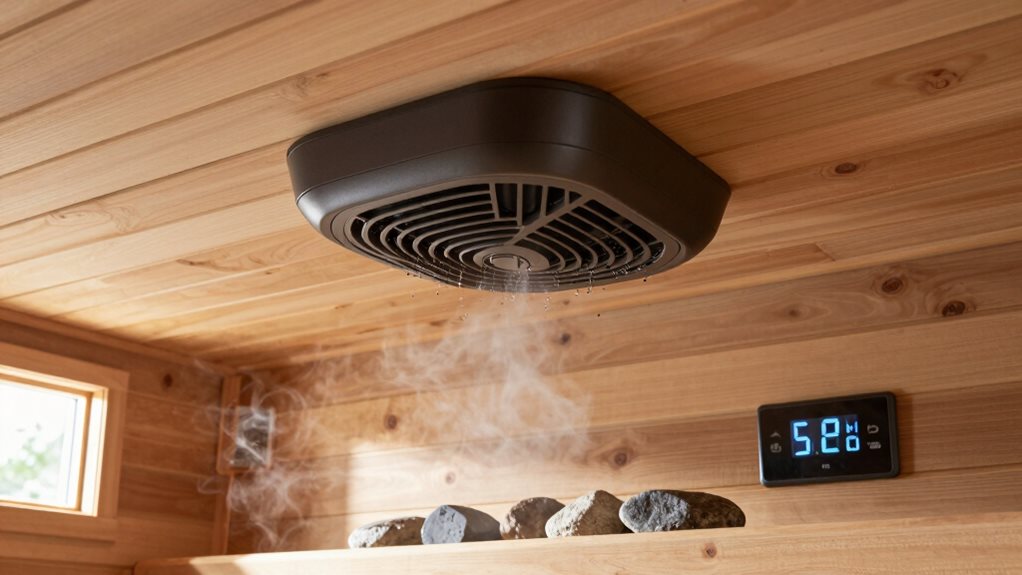
While manual ventilation adjustments serve basic needs, automated controls transform your sauna experience with perfectly timed airflow management.
Modern systems connect to your Wi-Fi, allowing you to control ventilation from your phone while monitoring real-time conditions.
Experience total control with wifi-connected ventilation, putting real-time monitoring and adjustments at your fingertips.
- Schedule your ventilation with 24-hour, 7-day timers that sync with heating cycles
- Let temperature sensors automatically adjust airflow between ceiling and benches
- Choose from multiple fan speeds based on occupancy and desired humidity
- Program pre-heating with timed ventilation that activates precisely when needed
- Improve safety with automatic ventilation during overheating situations
Your controller can integrate with systems like HUUM UKU or SaunaLink, creating a seamless experience where ventilation responds to changing conditions.
With child safety locks and door sensors, you’ll maintain ideal airflow without constant adjustments, letting you focus on relaxation.
Real-World Performance Comparison of Ventilation Designs
Theory only gets you so far—real-world testing reveals which ventilation designs truly deliver exceptional sauna performance. In side-by-side tests, mechanical systems consistently outperform passive setups, heating rooms 30-40% faster with fewer cold spots.
You’ll notice the difference most dramatically in larger saunas, where floor-level intakes paired with ceiling exhausts on opposite walls create powerful convection currents. A 4×4 inch vent delivering 33 CFM achieves ideal air changes (6-7 ACH) in family-sized rooms.
The winning combination? Dual variable-speed fans with low intake vents positioned 6 inches from the floor below your heater. This setup warms incoming air immediately and distributes heat evenly throughout the space, especially around your feet where comfort matters most.
Frequently Asked Questions
Do Ventilation Fans Increase Electricity Costs Significantly?
No, your ventilation fan won’t greatly increase electricity costs. It typically adds less than 1-3% to your sauna’s energy consumption, costing just pennies per month during normal use.
Can Mechanical Downdraft Systems Be Retrofitted to Existing Saunas?
Yes, you can retrofit mechanical downdraft systems to most existing saunas. You’ll need accessible bench cavities, electrical work, and possibly structural modifications to create exhaust ducts below benches.
How Loud Are Ventilation Fans During Sauna Operation?
You’ll hear 30-47 dB during operation, depending on fan quality. Well-designed systems with proper ducting, insulation, and quality fans stay below 30dB—barely noticeable during your sauna session.
Are Battery-Powered Ventilation Controls Reliable in High-Heat Environments?
No, they’re not reliable. Your battery controls will likely fail prematurely in sauna temperatures exceeding 50°C, causing erratic performance, reduced lifespan, and potential safety risks with electronic components.
Will Ventilation Fans Work With Wood-Burning Stoves or Only Electric?
Yes, ventilation fans work with wood stoves. You can use external stove blowers, heat-powered fans, or chimney exhaust fans—all specifically designed to be compatible with wood-burning appliances.
Final Thoughts
You’ve learned that proper fan placement makes a huge difference in how quickly your sauna heats up. By installing a mechanical downdraft system, positioning air inlets strategically, and placing exhaust vents correctly, you’ll enjoy faster warm-up times and more efficient operation. Remember, it’s all about controlling airflow with the physics of heat circulation. With automated controls, you’ll perfect the ventilation timing and get the best performance from your sauna setup.