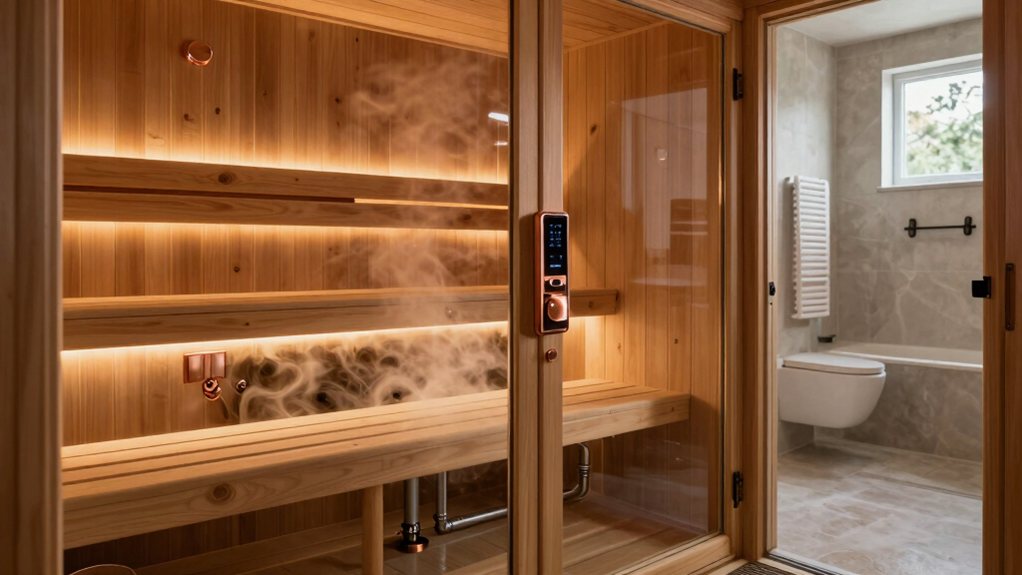

Installing a home sauna typically costs you between $3,000 and $10,000, though your final price swings wildly based on whether you pick a prefab kit, go custom, or choose between traditional, infrared, or outdoor models. A basic two-person infrared setup might run you just $1,500, while a sprawling custom cedar retreat with all the bells and whistles can blast past $20,000.
Your location, heater type, and electrical needs all shape the bill, and that’s before counting labor or surprise expenses hiding around the corner.
How Much Does a Home Sauna Cost to Install?
If you’re dreaming of unwinding in your own personal sweat lodge, you’ll probably want to know what kind of hit your wallet’s going to take. Installing a home sauna typically runs you about $3,000 to $10,000, though some estimates land closer to $2,500–$7,000 with an average around $3,100.
Your final bill depends heavily on what you choose. Prefab kits, which come pre-cut and ready to assemble, usually cost $2,300–$14,500 installed. These are your budget-friendly friends, like buying furniture from IKEA versus hiring a carpenter.
Custom builds, however, range from $4,300 to $34,000, soaring higher with premium woods and fancy heaters.
Labor alone sets you back $300–$2,500, and electrical work can surprise you if your garage isn’t sauna-ready. Size matters too: a cozy two-person unit might cost $800–$3,200, while a four-person retreat runs $2,000–$8,000.
Where you place your sauna also affects your budget significantly, as indoor installation typically costs more than outdoor setups due to ventilation requirements.
Heat source selection also significantly impacts your total investment, with gas and wood-burning heaters typically commanding higher prices than electric alternatives.
How Much Does Infrared Sauna Installation Cost?
You can expect to pay anywhere from $1,500 to $8,500 for an installed infrared sauna, though simpler plug-and-play models start closer to $1,500 while luxury custom builds can climb past $10,000.
Your final bill depends on factors like cabin size, wood quality, and whether you need electrical upgrades, which might add another $500 to $1,500 if your home’s wiring isn’t sauna-ready. Entry-level infrared saunas operate at lower temperatures between 120°F–150°F and can use a standard 120V household outlet, keeping your upfront electrical costs minimal. For those seeking maximum customization and control, a full DIY build or SaunaCloud hybrid approach offers professional-grade results without the limitations of prefab cabins.
Once everything’s running, you’ll enjoy relatively low operating costs, typically $10 to $30 monthly, since infrared technology heats your body directly instead of warming the entire room like a traditional sauna.
Price Range Overview
While you’re dreaming about that post-workout sweat session or weekend relaxation retreat, it’s worth knowing that infrared sauna installation won’t necessarily drain your savings account. You can find basic plug-and-play units starting around $1,500, though most homeowners spend between $2,300 and $8,500 for a complete setup.
Think of it like buying a car: compact models cost less, while family-sized versions with premium features push toward the higher end. Your final price depends on size, materials, and tech upgrades. For those seeking maximum durability in humid environments, Western Red Cedar offers superior moisture resistance compared to budget-friendly alternatives.
Installation labor adds $300 to $2,500, depending on complexity. Prefab indoor sauna kits typically range from $2,500 to $7,500 for those seeking a straightforward installation option.
Monthly operating costs stay surprisingly low, typically running $5 to $15. Compared to traditional saunas averaging $3,000 to $10,000, infrared options often sit at the budget-friendly end, making that home spa dream more accessible than you might expect.
Installation Requirements
Before you pick out the perfect spot for your new sauna, you’ll want to understand what actually goes into getting it up and running.
You’ll need to check your electrical setup first: most smaller units plug into standard outlets, but bigger models might need a dedicated 120V/20A circuit costing $150–$400, or even 240V for family-sized saunas.
Next, think about where it’ll live. Basements, garages, or bathrooms work great indoors with level floors and some breathing room around the cabinet.
Going outside? You’ll need weather protection like a concrete pad.
Unlike steam saunas, infrared models don’t turn your space into a rainforest, but you still want airflow to keep things comfortable and protect nearby walls.
Assembly runs $300–$1,500 for prefab units, while custom builds can hit $4,000 with insulation and carpentry.
DIY saves money, but those panels and heaters need careful handling. Infrared units typically require less upkeep because the dry environment discourages moisture buildup, making them an attractive choice for homeowners who want minimal maintenance responsibilities.
Operating Expenses
Operating Expenses
Once you’ve got your sauna set up, you’ll want to know what it actually costs to keep it running. Infrared saunas are pretty gentle on your wallet, usually running about $5 to $15 monthly with regular use. That’s less than a couple of fancy coffees!
Your actual bill depends on how often you sweat it out, how long you stay in, and what your local electricity rates look like.
Here’s what shapes your monthly costs:
- How many times you use it each week
- Length of your typical session
- Your area’s electricity prices
- The size of your sauna unit
- How energy-efficient your model is
Compared to traditional saunas, you’re saving money since infrared warms your body directly instead of heating a whole room. Infrared heaters typically consume about 1.5 kW to 6 kW, making them more energy-efficient than traditional electric options.
Annual maintenance stays light too, around $100 to $200 for basic cleaning and upkeep. For a more precise estimate, factor in your local electricity rate—for example, at $0.25 per kilowatt-hour, you can calculate exactly what your sessions will cost.
What Hidden Costs Catch Sauna Buyers Off Guard?
Why does a $3,000 sauna suddenly cost twice as much? Hidden expenses sneak up on you, turning your relaxing retreat into a budget headache.
Electrical work often blindsides buyers first. You might need a 240-volt hardwired connection, costing $500 to $2,000 for an electrician. If your panel can’t handle the load, add another $1,000 to $3,000. Labor eats 30% to 50% of your total bill. Substantial additional costs arise when your home’s electrical infrastructure is outdated and requires complete upgrading.
Permits pile on more. Outdoor structures need approval, running $50 to over $500, and skipping them means fines. Insurance companies may raise your premium $100 to $500 yearly, seeing fire or injury risks.
Monthly operating costs sting too: electric saunas add $25 to $50 to your bill. Annual maintenance? Another $150 to $600. Your wallet feels the heat long after installation.
What Size Sauna Can You Afford?
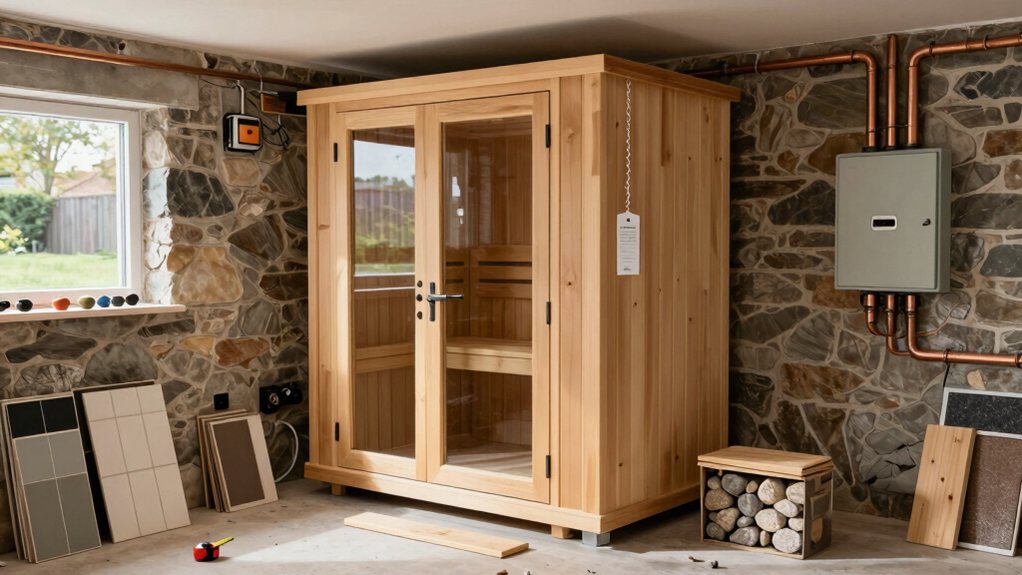
Hidden costs can wreck your budget, but the sauna’s size determines whether you’re sweating in style or sweating over your bank statement. You need to match your square footage to your wallet, because every extra foot hits your pocketbook harder.
Size determines whether you’re sweating in style or sweating over your bank statement—match your square footage to your wallet.
Here’s how size and budget shake out:
- $3,000 gets you a cozy two-person infrared or compact prefab unit, think phone booth, not living room
- $5,000 opens the door to small traditional saunas or modest custom builds
- $7,000 lands you a small-to-mid-size prefab where you can actually stretch your legs
- $10,000+ buys family-sized space with room for friends
- Per-square-foot costs run $50–$200, so measuring twice means spending wisely once
Bigger isn’t always better if you’re eating ramen to afford it.
Prefab or Custom Sauna: Which Saves You Money?
You’re probably wondering whether a ready-made sauna or a custom-built one will keep more money in your pocket, and the answer depends on what you value most.
Prefab units typically run $4,000–$8,000 upfront, while custom builds often start around $8,000 and climb past $20,000 when you factor in specialized labor and materials.
However, hidden costs like electrical work, shipping, and site preparation can shrink that savings gap, so you’ll want to weigh both the immediate price tag and what each option delivers over time.
Upfront Price Comparison
- Prefab saves on labor, you skip the 30–50% contractor markup
- Custom demands design time, planning and site-specific work add weeks
- DIY kits cut costs further, assemble yourself for 20–50% savings
- Site prep narrows the gap, electrical, flooring, and permits add $500–$2,500 either way
- Size and wood quality widen it, bigger, fancier builds favor prefab’s budget edge
For tight budgets, prefab delivers the sweat without the financial stress.
Long-Term Value
When you’re deciding between a prefab or custom sauna, it’s easy to focus on the price tag you’ll pay today, but the real question is which choice keeps more money in your pocket over the years.
Custom saunas typically recover 60%–80% of their cost through home value increases, while prefab units only return 40%–60%. That’s like getting a bigger refund on your investment.
Plus, custom builds last 20–30 years compared to prefab’s 7–15 year lifespan. Imagine buying one car that runs for decades versus replacing your ride every few years.
However, prefab saunas win on flexibility. You can disassemble and move them, like packing a tent instead of leaving a permanent campsite.
If you’re prioritizing budget upfront, prefab saves money now. But if durability, resale value, and personalized fit matter most, custom builds often deliver superior long-term value.
Why Do Outdoor Saunas Cost More Than Indoor?
Although indoor saunas have their own appeal, stepping outside often means stepping up your budget.
Step outside for your sauna, and you’ll likely step up your spending.
Outdoor saunas demand more from your wallet because you’re building a small house that battles Mother Nature daily.
Picture what you’re paying for:
A solid foundation, like concrete or gravel, so your sauna doesn’t sink or tilt.
Weatherproof walls and seals that laugh at rain, snow, and blazing sun.
Trenches and protected electrical lines running across your yard.
Building permits and local rules about where structures can sit.
Ongoing maintenance, like staining wood and fixing weather wear.
Indoor saunas often skip these steps by borrowing your home’s existing shelter.
You avoid foundation headaches, weather battles, and yard work.
That cozy spare room? It becomes your sauna without fighting the elements.
How Much Is Sauna Installation Labor?
How much will you actually pay someone to build your sauna? Labor typically runs $300 to $2,500, depending on what you’re installing.
Prefab kits keep costs low at $300–$1,500 since parts arrive nearly ready to go. Precut kits demand more hands-on work, pushing labor to $1,500–$2,500. Custom builds? Expect $45–$200 per hour because every board gets cut and fitted on-site.
Labor eats 30–50% of your total budget, so plan accordingly. Electrical work and ventilation add time and money, while larger sizes slow progress.
Think of it like assembling furniture: a pre-made bookshelf takes an hour, but building one from scratch takes all weekend.
Match your sauna type to your budget, and you’ll avoid sticker shock when the bill arrives.
What Will Your Sauna Cost to Run Each Month?
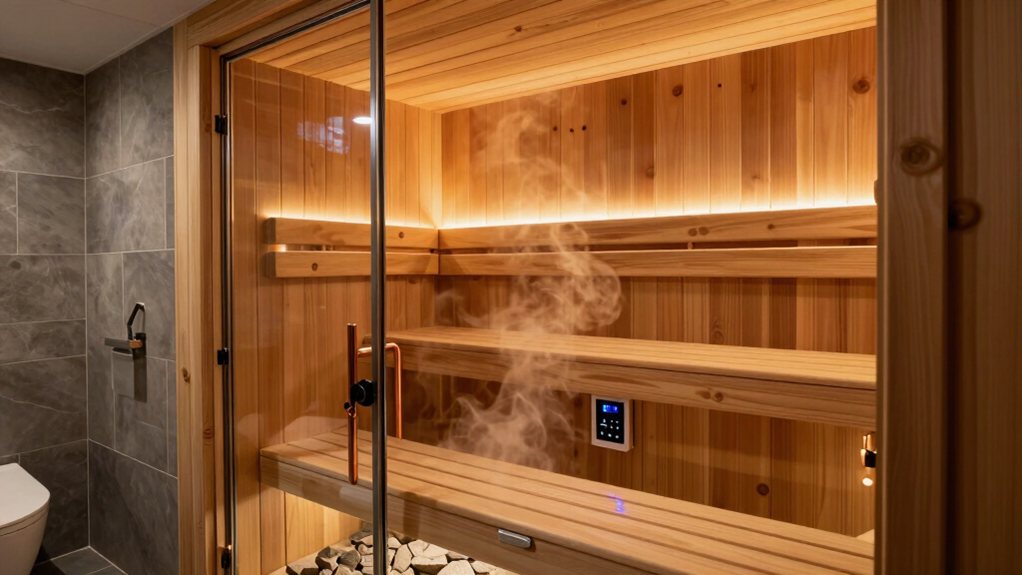
Add up your sauna’s monthly bill, and you’ll likely spend less than your streaming subscriptions. Infrared saunas run you about $3, $15 monthly, making them the cheapest option. Traditional electric models cost $15, $55, while wood-burning saunas hit $40, $90 depending on firewood prices.
Your actual bill depends on a few key factors:
- Heater wattage, bigger units draw more power
- Session length, longer sits mean higher costs
- Weekly frequency, daily use adds up faster
- Local electricity rates, your utility price per kilowatt-hour
- Sauna size, 2-person cabins cost far less than 6-person rooms
Use this quick formula: multiply your heater’s kW by hours used, sessions per week, 4.33 weeks, and your electricity rate.
A small infrared used three times weekly might add just $5 to your bill, roughly one fancy coffee.
Frequently Asked Questions
Can I Install a Sauna Myself?
Yes, you can install a sauna yourself, especially with a prefabricated kit. You’ll handle framing and assembly, but you should hire an electrician for the heater wiring.
Focus on proper ventilation, moisture barriers, and safety clearances.
Does a Sauna Increase Home Value?
A sauna can boost your home’s value, but you’ll rarely recoup the full cost.
In luxury markets, it helps differentiate your property and attract wellness-minded buyers, though actual ROI varies by location and quality.
What Permits Are Needed for Sauna Installation?
You’ll need electrical permits for wiring upgrades, building permits for structural changes, and possibly mechanical or plumbing permits depending on ventilation and steam features.
Check with your local building department first, as requirements vary by location and sauna type.
How Long Does Sauna Installation Take?
You’ll finish a portable infrared sauna in under 2 hours, while standard prefab kits take 4 hours. Traditional builds need 6 to 12 hours, but full projects with permits and electrical work typically span 1 to 4 weeks.
Can I Finance a Home Sauna Purchase?
Yes, you can finance a home sauna purchase. Many retailers offer in-house financing through partners like Affirm, Klarna, or PayPal Credit with instant decisions, promotional APRs, and terms ranging from 4 payments to 36 months.
Final Thoughts
You’ve explored the costs, from compact infrared units to custom outdoor retreats, and you’re ready to make your decision. Remember, a sauna isn’t just a purchase, it’s an investment in your daily relaxation and health.
Weigh your space, budget, and goals carefully, and you’ll find the perfect fit. Whether you choose prefab or custom, indoor or outdoor, your personal wellness sanctuary awaits.
Start planning, and soon you’ll be sweating out stress in your own home.