
You must hire a licensed electrician to install your sauna’s electrical system according to strict legal requirements. Your sauna needs a dedicated circuit (30-60 amps for traditional, 15-20 amps for infrared models), GFCI protection, proper wire gauge, and a disconnect switch near the entrance. Local permits are mandatory, and regular inspections are legally required. Proper installation guarantees your relaxing sauna experience doesn’t turn into a dangerous code violation.
International Safety Standards for Sauna Electrical Systems
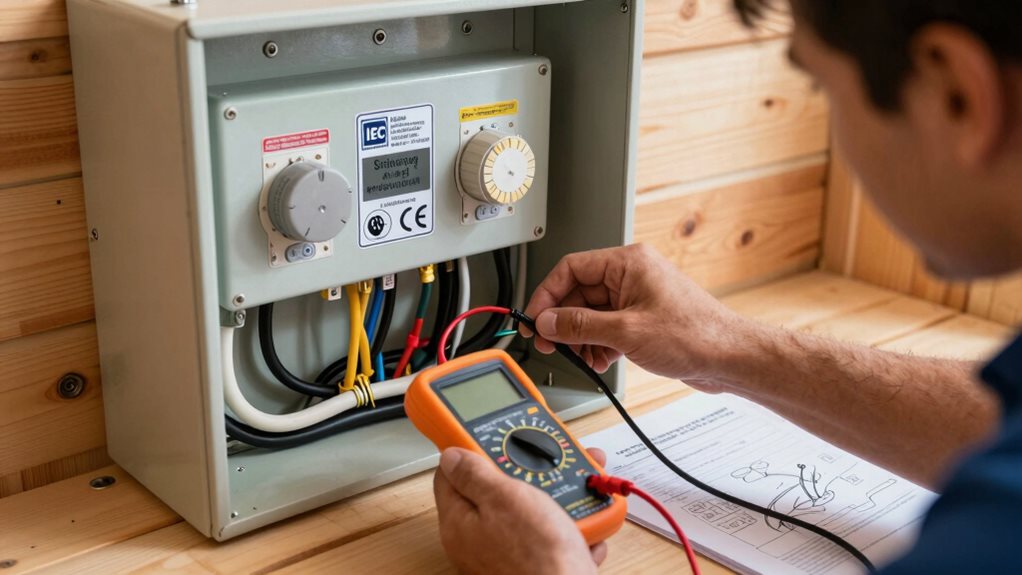
When it comes to sauna electrical systems, international safety standards provide the foundation for keeping users safe while enjoying the heat.
The IEC 60335-2-53 standard covers electric sauna heaters and infrared units up to 20 kW, with voltage limits of 250V for single-phase and 480V for other appliances. This standard was adopted in the U.S. as ANSI/UL 60335-2-53, replacing the older UL 875 guidelines.
You’ll find these standards include essential safety features like mandatory over-limit switches that shut off heaters if temperature sensors fail, and thermostat limits keeping room temperatures below 194°F.
They’ve also improved the sensor location, moving it away from directly above the heater to 6 inches from the ceiling, which prevents unnecessary shutdowns while maintaining safety.
Voltage Requirements Based on Sauna Type
When you’re choosing a sauna for your home, you’ll need to understand the different voltage requirements based on sauna type.
Traditional saunas typically require 240V power connections to operate efficiently, particularly for larger models with rock heaters that need quick warm-up times. Electric sauna heaters usually require substantial power output that a single 120V line cannot adequately provide.
In contrast, most infrared saunas work with standard 120V household outlets, making them easier to install without special electrical modifications.
Though larger infrared units may still need higher voltage connections.
Traditional vs. Infrared Voltages
The two main types of saunas require fundamentally different electrical setups based on their heating technology.
Traditional saunas operate at higher voltages (220-240V), demanding dedicated 30-60 amp circuits to power their intense heating elements.
In contrast, many infrared saunas work with standard 110-120V outlets and only need 15-20 amps, making them more accessible for home installation.
When planning your sauna installation, remember these vital voltage differences:
- Traditional saunas require professional hardwiring to a dedicated high-voltage circuit
- Infrared models under 1,800 watts can often use existing household outlets
- Larger infrared units (3-4 person) still need 220-240V, similar to traditional models
- Commercial traditional saunas may require specialized three-phase power (208V/3PH)
Always verify the manufacturer’s specifications before attempting any electrical connections.
Residential Circuit Considerations
Building on the voltage differences we’ve covered, your sauna’s electrical setup at home demands specific circuit configurations to function safely and effectively.
You’ll need a dedicated circuit regardless of your sauna type to prevent overloads and guarantee consistent power.
For traditional saunas with 4.5-6.0kW heaters, you’ll need a 30-amp breaker with 10/2 wire, while larger units may require 40-60 amp service.
If your heater exceeds 8.0kW or is located more than 30 feet from your panel, you’ll need heavier 8/2 wire.
Most home saunas require 240V service, though small infrared models can operate on 120V circuits with 15-20 amp breakers.
Proper Circuit Breaker Sizing and Amperage Calculations
Every sauna installation requires precise circuit breaker sizing to confirm both safety and peak performance.
You’ll need to match your breaker size directly to your heater’s specifications, typically requiring a double-pole breaker for 240V systems. For most traditional saunas, a 40-amp breaker is standard, though requirements range from 30-60 amps depending on your heater’s kW rating.
To determine the proper setup for your sauna:
- Calculate needed power (1 kW per 50 cubic feet, plus 1 kW for glass features)
- Select appropriate wire gauge (#10 for 30-amp, #8 for 40-amp, #6 for 50-60 amp circuits)
- Install the exact breaker size specified on your heater’s nameplate
- Confirm your home’s electrical panel can support the additional load
Dedicated Circuit Requirements and Code Compliance
Your sauna requires a dedicated circuit that can’t be shared with any other appliances or lighting to prevent overloads and guarantee consistent heating.
You’ll need to match the amperage to your specific sauna heater requirements, typically 40-amps for residential saunas running on 240V power.
National Electrical Code compliance isn’t optional—it’s legally required for safety reasons, and your local Authority Having Jurisdiction may add extra requirements beyond the basic NEC standards.
Exclusive Circuit Necessity
When installing a sauna in your home, a dedicated electrical circuit isn’t just recommended—it’s mandated by the National Electrical Code (NEC) for critical safety reasons.
Your sauna heater needs its own exclusive power line that doesn’t share with any other appliances, lights, or outlets.
This exclusive circuit requirement exists for four important safety reasons:
- Prevents dangerous circuit overloads that could lead to electrical fires
- Maintains consistent power delivery for proper heater function
- Eliminates unexpected shutdowns during your relaxation time
- Ensures compliance with building codes and insurance requirements
Most sauna heaters require 220-240V circuits with specific breaker sizes exactly matching the manufacturer’s specifications.
Smaller infrared models might use 120V circuits, but they still need their own dedicated line.
For proper sizing, the general rule is to install a heater with 1 KW per 50 cubic feet of sauna space to ensure effective heating.
Amperage Sizing Matters
Three critical factors determine the appropriate amperage for your sauna circuit: the type of sauna, its size, and the heater’s power rating.
Infrared saunas typically require less power, with smaller models needing only 15 amps on a 120V circuit, while traditional saunas demand considerably more.
You’ll need to match your breaker size precisely to your sauna’s requirements.
For traditional units, a 4.5-6kW heater requires a 30-amp circuit with 10-gauge wire, while larger 8kW models need 40 amps and 8-gauge wire.
The largest traditional saunas may require up to 60 amps with 6-gauge wiring.
Remember that wire gauge must increase as amperage rises.
Using undersized wiring isn’t just against code—it’s a serious fire hazard that could void your homeowner’s insurance.
NEC Compliance Guidelines
The National Electrical Code (NEC) strictly mandates that all electric sauna heaters must operate on dedicated circuits, which forms the cornerstone of safe sauna electrical installation.
You’ll need to follow these requirements whether you’re installing a traditional 240V sauna or a plug-in infrared model.
When guaranteeing NEC compliance, remember these critical points:
- Your sauna heater needs its own circuit—no sharing with outlets or lights that could cause overloading.
- The breaker must be precisely sized to match your heater’s specifications (typically 30-60 amps for traditional saunas).
- You must use high-temperature rated wiring that can withstand the intense heat environment.
- All installations require proper grounding and bonding, which prevents dangerous electrical situations in your moisture-rich sauna.
GFCI Protection for Wet Sauna Environments
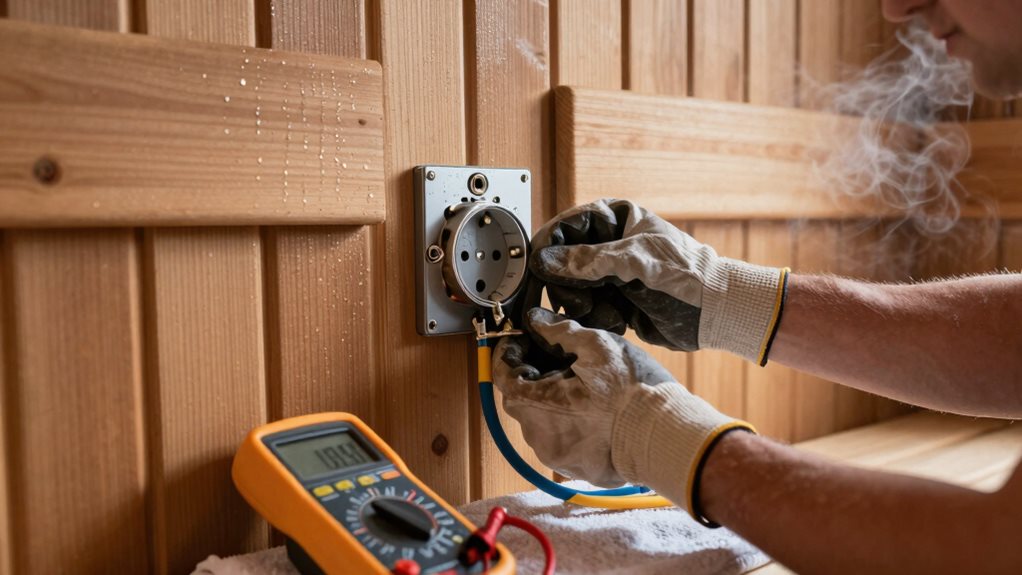
Ground Fault Circuit Interrupter (GFCI) protection stands as a critical safety requirement for wet sauna environments due to the heightened risks of electrical shock when moisture and electricity mix.
The National Electrical Code requires GFCI protection for all 125V, 15- and 20-ampere receptacles within 6 feet of your sauna’s interior walls.
You’ll need to install either a GFCI circuit breaker at your electrical panel or a GFCI receptacle at the beginning of the circuit. For hardwired sauna heaters, a GFCI breaker on the dedicated circuit provides the necessary protection.
Remember, your sauna’s high moisture levels and heat can create dangerous leakage currents that GFCIs detect and interrupt before they become life-threatening.
Don’t forget to test your GFCI devices regularly, as heat and moisture can degrade their performance over time.
Appropriate Wiring Specifications and Heat Ratings
Selecting appropriate wiring specifications for your sauna isn’t just about code compliance—it’s vital for safety and longevity in these challenging environments.
Proper sauna wiring goes beyond meeting codes—it’s essential for protecting your investment and ensuring safe operation in extreme conditions.
Traditional saunas require 240V service with heavier gauge wiring, while infrared models can often use standard 120V circuits.
Your wiring must match both voltage and amperage needs based on the heater’s specific requirements. For safety, follow these important guidelines:
- Choose the correct wire gauge (8 AWG for 40-amp, 10 AWG for 30-amp circuits)
- Install only copper conductors with high-temperature insulation ratings
- Never use exposed Romex inside sauna walls where heat can damage it
- Select moisture-resistant materials designed to withstand years of steam and heat
Professional Installation and Permitting Process
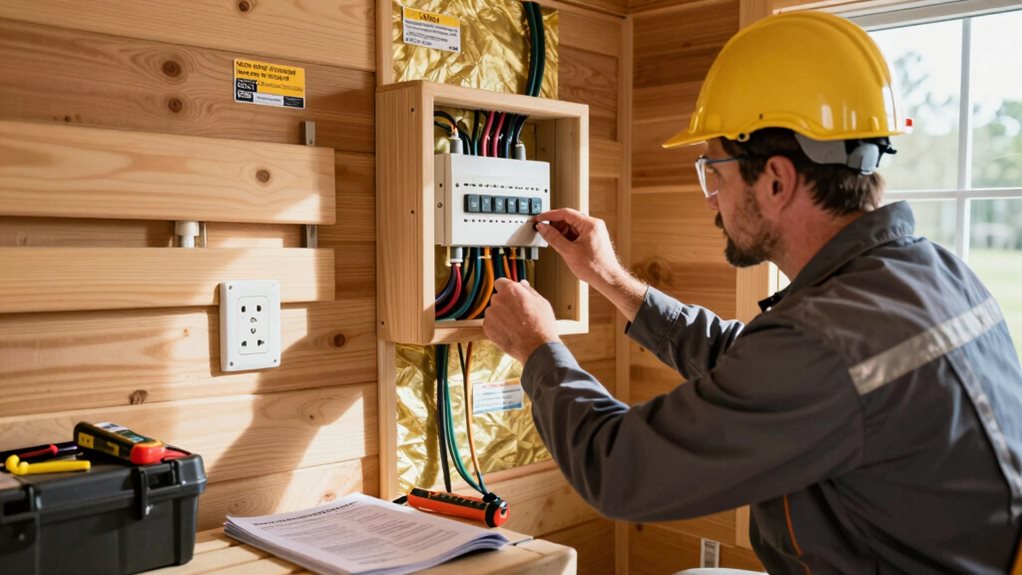
When undertaking sauna electrical work, hiring a licensed professional isn’t merely recommended—it’s often legally required. Most jurisdictions mandate that solely licensed electricians install sauna wiring to guarantee proper code compliance and safety.
Before installation begins, you’ll need to acquire electrical permits from your local building department, which typically requires submitting heater specifications and wiring plans.
Your electrician will calculate the proper circuit sizing based on your heater’s needs, verify your home’s electrical capacity, and confirm all components meet local code requirements.
After installation, an inspector will verify that everything meets code—from dedicated circuits and GFCI protection to proper wire gauge and grounding.
Professional installation not only prevents potential inspection failures but also protects against serious safety hazards and maintains your warranty coverage.
Disconnect Switch Placement and Emergency Safety Features
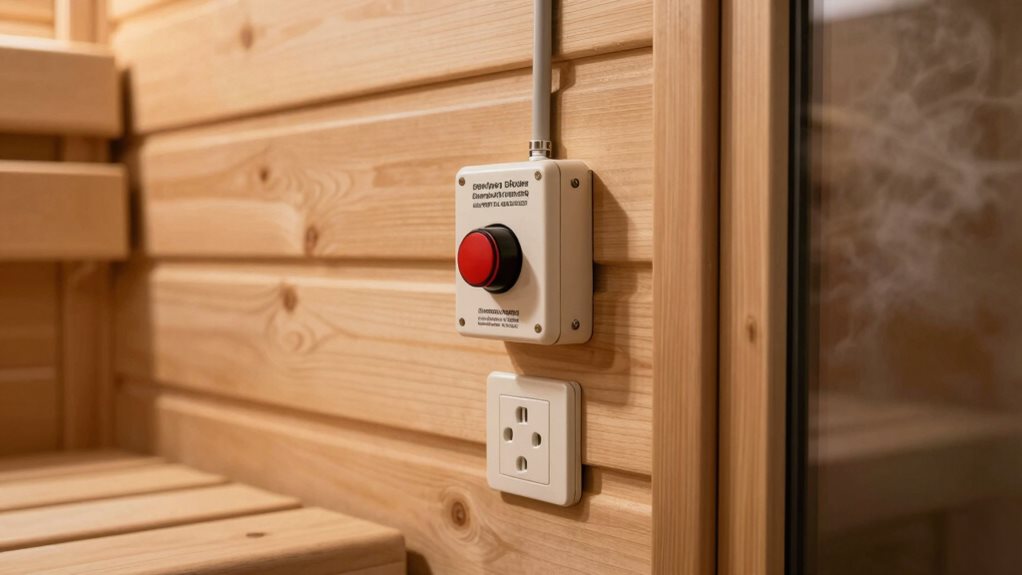
The disconnect switch serves as your sauna’s emergency “off button,” providing a critical safety feature that’s required by building codes nationwide.
Don’t compromise on safety – a properly installed disconnect switch isn’t optional, it’s mandatory protection required by national building codes.
You’ll need to mount this switch within 3 feet of your sauna’s entrance, but never inside the hot area itself. For standalone saunas, a wall-mounted disconnect is preferable to exposed cords.
Your safety depends on these four critical features:
- A clearly labeled disconnect switch for instant power cut-off
- GFCI protection to prevent electrical shocks from moisture exposure
- Automatic shut-off timers as a secondary emergency feature
- Dedicated 240V circuit with appropriate amperage for your specific heater
Regular Inspection and Maintenance Obligations
Regular inspection and maintenance aren’t just good practices—they’re legal obligations that protect you and your sauna users from potential electrical hazards.
You must test GFCI devices monthly by pressing the test button, and schedule professional inspections annually by a licensed electrician who understands NEC standards.
Keep detailed logs of all maintenance activities, including quarterly visual checks for overheating signs and biannual verification of breaker operation.
After completing maintenance, you’ll need to tighten connections, clean control panels, and replace any worn wiring immediately.
Frequently Asked Questions
Can I Install My Sauna on a Generator or Solar Power?
You’ll need a large generator (20-50% above your sauna’s kW) or robust solar system with pure sine wave inverters. Infrared saunas work better with alternative power sources than traditional heaters.
How Far Should Electrical Components Be From Water Sources?
You’ll need all electrical components at least 5-6 feet from water sources, with GFCI protection required anywhere within 10 feet of moisture. Always follow your local electrical code requirements.
Do International Safety Standards Differ From US Requirements?
Yes, international standards differ greatly from US requirements. You’ll notice IEC standards allow higher temperatures, have less restrictive sensor placement, and generally permit more operational flexibility than traditional UL regulations did.
Are Wireless Control Systems for Saunas Subject to Different Regulations?
Yes, wireless sauna controls are still subject to NEC requirements. You’ll need proper low-voltage wiring separation, outside-room mounting, and must follow manufacturer specifications even with wireless interfaces.
Can I Retrofit GFCI Protection to an Older Sauna Installation?
Yes, you can retrofit GFCI protection to your older sauna, but you’ll need to match it to your heater’s specifications and verify compliance with local codes and manufacturer requirements.
Final Thoughts
You’ll find that proper sauna electrical work isn’t just about comfort—it’s about safety. By following international standards, installing appropriate circuits, and using heat-rated materials, you’re protecting yourself and your family. Remember, electricity and heat create unique hazards that require specific precautions. Don’t cut corners by skipping permits or professional installation. Regular maintenance guarantees your sauna remains a place of relaxation, not risk.