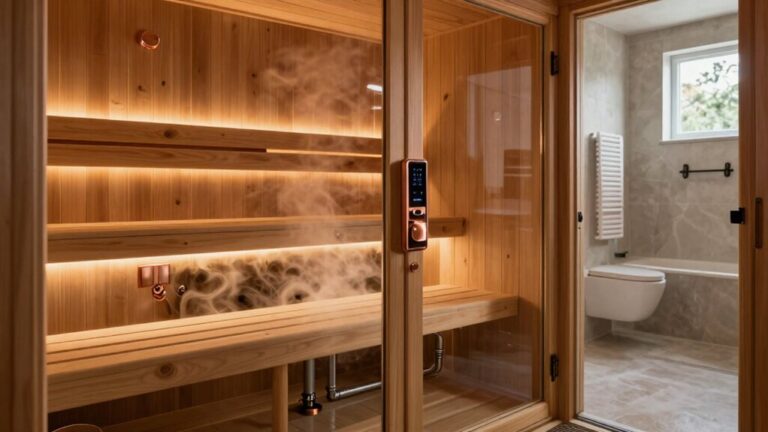
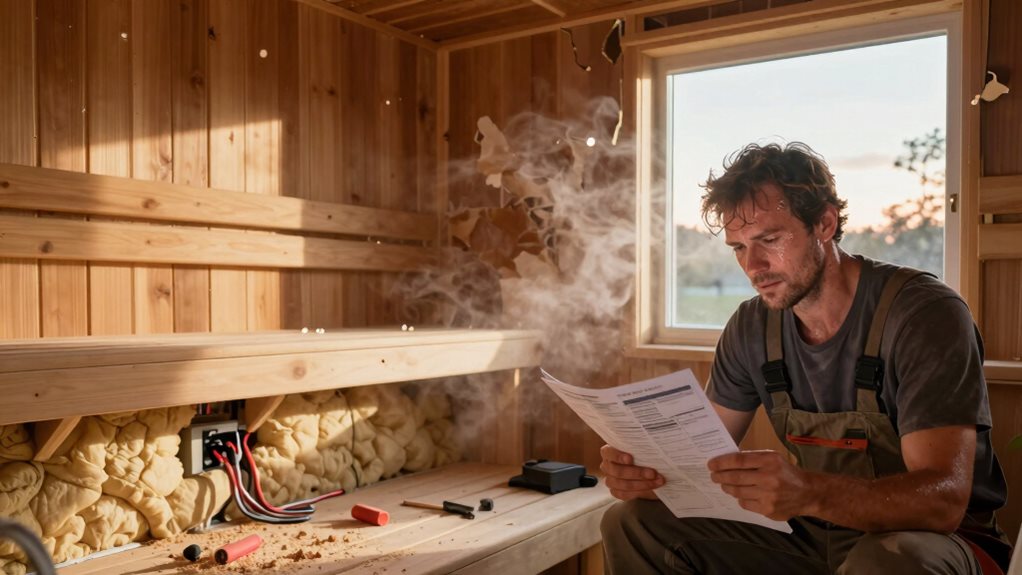

When building your first DIY sauna, focus on proper sizing (4’x5′ for two people), foundation stability, and moisture protection. Don’t skimp on ventilation—install both intake and exhaust vents for healthy air circulation. Match your heater’s power to your space (1kW per 50 cubic feet), and position benches strategically at the right heights (upper bench at 35″). Careful planning with these fundamentals will save you from costly rebuilds and guarantee your sauna delivers the relaxing experience you’re hoping for.
Planning Your Sauna Space: Critical Layout and Positioning Factors
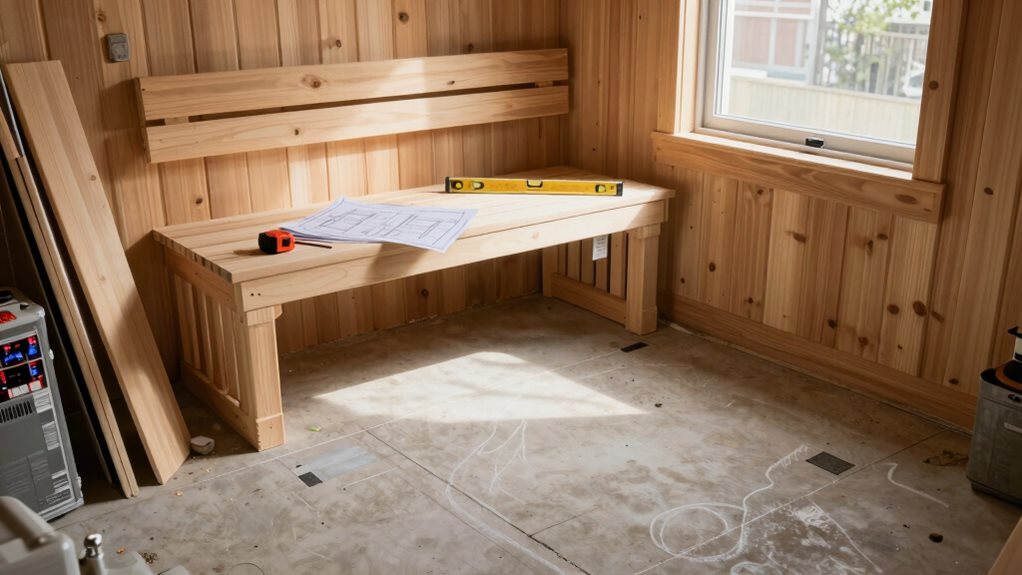
When planning your DIY sauna, the layout and positioning decisions you make early on will determine both the comfort and functionality of your finished space.
Start by measuring your available area carefully, as saunas range from compact 4’x5′ models for two people to larger 8’x5′ designs that accommodate six bathers. Consider that L-shaped benches are ideal for larger sauna layouts as they maximize seating while promoting social interaction among users.
For efficient flow, divide your space into wet and dry zones. Position your sauna in the wet zone, ideally at the back of the room with the shower nearby.
Inside your sauna, place two-tier benches along the back wall with the heater on the opposite side. Your door should be adjacent to the heater, with vents strategically positioned below the heater and diagonally opposite under the upper bench for proper air circulation.
Structural Foundations: Ensuring a Safe and Durable Build
Your sauna’s foundation is the bedrock of a successful build, requiring proper skid placement, joisting, and moisture protection to avoid costly repairs later.
You’ll need to install parallel pressure-treated skids on level ground or concrete pads, creating a stable platform that won’t shift or sink over time.
Careful moisture-proofing beneath your foundation, using vapor barriers and proper drainage, will protect your investment from rot and extend your sauna’s lifespan considerably.
For maximum durability, consider pouring a concrete pad foundation with the recommended 3-4 inch thickness that will properly distribute the sauna’s weight.
Stable Skid Installation
Three key elements make skid foundations the ideal choice for DIY sauna builders: they’re cost-effective, time-efficient, and surprisingly durable for standard-sized structures.
Using 6×6 galvanized lumber, you’ll create a foundation that resists moisture damage while providing excellent structural support.
To install your skid foundation properly:
- Dig parallel trenches 12 inches wide and 6 inches deep, positioned exactly 8 feet apart from outside edge to outside edge.
- Fill with crushed stone and compact firmly, creating a level base that’ll prevent shifting and settling for decades.
- Secure your skids with galvanized elbow brackets and lag screws, then frame with 2×8 joists spaced 16 inches on center.
Don’t forget to extend your gravel pad 2 feet beyond your sauna’s footprint, guaranteeing proper drainage and easy access for maintenance.
Joisting Done Right
Proper joisting forms the backbone of your sauna’s structural integrity, making it essential to get this step right from the beginning.
For standard saunas, install ceiling joists at 7 feet from the finished floor, using 2×6 or 2×8 lumber depending on your span requirements.
When installing joists, attach a ledger board along a level line (typically 82-84 inches high), then secure your joists spaced at 16-inch centers.
Remember, joists should run in the longest direction across your ceiling if you’re planning to install tongue and groove boards perpendicular to them.
Don’t forget to add blocking between joists for heater supports, and install R-20 insulation to prevent heat loss.
For ceilings higher than 84 inches, you’ll need to create a drop ceiling to guarantee proper heat distribution.
Moisture-Proof Foundation Planning
When building a sauna that will last for years, the foundation becomes your first line of defense against moisture damage.
Whether you choose gravel or concrete, proper drainage is crucial to prevent water pooling that can rot wood and create mold. Your foundation should extend 6-12 inches beyond your sauna’s dimensions and be slightly raised to direct water away from the structure.
- Create a proper drainage slope – Angle your foundation slightly so water naturally runs away from your sauna, preventing the heartbreak of discovering rot after just one season.
- Install a waterproof membrane – Roll out PVC membrane with even overhang, securing it 6-8 inches up the walls to create a moisture barrier you can trust.
- Choose rot-resistant materials – Select cedar, spruce, or hemlock for lasting durability against the elements. In humid climates, consider building on raised deck foundations to maximize airflow beneath the structure and further prevent moisture accumulation.
Mastering Insulation for Maximum Heat Efficiency
Insulating your DIY sauna properly stands as the cornerstone of creating a genuinely efficient and enjoyable heat experience.
You’ll want to choose materials with strong R-values, like mineral wool (R-3.0-3.5 per inch) or PIR insulation, which performs twice as efficiently as conventional options at half the thickness.
Don’t forget to completely fill all wall cavities with your chosen insulation to prevent heat escape.
Install a foil vapor barrier with the reflective side facing inward to bounce heat back into your sauna. Seal all seams with high-temperature aluminum tape, guaranteeing overlaps at corners and edges.
For traditional saunas, thicker insulation works best to retain convective heat, while proper insulation can slash heat loss by 50% – directly reducing your energy costs and keeping your sauna toasty for years to come.
Remember that the ceiling requires substantially more insulation than walls, with recommended R-values of R-26 to R-30 since most heat loss occurs through the overhead area.
For barrel saunas specifically, choose flexible materials that can conform to the curved walls while maintaining effective thermal performance.
Proper Ventilation: The Most Overlooked Sauna Component
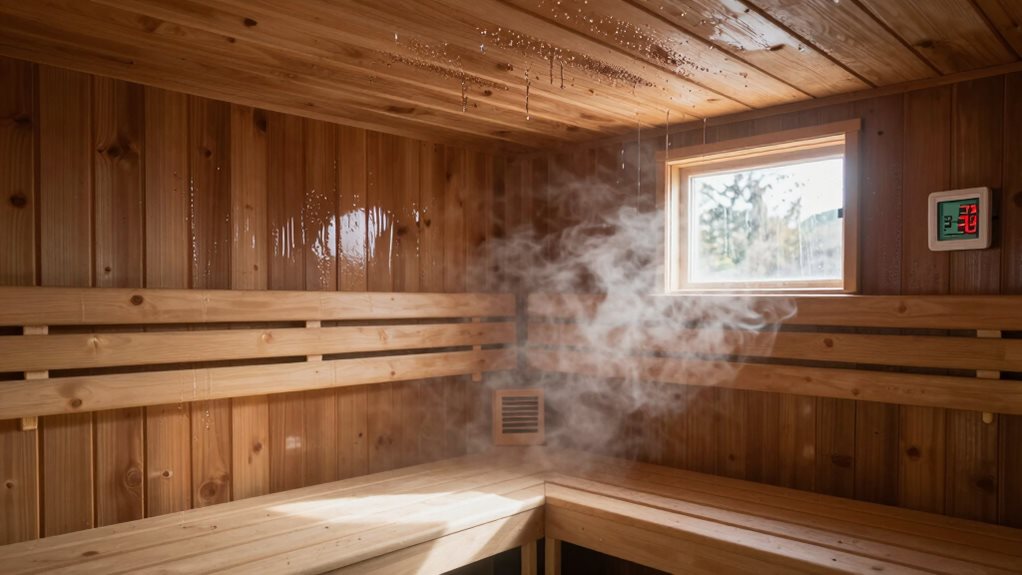
Despite its critical importance for both comfort and safety, ventilation remains the most frequently overlooked component in DIY sauna construction. Proper airflow prevents carbon dioxide buildup and creates a more enjoyable experience by removing excess moisture and keeping temperatures balanced.
Your ventilation system should include both intake and exhaust vents positioned strategically:
- Place your intake vent low near the heater (about 31 inches above the floor) to supply fresh air where it’s needed most.
- Install your exhaust vent diagonally opposite the intake, preferably high in a corner under the top bench.
- Size your vents correctly—remember the 4-person rule: 25 square inches for intake (6-inch round duct) and slightly larger for exhaust.
Don’t skimp on duct size—larger ducts reduce resistance and noise, making your sauna experience much more pleasant. For optimal performance, you can close the upper vent during initial heating to speed up warm-up time. Aim for at least one complete air exchange per hour to maintain oxygen-rich breathing conditions.
Selecting the Right Heating System for Your Needs
Choosing between electric heaters and wood-burning options will greatly influence your sauna experience, with each offering distinct advantages for different settings and preferences.
You’ll need to carefully calculate power requirements based on your sauna’s size, as an undersized heater will struggle to reach proper temperatures while an oversized one wastes energy and money.
Proper professional installation of your chosen heating system, especially for wood-burning or gas units that require ventilation and safety clearances, will prevent dangerous situations and guarantee your DIY sauna functions efficiently for years to come.
Consider that traditional wood-burning saunas provide an authentic experience with löyly steam effect when water is ladled over the heated stones.
For those with limited space or specific health concerns, infrared heaters provide an excellent alternative with their compact design and potential benefits for skin conditions.
Electric vs. Wood Options
When you’re planning your DIY sauna, the heating system will fundamentally shape your entire sauna experience.
Electric heaters offer simplicity with consistent temperatures and minimal maintenance, though they take longer to heat up.
Wood-fired options deliver faster heating, deeper heat penetration, and authentic sensory elements like crackling sounds and woodsy aromas. The wood stove creates more thermal mass, resulting in a different and often preferred heat experience.
- Installation Considerations – Electric requires no chimney but needs dedicated electrical circuits that might cost up to $10,000 with upgrades, while wood-fired systems need proper chimneys but avoid electrical dependencies.
- Heat Experience – Wood stoves produce richer steam and deeper-penetrating heat that many traditionalists prefer, compared to electric’s more consistent but less immersive heat.
- Lifestyle Match – Electric offers push-button convenience for busy lifestyles, while wood-fired appeals to those who enjoy the ritual of tending a fire and aren’t deterred by power outages.
Power Requirements Matter
Understanding your sauna’s power requirements may seem challenging, but it’s absolutely crucial for both safety and performance. Most home saunas need 220-240V power, considerably higher than standard household outlets.
For sizing, follow the 1kW per 50 cubic feet rule. A small sauna (3’x4’x7′) needs a 4-5kW heater, while larger spaces require more power. Remember to add 1kW if you’ve installed windows or glass doors due to heat loss.
Your sauna will need a dedicated circuit with proper GFCI protection. Traditional saunas typically draw 30-50 amps, requiring 30-60 amp breakers depending on size. Smaller infrared models can often run on standard 120V outlets, drawing just 10-12.5 amps.
Always consult an electrician to verify your home’s electrical panel can support these demands before purchasing.
Proper Installation Saves Headaches
The right heating system forms the foundation of your sauna experience, making proper installation absolutely crucial for both performance and safety.
Whether you choose electric, wood-burning, infrared, or gas, each option requires specific considerations to function properly in your space.
- Match your heater to your sauna size – Installing an oversized heater wastes energy and creates uncomfortable heat, while an undersized unit will struggle endlessly to reach proper temperatures.
- Consider your location carefully – Wood-burning heaters work beautifully in rural settings with ample wood supply, while electric options make more sense for urban DIYers.
- Don’t ignore professional help when needed – Gas heaters require professional installation for safety, and even electric units need proper ventilation to prevent moisture damage and guarantee your sauna remains a haven, not a hazard.
Bench Design and Interior Ergonomics That Enhance Comfort
A well-designed sauna bench forms the foundation of your entire sauna experience, creating the difference between discomfort and blissful relaxation.
Position your upper bench at 35 inches from the floor to capture ideal heat without bumping your head. For two-tier designs, place the lower bench between 16-21 inches high.
Make your upper bench 24 inches deep for comfortable reclining, though 20 inches works in smaller spaces. Use 2×4 boards with ¾-inch gaps between slats for perfect air circulation.
If you have room, consider an L-shaped configuration that allows both sitting and lying down.
Remember to install cross-members every 2 feet to prevent sagging, and always attach fasteners from underneath to avoid contact with hot skin.
These thoughtful details will transform your DIY sauna into a spa-worthy retreat.
Moisture Management: Protecting Your Investment Long-Term
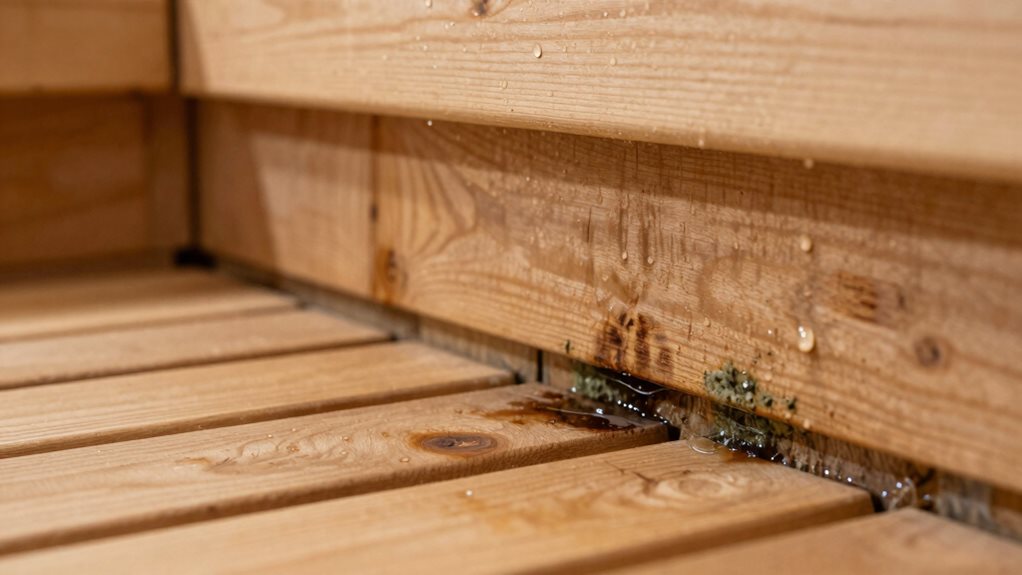
Proper moisture management serves as your sauna’s silent guardian, protecting your investment from the damaging effects of unchecked humidity.
Installing both intake and exhaust vents creates a healthy air exchange rate of 1-2 changes per hour, preventing mold and structural damage. After sessions, run a compact dehumidifier to extract excess moisture, greatly extending your sauna’s lifespan.
For ideal moisture control:
- Use digital hygrometers near the ceiling to monitor humidity levels (40-60% for aromatic experiences, 5-10% for traditional Finnish saunas).
- Apply water gradually—one ladle at a time with minute-long intervals—allowing steam to distribute evenly throughout your space.
- Keep ventilation systems clear and adjustable, never blocking them in attempts to trap heat, which creates unhealthy air quality and moisture buildup.
Frequently Asked Questions
How Much Should I Budget for My First DIY Sauna Project?
You’ll need $2,500-$5,000 for a basic DIY sauna project, including materials, heater unit, and electrical work. You can save money by assembling a prefabricated kit yourself.
Can I Convert an Existing Closet or Small Room Into a Sauna?
Yes, you can convert a closet or small room into a sauna. Walk-in closets work well for 1-2 person saunas and can be completed for under $4,000 with proper insulation and ventilation.
How Long Does a Typical DIY Sauna Installation Take to Complete?
You’ll spend 4-8 hours assembling a pre-made sauna kit or 40-80 hours building from scratch. Factor in additional time for site preparation, foundation work, and electrical installation.
Are Infrared Saunas Easier to Install Than Traditional Finnish Saunas?
Yes, you’ll find infrared saunas much easier to install. They require simple panel assembly and basic electrical connections, while Finnish saunas demand extensive construction, insulation, and complex heating system integration.
What Permits or Inspections Are Typically Required for Home Sauna Installation?
You’ll need building permits for permanent structures, electrical permits for 240-volt installations, and possibly zoning approvals. Expect inspections for electrical work, structure, ventilation, and fire safety compliance.
Final Thoughts
You’ve learned the crucial elements of building your first DIY sauna without costly mistakes. Remember, careful planning, proper insulation, ventilation, and moisture control are your keys to success. Whether you’ve chosen electric, wood, or infrared heating, your well-designed space will provide years of relaxation. By avoiding these common pitfalls, you’ll create a safe, efficient, and comfortable retreat that’s worth every hour of effort you’ve invested.