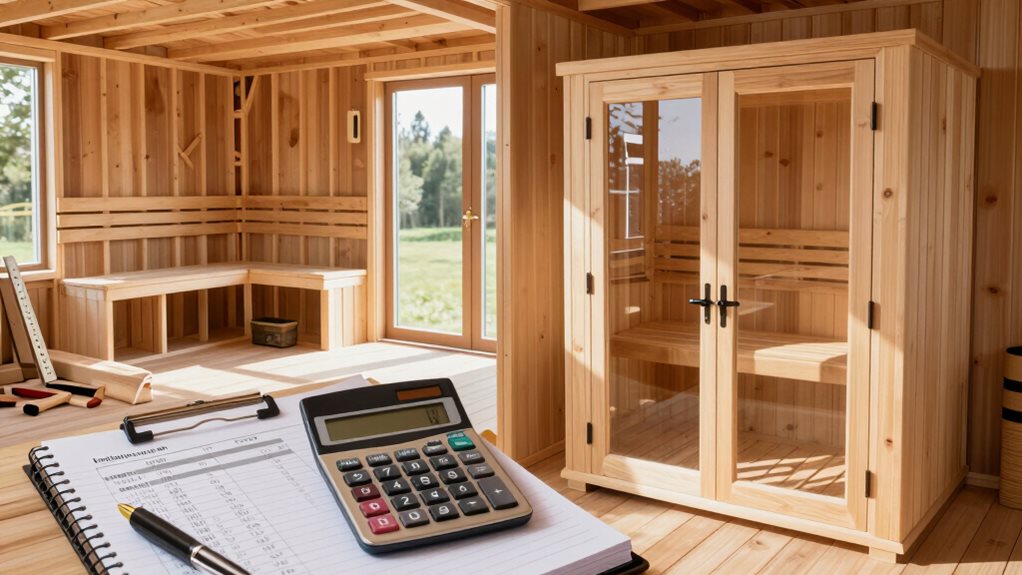

DIY sauna kits ($1,200-$8,000) can save you up to 50% compared to prefab models ($8,000-$20,000+), but you’ll need carpentry skills and 40-80 hours of labor. Prefab saunas offer quicker assembly and typically higher resale value (50-85% recovery rate). Consider hidden costs like permits ($50-$500), foundation work ($200-$500), and maintenance ($150-$200 annually). Your choice depends on your budget, skills, and time availability—each option offers distinct advantages beyond the price tag.
The Real Cost Breakdown: DIY vs. Prefab Sauna Options
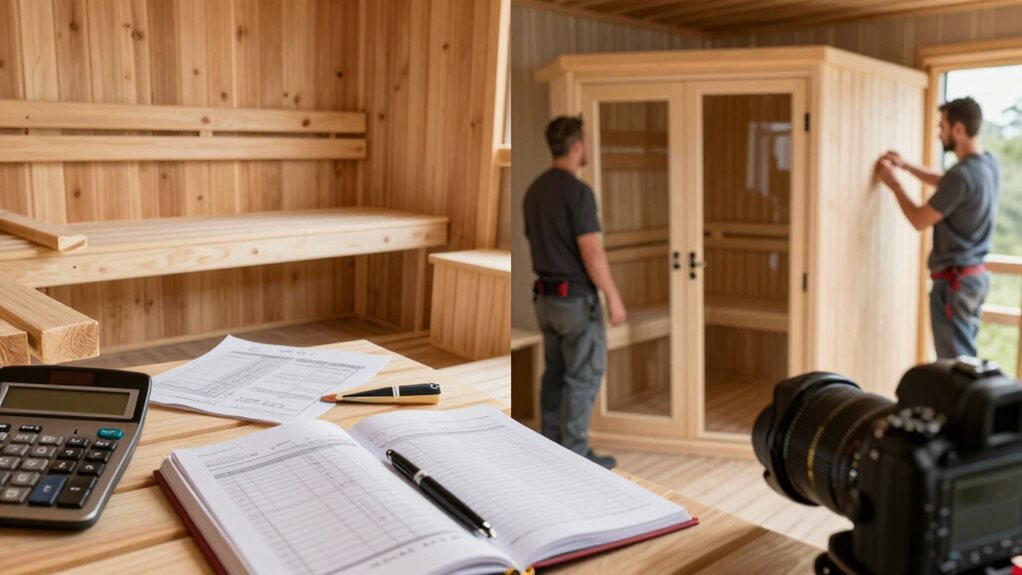
When comparing DIY and prefab sauna options, understanding the true cost breakdown is essential before making your investment.
DIY kits range from $1,200 for small infrared models to $8,000 for premium family-sized options, while prefab units start at $8,000 and can exceed $20,000 with installation.
The price gap between DIY and prefab saunas is substantial—invest wisely based on your budget and assembly comfort level.
Don’t forget the extras! DIY projects require foundation work ($200-$500), electrical ($300-$800), and possibly permits ($50-$200).
Meanwhile, professional installation of prefab units adds $500-$5,000 to your bill, depending on complexity.
You’ll save considerably with DIY approaches—up to 50% if you’re comfortable with assembly, and even more if you build from scratch.
A basic 2-person barrel sauna costs just over $2,000 when you build it yourself.
Choosing thermowood or Nordic spruce instead of premium cedar can reduce your material costs by 30-40% without sacrificing quality.
Time Investment: What to Expect From Each Approach
Before diving into your sauna project, you’ll need to understand the time commitment each approach demands—a factor that’s just as important as your budget.
Full scratch builds require the most time, with even experienced DIYers needing 1-3 months of weekend work. You’ll follow a strict sequence (framing, insulation, vapor barrier, ceiling, then walls) that doesn’t allow for do-overs.
Pre-cut kits greatly reduce this timeline by eliminating measurement errors and material waste, making them ideal for first-timers who still want the satisfaction of building.
Prefab saunas offer the quickest solution, especially barrel styles with their simple design. With proper space measurements beforehand, you can assemble these in hours rather than weeks.
Your skill level matters too—if you’ve built decks or finished basements, you’ll work faster than complete novices tackling their first construction project. For safety and compliance, many DIYers hire professionals to handle the 240V/30A circuits required for sauna heaters. Dedicated DIYers can potentially complete a foundation deck in one session using clear Cedar for both durability and aesthetic appeal.
Material Quality and Longevity Considerations
When you’re choosing between cedar and hemlock for your sauna, you’ll find each offers distinct benefits for your project.
Cedar naturally resists moisture and decay, making it ideal for outdoor saunas where exposure to elements is a concern.
Hemlock, with its lower cost and excellent durability, provides good heat retention and a pleasant aroma, though it may require more maintenance over time compared to cedar.
Thermowood offers exceptional stability in changing humidity levels, making it an excellent alternative to traditional sauna woods.
Cedar vs. Hemlock Durability
The durability of your sauna materials plays a crucial role in determining how well your investment will hold up over time.
Cedar offers superior protection against the harsh conditions saunas face, thanks to its natural oils that resist rot, decay, and insects. Hemlock, while structurally strong, requires more care to maintain its integrity, especially in humid environments.
- Cedar saunas can last for decades with minimal maintenance, making them ideal for outdoor installations.
- Hemlock performs well indoors where humidity is controlled but needs regular sealing to prevent moisture damage.
- Natural cedar oils act as built-in protection against mold and mildew, a notable advantage in steamy conditions.
- Hemlock’s affordability makes it attractive, but you’ll spend more time on upkeep.
- Both woods resist warping from heat, but cedar’s density gives it an edge in stability.
Western red cedar distributes heat uniformly across its surface while maintaining a cool to touch exterior, enhancing comfort during sauna sessions.
Heat Retention Properties
Heat retention represents the backbone of any effective sauna experience, determining how efficiently your sauna warms up and maintains consistent temperatures.
When choosing between DIY and prefab options, consider the insulation materials carefully. Mineral wool offers excellent thermal resistance with an R-value of 3.0-3.5 per inch, while expanded polystyrene delivers slightly better performance at 3.6-4.2 per inch.
Your wood selection greatly impacts heat management. Nordic Spruce conducts 20-25% less heat than untreated wood, while Thermally Modified Aspen provides up to 30% better insulation. Alaskan Yellow Cedar delivers consistent heat distribution due to its dense growth pattern with an average of 43 rings per inch. Proper insulation significantly shortens warm-up time and helps maintain the optimal sauna environment.
For stones, olivine diabase and basalt excel at absorbing and radiating heat consistently.
Don’t overlook your flooring choice—cedar duckboard naturally insulates, while concrete maintains heat well but feels cold initially.
Foil-faced insulation works effectively when installed with the foil facing the interior.
Hidden Expenses That Can Blow Your Budget
You’ll need to budget for permit and inspection fees, which can run from $100 to $500 depending on your location and project scope.
Your sauna’s long-term costs don’t end after construction, as annual maintenance expenses typically range from $150 to $200 for cleaning, sealing, and occasional repairs.
While DIY approaches might save on initial labor, they often overlook these hidden costs that can unexpectedly inflate your total investment.
Permit and Inspection Fees
Many DIY sauna enthusiasts are shocked when permit and inspection fees suddenly add hundreds or even thousands of dollars to their budgets.
These costs vary based on your location and project scope, but they’re unavoidable if you want to stay legal.
Common sauna permit and inspection fees include:
- Basic sauna installation permits ($40-$47)
- Plan review fees (typically 25% of your permit fee)
- Re-inspection charges ($50 for first, increasing to $200 for third visits)
- After-hours inspections ($235/hour with 4-hour minimum)
- Late permit penalties (double the original fee)
Ongoing Maintenance Costs
While the upfront costs of both DIY and prefab saunas often grab all the attention, the ongoing maintenance expenses can quietly drain your wallet over time if you’re not prepared.
Your sauna’s wood will need annual treatments to maintain its appearance, with DIY units typically requiring more frequent care due to construction quality issues.
Heater elements need replacement every 5-7 years, costing you more with DIY models since you’ll source parts independently without manufacturer support.
Don’t forget ventilation maintenance ($50-100 annually) and indoor-specific expenses like HVAC filter replacements ($200-600 yearly).
Outdoor saunas bring additional challenges including weather seal replacements ($100-300) and foundation adjustments ($150-400).
Prefab models generally offer lower long-term maintenance costs thanks to precision construction and manufacturer warranties covering many troubleshooting needs.
Customization Possibilities: Making Your Sauna Truly Yours
Transforming a standard sauna into a personalized retreat begins with understanding the wealth of customization options at your disposal.
You’ll find both DIY and prefab options offer ways to create a space that’s uniquely yours.
- Choose between Western Red Cedar for its aromatic qualities or other wood species that match your design vision.
- Select your ideal door style—full glass for an open feel, solid wood for tradition, or partial glass for a blend of both.
- Customize bench configurations to fit your space, from L-shaped designs that maximize room to traditional tiered options.
- Add comfort elements like ergonomic backrests, headrests, and footrests that improve your relaxation experience.
- Personalize your atmosphere with LED RGBW lighting and heat-resistant Bluetooth speakers for the perfect ambiance.
Prefab sauna kits provide the advantage of quick assembly while still allowing for customization, with most taking only 2-4 hours to put together.
Space Requirements and Location Planning
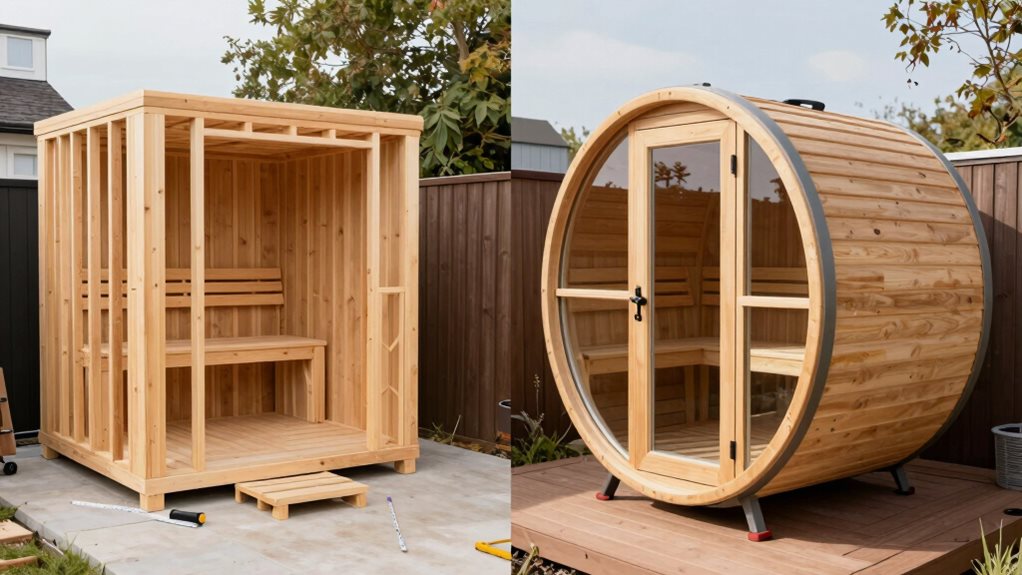
Before committing to a sauna purchase or build, you’ll need to carefully consider where it will go and how much space you’ll require. Indoor saunas typically need 4–6 square feet per person, while outdoor versions demand larger footprints plus extra clearances.
For indoor installation, check your ceiling height (7 feet is ideal) and allow 12–18 inches around the heater.
Outdoor saunas require proper foundations and must comply with zoning rules and setbacks. Don’t forget about door swing space and service access! Barrel saunas offer an excellent alternative as their efficient round design minimizes wasted space while promoting better airflow. Traditional outdoor saunas require between 16-100 square feet depending on capacity and features.
When planning dimensions, a 2-person sauna needs about 4×4 feet, while a 4-person requires roughly 5×6 feet.
Square rooms distribute heat more evenly than rectangular ones. Remember to include bench depths of at least 18–24 inches for lower benches and 24–30 inches for upper ones.
The Skill Factor: Do You Have What It Takes?
How many nail guns have you operated, and can you tell your vapor barrier from your heat-resistant tape?
Building a sauna from scratch demands specific skills that go beyond basic DIY knowledge. Before committing to a project that could span 1-3 months of weekend work, honestly assess your construction experience.
Consider these critical factors:
- Carpentry proficiency – Can you frame walls with joists precisely spaced 16 inches apart?
- Team availability – You’ll need reliable help for wall lifting and ceiling installation.
- Tool inventory – Power saws, drills, and specialized measuring equipment are crucial.
- Time commitment – Expect 40-80 hours of labor, with proper sequencing between steps.
- Experience level – Previous deck-building or basement finishing skills transfer well.
If you’re a first-timer, pre-cut kits minimize errors and material waste while still delivering that satisfying DIY accomplishment.
Long-Term Operating Costs and Energy Efficiency
While building skills matter, your sauna’s impact on your utility bills deserves equal attention. Both DIY and prefab options offer different efficiency profiles that affect your long-term costs.
Electric heaters provide the most cost-effective operation in either type, typically adding just $15-$30 to monthly bills.
Prefab saunas come with consistent, quality insulation for immediate efficiency, while DIY kits let you customize insulation levels—potentially matching or exceeding prefab performance if done correctly.
The money you save on DIY assembly ($1,500-$3,000) can be redirected toward superior insulation materials.
Meanwhile, professional prefab installation guarantees peak energy-saving setup.
Premium options in both categories feature digital controls that enhance heater runtime, reducing your per-session costs regardless of how frequently you enjoy your sauna retreat.
Resale Value: Which Option Pays Off Later?
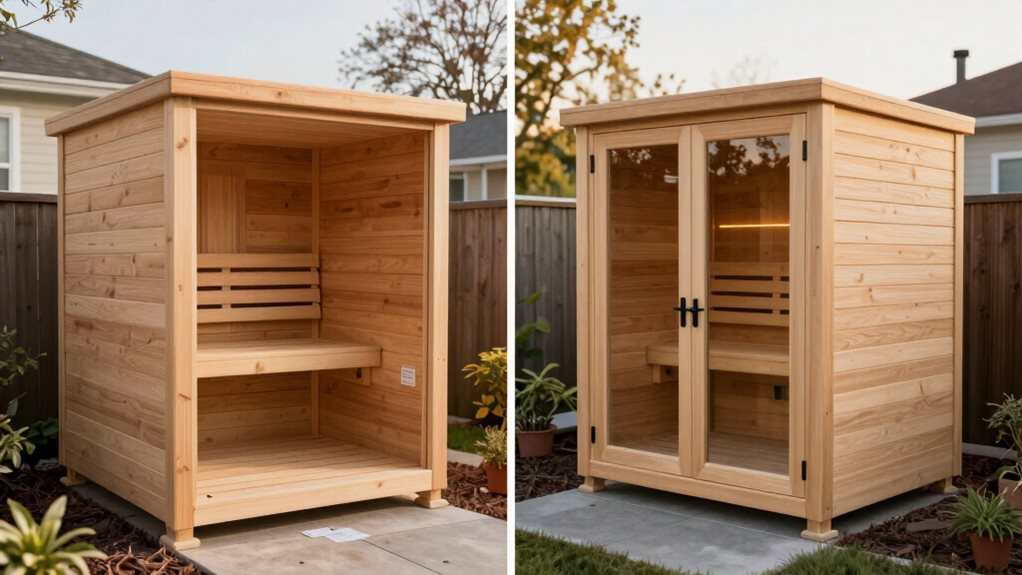
When you’re deciding between DIY and prefab saunas, their potential return on investment deserves serious consideration.
While prefab kits ($2,500-$7,500) typically offer a more predictable 50-85% recovery rate at resale, custom installations can command higher premiums in wellness-focused markets but with more variable returns.
You’ll maximize your sauna’s long-term value retention with either option by guaranteeing professional-quality installation, proper maintenance, and keeping documentation of all materials and certifications.
Recovery Rate Analysis
Considering the substantial investment you’re making in a home sauna, understanding the potential recovery of your costs during resale becomes critically important.
Different sauna types offer varying returns on your investment when it’s time to sell your home.
- Custom saunas provide the highest recovery at 60-80% of your initial cost, adding $8,000-$20,000 to your property value.
- Prefab units recover 40-60% of your investment, typically adding $8,000-$15,000 at resale.
- DIY projects can approach prefab recovery rates, but only with proper documentation and quality installation.
- Longer-lasting saunas (20-30 years for custom) generally deliver better returns than shorter-lived options.
- Professional installation markedly boosts recovery rates, as buyers value warranties and guaranteed quality.
Your choice between prefab, custom, or DIY will directly impact how much of your investment you’ll recoup later.
Market Premium Differences
Three distinct pathways to sauna ownership lead to dramatically different resale outcomes when it’s time to sell your home.
Professional custom saunas typically add $8,000-$20,000 to your property value, recovering 60-80% of your initial investment—the highest return of all options.
Quality prefab units with professional installation documentation generate more modest premiums ($8,000-$15,000), recovering about 40-60% of their cost while still appealing to mainstream buyers.
DIY builds tell a different story. Without proper permits and professional-grade workmanship, they often add less than $5,000 to home value and recover a smaller percentage of costs.
Worse, they can trigger inspection issues that delay your sale. For maximum resale value, prioritize documentation, proper permits, and professional installation—elements that reduce a buyer’s perceived risk and justify higher premiums.
Long-Term Value Retention
Although all sauna options initially seem like an investment, their long-term financial returns differ dramatically when it’s time to sell your home.
Custom builds typically recover 60-80% of your costs, while prefabs return about 40-60% and DIY results vary widely based on quality.
- Custom saunas add $8,000-$20,000 to your home’s value and can shorten market time by 15-20%
- Prefab models contribute $8,000-$15,000 and come with valuable warranties and documentation
- High-quality DIY installations can approach prefab value if properly permitted and documented
- Custom designs last 20-30 years, prefabs 15-25 years, affecting long-term value retention
- Buyer perception matters—luxury buyers prefer custom integration, while prefab’s professional installation signals reliability
Your sauna’s construction quality and documentation will ultimately determine how much of your investment you’ll recover years later.
Financing Options and Ways to Save on Your Sauna Project
Several financing options can make your dream sauna project affordable without emptying your savings account. Many home improvement stores offer zero-interest financing for 6-12 months on purchases over $2,000, which covers most DIY sauna kits.
You’ll save $1,500-$3,000 immediately by assembling the sauna yourself instead of hiring professionals.
Consider cost-effective foundation options like gravel pads ($200-$400) rather than poured concrete slabs ($1,200+).
For additional savings, look for end-of-season sales when retailers discount remaining inventory.
Barrel saunas provide excellent value due to their efficient heating design, reducing long-term energy costs. Some manufacturers also offer factory-direct pricing, eliminating retail markups.
If you’re handy with tools, the 6-8 hour DIY installation process requires only basic equipment costing $100-$300.
Frequently Asked Questions
How Difficult Is Sauna Maintenance for DIY Versus Prefab Models?
DIY saunas require more hands-on maintenance and repairs you’ll need to handle yourself, while prefab models offer simpler upkeep with manufacturer guidelines and potential warranty service support.
Can I Convert an Existing Closet or Small Room Into a Sauna?
Yes, you can convert a closet into a sauna. You’ll need to insulate properly, install vapor barriers, add appropriate wood paneling, and guarantee adequate electrical capacity for your heater.
What Permits Are Required for Outdoor Versus Indoor Sauna Installations?
You’ll need building permits for indoor and outdoor saunas exceeding 120-200 sq. ft. Electrical permits are crucial for 240V installations. Outdoor saunas also require zoning compliance and possible HOA approval.
How Do Climate Differences Affect Sauna Construction and Material Choices?
Your sauna’s construction must match your climate. You’ll need rot-resistant cedar in humid areas, dense Nordic spruce for cold regions, and reflective insulation in dry climates for peak performance and longevity.
Are Portable Sauna Options Worth Considering for Limited Budgets?
Yes, you’ll get excellent value with portable saunas. They’re affordable ($200-$1,500), require no installation, offer health benefits, and cost less to operate while avoiding foundation and electrical expenses.
Final Thoughts
You’ve got options for your sauna dream, whether you’re handy with tools or prefer ready-made solutions. DIY offers customization and potential savings if you have skills, while prefab delivers convenience and predictable costs. Consider your budget, time, and abilities honestly before deciding. Remember, the best sauna isn’t just about upfront costs—energy efficiency and quality materials will affect your enjoyment for years to come.