
Custom sauna builds cost more upfront ($5,500+) compared to kits ($1,500-$3,000), but offer better value through superior materials and craftsmanship. You’ll get thicker wood panels (¾-1 inch vs. ½-⅝ inch), better insulation, and designs customized to your space. Custom saunas last 20-30 years versus 7-15 years for kits and typically include longer warranties. The decision comes down to balancing immediate budget constraints against long-term enjoyment and durability benefits.
Understanding the Real Cost Difference Between Kits and Custom Builds
When you’re deciding between a sauna kit and a custom build, understanding the true cost difference is essential for making the right investment.
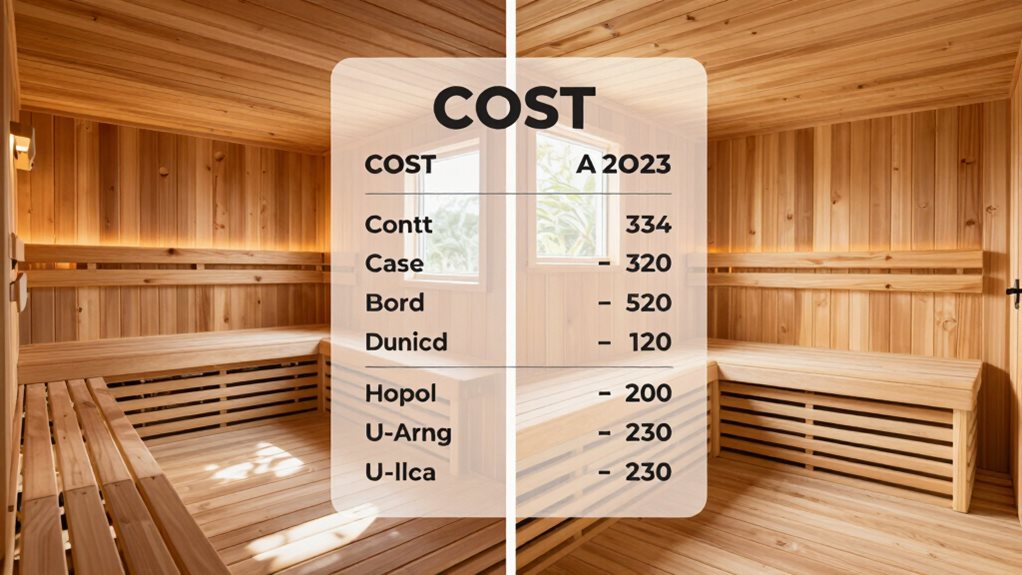
DIY kits offer the most affordable entry point at $1,500-$3,000, while prefabricated options using spruce range from $2,000-$10,000. If you’re looking for higher-quality woods like cedar or hemlock, expect to pay $3,000-$15,000 for kits.
Custom builds start considerably higher at $5,500 and can easily exceed $15,000 for luxury options, with premium designs reaching $50,000+.
While kits save money upfront, don’t forget installation costs—prefab installations run from a few hundred to several thousand dollars, while custom work might cost up to $200 per hour.
If you’re handy, DIY installation can cut labor costs by up to 50%, but requires technical skills and time commitment.
Material Quality Comparison: What You’re Actually Getting
What exactly separates premium sauna materials from standard options regarding quality?
When you invest in a custom sauna, you’re getting thicker wood panels (¾-1 inch) that retain heat better and last 15-25 years versus the thinner panels (½-⅝ inch) in prefab units that typically last 10-15 years.
Custom saunas deliver superior longevity and performance through thicker wood panels that effectively retain heat and extend lifespan by up to a decade.
Custom builds also offer superior wood grades with fewer knots and imperfections. Custom saunas generally deliver better long-term value with superior construction techniques that contribute to their extended lifespan. Many custom builders focus on architectural appeal that enhances property value beyond basic prefab models.
Three key material differences between custom and kit saunas:
- Wood thickness – Custom saunas use thicker panels that improve durability and heat retention
- Wood grade – Premium-grade lumber in custom builds versus good-grade wood with more knots in prefab units
- Material options – Custom builds offer choices between cedar, hemlock, and pine, each with specific benefits like decay resistance or better insulation
The Space and Size Trade-offs in Pre-designed vs. Custom Saunas
Choosing between pre-designed and custom saunas involves considerable space and size considerations that directly impact your sauna experience.
Pre-designed options come in standard dimensions like 4’x4′ for two people or 6’x6′ for four, making them easy to place in typical rooms but inflexible for unusual spaces.
Custom saunas, however, can fit virtually anywhere – from awkward corners to converted closets. While pre-designed kits install quickly (often under an hour), they can’t adapt to architectural quirks. For optimal comfort and functionality, a ceiling height minimum of 7 feet is recommended for any sauna installation.
Custom builds require more planning with blueprints and CAD drawings but reward you with perfect space utilization.
Remember to allow two feet of bench space per person, and consider that square layouts distribute heat more evenly than rectangular ones. Traditional saunas typically operate at higher temperatures of 185-190°F compared to infrared saunas.
If you’re working with standard dimensions, pre-designed models work well, but for unique spaces, custom is your only practical choice.
Heat Efficiency and Insulation: Budget vs. Premium Options
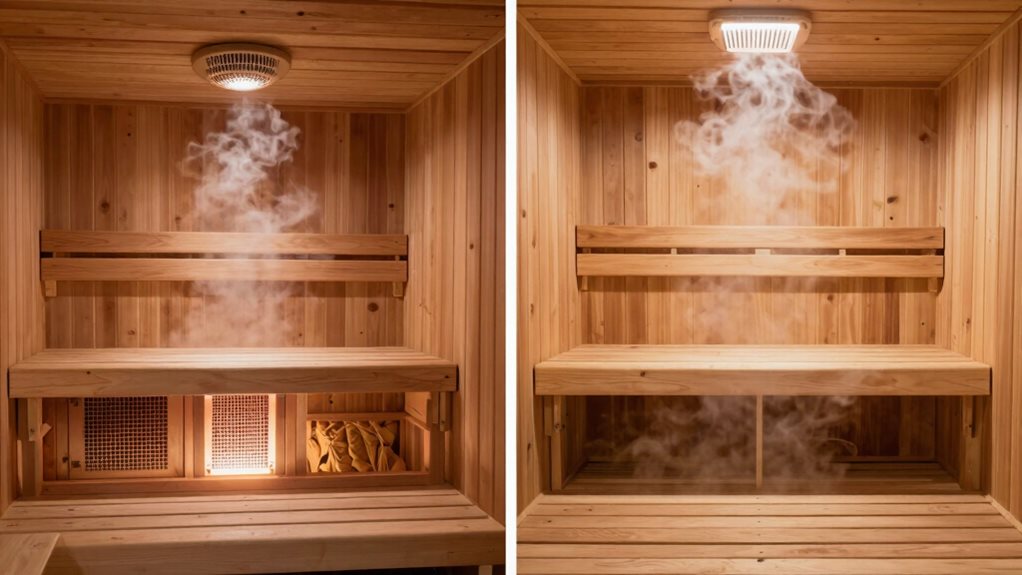
Heat efficiency stands as a crucial dividing line between budget kit saunas and premium custom builds, directly impacting both your comfort and energy bills.
While kit saunas typically feature thinner walls with basic insulation, premium builds invest in extensive thermal barriers that pay dividends over time.
Key differences to evaluate:
- Material quality – Premium builds use mineral wool (R-3.5 per inch) that maintains performance in humid conditions, while budget kits often rely on fiberglass that degrades with moisture exposure.
- Insulation strategy – Custom saunas feature thicker ceiling insulation (R-26 to R-30) where heat loss is greatest, compared to uniform thin insulation in kits. These differences in insulation quality significantly impact heat retention, allowing premium saunas to maintain temperatures longer with less energy consumption.
- Vapor barriers – High-end builds include properly sealed, continuous foil barriers that prevent moisture damage and maintain insulation effectiveness for years. The absence of proper vapor barriers can lead to moisture migration through the walls, potentially causing structural damage and reducing overall insulation performance.
DIY Construction Requirements: Skills, Tools, and Time Investment
Building your own sauna from scratch requires specific carpentry skills like framing with lumber, installing electrical components, and attaching tongue-and-groove paneling with proper expansion gaps.
You’ll need to invest in vital tools including a table saw, drill with specialized bits, nail gun, and level, plus materials such as wood paneling, insulation, and electrical components.
While a small sauna project can be completed over several weekends, you’ll need to factor in time for site preparation, electrical rough-in, framing, and the meticulous installation of ceiling and wall panels in the correct sequence. Be sure to use softwoods like cedar that can withstand the high temperatures and humidity of a sauna environment.
Before beginning construction, ensure compliance with local building regulations by checking with your planning authority to avoid future complications or safety hazards.
Essential Carpentry Skills
Crafting a custom sauna requires several essential carpentry skills that form the foundation of your DIY project.
You’ll need to master framing techniques using 2×4 construction with 16-inch centers, making sure your walls are plumb and your foundation is level. Properly installing wood involves working from specific directions—ceiling first, then walls from top to bottom—while leaving small gaps for water drainage. You must also include nailers in corners to provide sufficient support for interior finishing.
To succeed with your sauna build, focus on these key skill areas:
- Framing abilities – constructing the base with pressure-treated wood and creating sturdy wall frames before adding insulation.
- Wood installation precision – using proper fastening techniques like hidden nails and maintaining consistent spacing.
- Insulation and sealing expertise – installing continuous vapor barriers with sealed seams and properly filling all stud cavities.
Tool Investment Breakdown
A successful DIY sauna build requires the right tools, with your investment spanning five vital categories.
You’ll need basic hand tools like rubber mallets, utility knives, and staple guns for assembly work, alongside power tools such as drills, saws, and nailers for structural components.
Measurement tools are equally important—invest in quality measuring tapes, levels, and angle tools to guarantee your sauna is perfectly aligned.
Don’t overlook specialty tools like caulk guns for sealing gaps and hand planers for fitting boards precisely.
Finally, safety gear isn’t optional. Gloves, eye protection, and proper lighting will protect you throughout the building process.
While you don’t need every tool at once, gradually acquiring quality tools for each phase will make your custom sauna build safer, more efficient, and ultimately more successful.
Timeline Reality Check
When you commit to a DIY sauna project, your timeline expectations need a serious reality check.
What professionals complete in days often takes hobbyists months, especially if you’re learning carpentry, electrical, or insulation skills on the fly. The learning curve is steep, and weekend warriors typically need 40-80 total hours for a custom build.
Your timeline will be affected by:
- Permit acquisition – Can add weeks before you even start construction
- Trade coordination – Scheduling electricians and inspections introduces unpredictable delays
- Precision work – Interior cladding and vapor barrier installation consume disproportionate time for beginners
Kit assemblies might take just 1-3 days for skilled DIYers, while scratch builds stretch to 1-3 months of weekend work. Pre-made sauna kits can dramatically reduce construction time to 1 to 2 days compared to custom-built options.
Add concrete curing time and inspection delays, and your “quick project” could easily span a season.
Professional Installation Considerations and Hidden Expenses
Professional installation of your sauna involves numerous considerations that can greatly impact your budget.
When hiring professionals, expect to pay $40-$120 per hour for carpenters and $50-$100 per hour for electricians. These costs add up quickly, with labor typically representing 20-40% of your total investment.
Hidden expenses often emerge in electrical requirements, where dedicated circuits, GFCI protection, and hardwiring can cost $300-$1,500.
Plumbing may add $350-$1,750 if you’re installing a steam sauna with specialized generators ($2,800-$5,800).
Don’t forget permit and inspection fees, accounting for 2-5% of your project’s cost.
Installation complexity also impacts timeline: simple infrared saunas might take just one day, while custom traditional builds can stretch to five days or longer, with professional fees scaling from $500 to over $3,000.
Long-Term Value Assessment: Durability and Home Appreciation
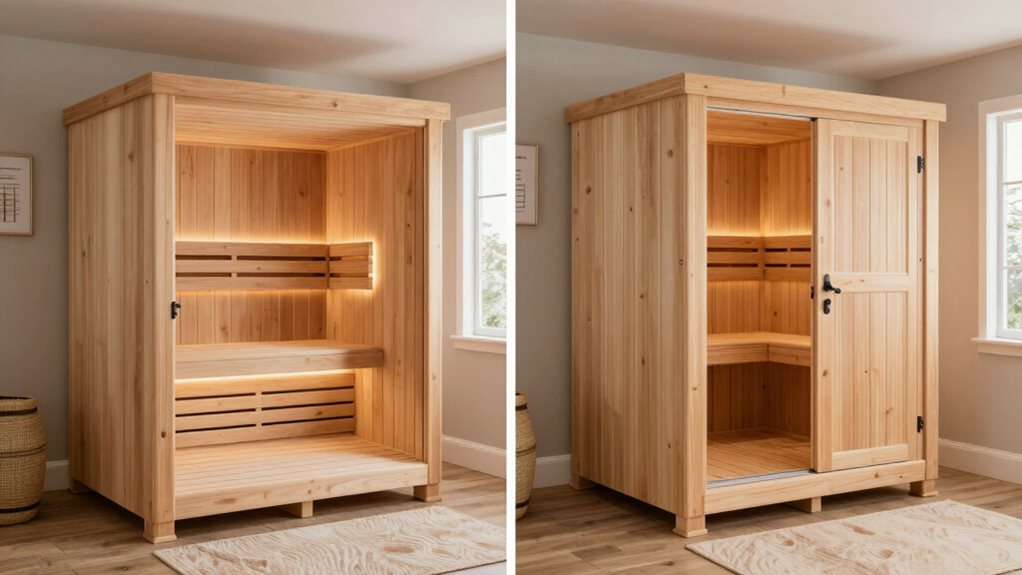
Considering the important investment that any sauna represents, determining long-term value becomes crucial when deciding between custom and kit options. The durability difference is striking – custom saunas with their thicker wood panels (¾-1 inch) outlast prefab units by 5-15 years, requiring less maintenance along the way.
When evaluating long-term value, focus on these key factors:
- Lifespan expectancy: Custom builds last 20-30 years versus 7-15 years for kits
- Warranty coverage: Custom options offer 10-15 year extensive protection while kits typically provide just 1-5 years
- Home value impact: Custom saunas function as permanent luxury features that can reduce luxury home market time by 15-20%
You’ll find that custom saunas, while initially more expensive, often deliver superior value through longevity and property appreciation.
Design Limitations and Customization Possibilities
How much freedom do you truly have when designing your dream sauna? The answer largely depends on whether you choose a kit or custom build.
With custom saunas, you’ll enjoy flexibility to work with unusual spaces, irregular footprints, or challenging ceiling heights that kit manufacturers simply can’t accommodate. You’re also unrestricted in wood species selection, bench configurations, and integrated features like specialty lighting or sound systems.
Kit saunas, while convenient, limit your options to manufacturer-standard dimensions, materials, and layouts. They may perform poorly when installed indoors without proper vapor sealing and often lack adaptability to your site’s electrical supply constraints.
When planning your sauna, consider whether your space requires bespoke solutions or if standard kit dimensions will satisfy your needs without compromising performance.
The Full Ownership Timeline: From Purchase to Maintenance
When you purchase a sauna, you’re committing to a multi-year relationship that includes both upfront costs and ongoing care requirements.
Your initial investment of $3,000-$5,000 for an infrared model or potentially more for a traditional sauna represents just the beginning of your ownership experience.
Regular maintenance, from quick post-session wipe-downs to annual professional inspections, will protect your investment and dramatically extend your sauna’s lifespan from as little as 5 years (if neglected) to 20-30+ years (if properly maintained).
Initial Setup Considerations
The expedition to sauna ownership begins long before you feel that first wave of therapeutic heat. Your adventure starts with critical pre-installation assessments to guarantee your home can support your desired sauna type. Both custom and kit options require careful planning.
Before purchase, complete these vital checks:
- Electrical capacity – Determine if you need a dedicated circuit (120-240V for infrared models) or higher-amperage connections for traditional systems.
- Space and structural evaluation – Measure doorways for kit delivery access and assess if your floor can handle the weight load.
- Permit requirements – Research local building codes and secure necessary permits, especially for hardwired or plumbed installations.
Remember to budget for site preparation costs including electrical work, moisture barriers, and ventilation upgrades—these often-overlooked expenses can greatly influence your total investment.
Long-Term Value Assessment
Beyond the initial purchase and setup of your sauna, you’ll face a timeline of costs and considerations that greatly affect your investment’s true value.
Custom saunas typically cost $4,000-$50,000+ upfront, while prefab kits range from $1,500-$7,000.
Annual operating costs run $100-$600 depending on your heater type, with infrared models generally more economical.
Plan for heater replacements every 8-15 years, costing $500-$3,000 based on type.
While prefab kits rarely boost home value, high-end custom saunas can appeal to luxury buyers, especially in cold-climate regions.
Premium materials and professional installation preserve value better than budget options.
Regular maintenance matters: weekly cleaning, annual deep cleaning, and 5-10 year component servicing will extend your sauna’s life and preserve your investment.
Frequently Asked Questions
Are Wood-Burning Saunas Allowed in Urban Residential Areas?
You’ll need to check local zoning codes, air quality regulations, and HOA rules. Wood-burning saunas are often restricted in urban areas due to smoke concerns and fire safety requirements.
How Much Does Sauna Insurance Cost Annually?
You’ll typically pay $500-1,800 annually for sauna business insurance, depending on your facility size, services offered, location, employee count, and coverage limits you choose.
What’s the Average Energy Consumption for Electric Saunas?
Your electric sauna will consume 6-9 kWh per traditional session (3-9 kW/hour) or 1.5-3.5 kWh per infrared session (1-3 kW/hour). Portable models use less at 1-1.5 kW/hour.
Do Outdoor Saunas Require Special Building Permits?
Yes, you’ll likely need permits for outdoor saunas exceeding size thresholds (120-200 sq ft), plus electrical permits for heaters, and zoning approvals for setback compliance.
Can Saunas Be Installed on Decks or Porches?
Yes, you can install saunas on your deck or porch if it’s sturdy enough to support 3,000 lbs. Verify the structure’s load capacity and consider using paving stones to distribute weight evenly.
Final Thoughts
Your sauna choice ultimately depends on your priorities. Kit builds offer affordability and simplicity, while custom options provide personalized quality and design freedom. Consider your budget, space, DIY skills, and long-term goals before deciding. Remember, the cheapest option isn’t always the best value—factor in durability, maintenance costs, and potential home value increases. Whether you choose a kit or custom build, you’re investing in your health and home enjoyment.