
To choose the perfect sauna heater, you’ll need to match power to room size using the 1 kW per cubic meter rule. Measure your sauna’s length, width, and height, then calculate the volume. Add 10-15% capacity for glass surfaces or poor insulation. For example, a 5×7 room needs a 6 kW heater, while an 8×10 room requires 10.5-12 kW. Proper sizing guarantees quick warm-up times and consistent heat for your ultimate relaxation experience.
Understanding Sauna Sizing Fundamentals
Every successful sauna experience begins with proper sizing of your heater. The most basic rule to follow is matching kilowatt (kW) power to your sauna’s volume, but several factors can adjust this calculation.
Your insulation quality directly impacts heater needs—better insulation means you can use less power while maintaining ideal temperatures. If you’ve got large windows or glass doors, plan to add 10-15% more capacity to overcome heat loss through these surfaces.
Don’t forget about ceiling height! A standard 7-foot ceiling follows basic sizing charts, but taller ceilings create stratification where heat rises away from benches.
Room shape matters too—irregular layouts or connected spaces require additional power. Remember, it’s always better to slightly oversize than undersize your heater, guaranteeing quick warm-up times and consistent heat. Location plays a significant role, as saunas in colder climates will require more heating capacity to reach optimal temperatures. When calculating heater requirements, apply the standard formula of 1 kW per 1.42 cubic meters of sauna space as your starting point.
Calculating Your Sauna’s Volume Requirements
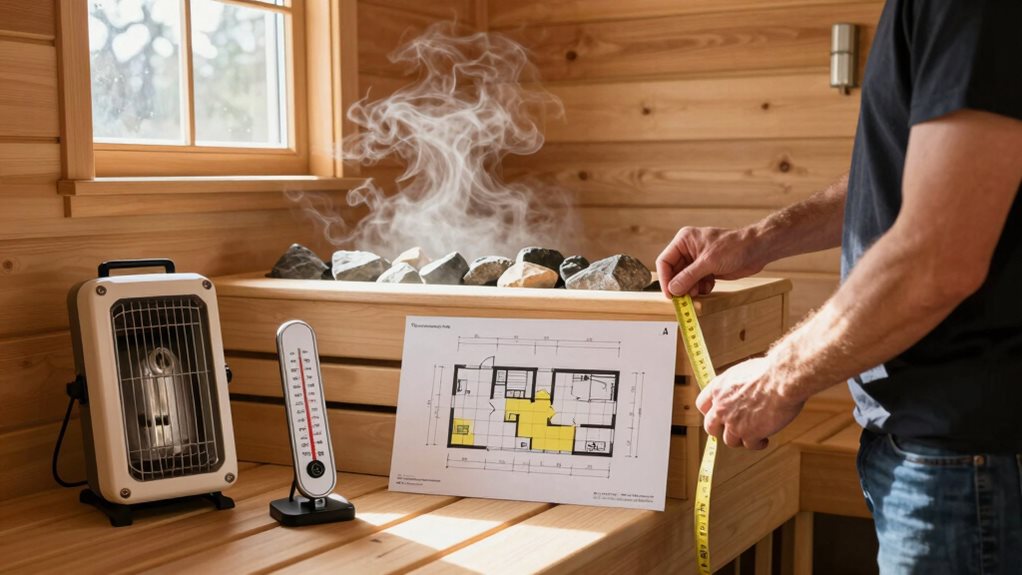
You’ll need to measure your sauna’s interior dimensions and calculate the cubic volume as the first step in selecting the right heater.
For rooms with windows or glass doors, you’ll need to add extra capacity to compensate for heat loss through these surfaces, typically using manufacturer-provided coefficients. Add 1.5m³ for single-glazed glass and 0.75m³ for double-glazed glass to your computational volume.
A good rule of thumb is that you’ll need roughly 1 kW of heater power for every 45-50 cubic feet of space, but this varies based on your sauna’s insulation, materials, and glass area.
Measure Cubic Space Accurately
Before selecting any sauna heater, you’ll need to determine the exact volume of your sauna space, as this measurement directly impacts the required heater power.
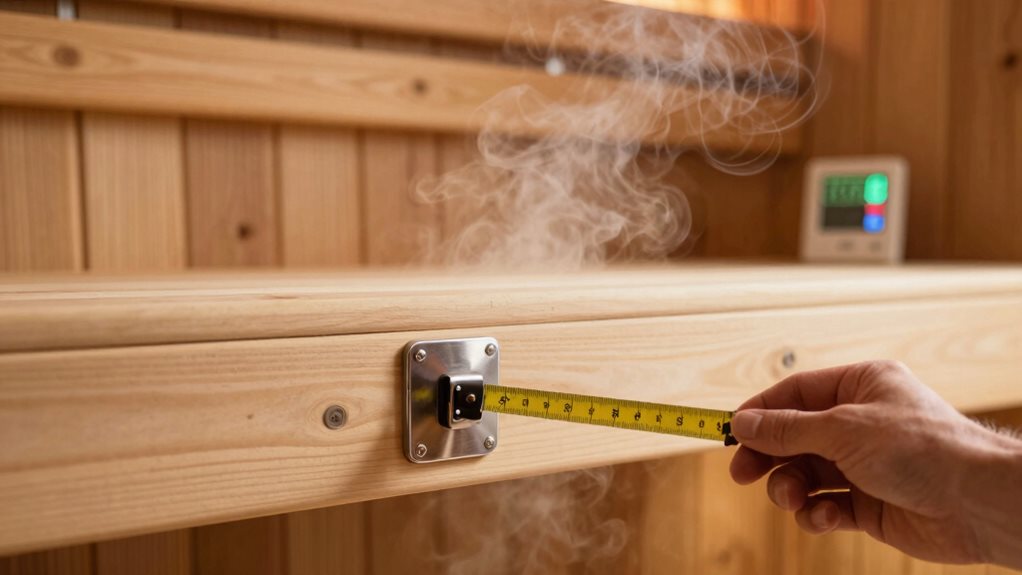
Using a rigid tape measure, take three key measurements: length from wall to wall, width across the shortest clear span, and height from floor to ceiling.
For accuracy, record all dimensions in the same unit system to two decimal places. Calculate volume by multiplying length × width × height.
Don’t subtract benches or fixtures from your calculations—they’re part of the total heat load.
If your sauna has stone or tile surfaces, you’ll need to adjust your calculations upward to account for greater heat loss.
Volume Adjustments For Glass
Glass installations in your sauna dramatically change heat requirements, since glass conducts heat much faster than wood walls.
You’ll need to adjust your volume calculations to account for this heat loss.
For each square meter of single-glazed glass, add 1.5 cubic meters to your sauna’s volume when sizing your heater.
Double-glazed glass requires a smaller adjustment of 0.75 cubic meters per square meter.
For example, if your 8 cubic meter sauna has a 4-square-meter glass wall, you’d add 6 cubic meters with single glazing, bringing your computational volume to 14 cubic meters.
Rule-of-Thumb Sizing Methods
Calculating the right heater size for your sauna doesn’t need to be complicated, as several reliable rule-of-thumb methods can guide your decision.
For metric measurements, plan for 1 kW of heater power per cubic meter of adjusted sauna volume. If you’re working with imperial measurements, you’ll need about 1 kW for every 35 cubic feet.
Remember that these calculations must account for heat-stealing surfaces like glass. For each square foot of glass, add 5 cubic feet to your volume calculation (or use manufacturer-specific multipliers like HUUM’s 4.9 or Harvia’s 2).
A typical 6×6×9-foot sauna with a glass wall would adjust from 324 cubic feet to nearly 400 cubic feet after accounting for cold surfaces, greatly impacting your heater requirements.
Common Heater Size Specifications for Home Saunas
When selecting your sauna heater, you’ll need to match the wattage to your space size, typically following the 1 kW per 50 cubic feet rule for indoor installations.
You’ll need to adjust this calculation for special conditions like glass walls, outdoor placement, or if you prefer particularly high temperatures.
For optimal performance, specific heater sizes correspond to room volumes – a 6 kW heater fits spaces between 250-450 cubic feet while an 8 kW model suits larger areas up to 700 cubic feet.
Avoiding common sizing mistakes, such as underestimating your needs or failing to account for heat loss through windows, will guarantee your sauna reaches and maintains your desired temperature efficiently.
Wattage for Space Size
Selecting the right wattage for your home sauna is crucial for maintaining proper heat levels and efficiency. A helpful rule of thumb is to calculate 1kW per 50 cubic feet of space, with an extra 1kW if your sauna has windows or glass doors.
For most home installations, you’ll need between 6-9kW for traditional electric saunas, while infrared models require much less power at 1.5-2.5kW. Consider upgrading to 8kW units when your sauna has glass features for optimal performance. Most residential sauna heaters are designed for 240V/1PH systems since this voltage configuration can deliver the substantial power required.
Your sauna’s size determines specific needs: small 3’×4’×7′ spaces work well with 4-5kW heaters, medium 5’×7’×7′ rooms need 6-8kW units, and large 8’×10’×7′ saunas require 10-12kW heaters.
To calculate your exact requirements, multiply length × width × height to find your sauna’s volume in cubic feet, then divide by 50 to determine the minimum kW needed.
Adjustment for Special Conditions
Standard heater size calculations need significant adjustments for special sauna conditions.
If your sauna has poor insulation or large glass areas, you’ll need to increase your heater capacity by 25-30%. Those beautiful floor-to-ceiling windows might look stunning, but they’re stealing your heat!
For outdoor saunas or those next to unheated spaces, plan for more power to overcome thermal losses.
You’ll also want to take into account your preferred sauna experience—if you enjoy frequent water pours on rocks (löyly) or higher temperatures, size up your heater accordingly. This guarantees proper steam production and faster recovery times between sessions.
Use manufacturer calculators that factor in insulation quality rather than relying on volume alone.
Avoiding Sizing Mistakes
Many sauna enthusiasts make costly mistakes when sizing their heater, often resulting in uncomfortable experiences and wasted energy.
Undersizing your heater leads to frustratingly long heat-up times, poor steam quality, and constant operation that shortens your heater’s lifespan. Meanwhile, oversized heaters cause uncomfortable temperature spikes and inefficient short cycling.
For peak performance, follow the metric rule of 1 kW per cubic meter or roughly 1 kW per 35-50 cubic feet. Always round up when in doubt.
For example, a standard 5×7 room (about 245 ft³) typically needs a 6 kW heater, while larger 8×10 spaces (around 560 ft³) require 10.5-12 kW models. For more precise calculations, you can utilize our Sauna Heater Sizing Tool available online.
Don’t forget to adjust your calculations for glass surfaces, poor insulation, or high ceilings—these factors can increase your power needs by 10-30%.
Adjusting for Glass and Outdoor Installations
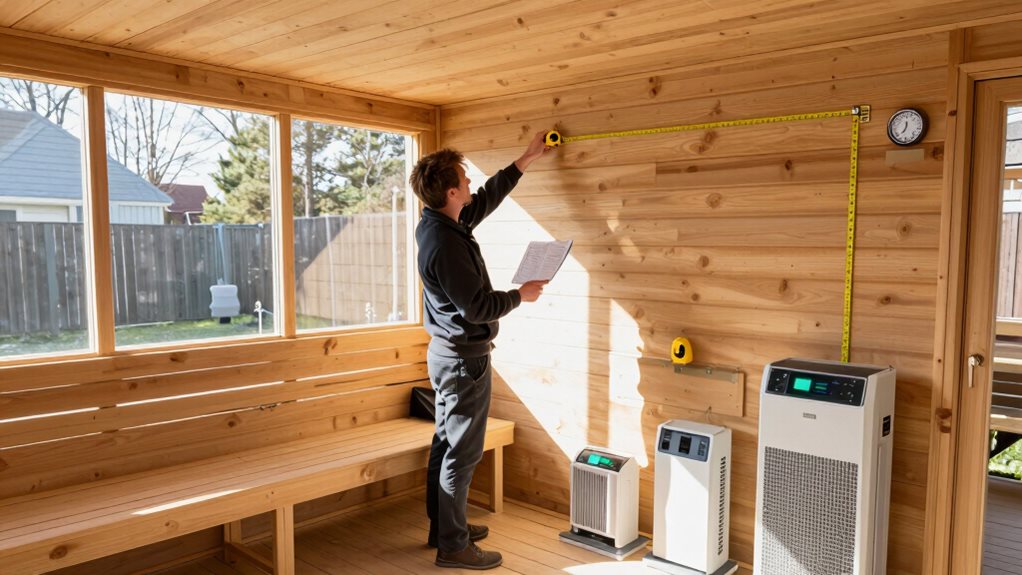
When designing a sauna with glass walls or for outdoor use, you’ll need to adjust your heater size considerably to maintain proper temperatures.
Glass walls and outdoor saunas require significantly larger heaters to reach and maintain optimal temperatures.
Glass surfaces increase heat loss, requiring you to add 10-15% more heater capacity than standard calculations suggest.
For substantial glass installations, your actual cubic footage can increase by over 40% in adjusted volume.
For example, a 294 cubic foot sauna might need to be calculated as 433 cubic feet when accounting for glass surfaces.
Outdoor saunas face additional challenges, especially in cold climates.
You’ll need to add another 10-15% to your heater size.
When you combine glass walls with outdoor installation, expect to increase your heater size by 20-30% total.
Always round up to the next size after making these adjustments.
Poor insulation quality significantly reduces heat retention and may require additional kW capacity to compensate for increased heat loss.
The Impact of Material and Insulation on Heater Selection
The construction materials and insulation of your sauna play an essential role in determining the right heater size for your space. Thicker wood staves can boost insulation by up to 25%, allowing you to choose a smaller heater while maintaining efficient heat.
Your heater’s material affects performance too. Soapstone-clad Tulikivi heaters store heat exceptionally well, while stainless-steel IKI models offer durability and excellent stone capacity.
If you’ve invested in a SaunaLife barrel sauna with thicker walls, you’ll need less power to achieve ideal temperatures.
The thermal mass of your heater matters greatly. Wood-burning stoves like the HUUM Hive Heat 12 provide superior heat retention through their cast iron construction, while Harvia models with large stone chambers guarantee long-lasting steam production. Properly installed heat shields are essential when using wood stoves such as the Harvia M3, especially to mitigate potential fire risks in barrel saunas.
Consequences of Undersized Heater Installation
Installing an undersized heater in your sauna creates a cascade of problems that can transform your relaxation sanctuary into a source of frustration.
You’ll notice your sauna struggling to reach proper temperatures, remaining lukewarm even after extended warm-up times of 60+ minutes. When you pour water on the rocks, you’ll get disappointing steam quality instead of the satisfying löyly experience.
Your energy bills will climb as the heater runs continuously at maximum output rather than cycling efficiently. This constant strain accelerates wear on heating elements and controls, leading to premature failures and unexpected repair costs.
Safety concerns emerge too, with potential electrical hazards from overtaxed systems and poor ventilation effects when you’re forced to extend sessions to compensate for inadequate heat. Proper ventilation is critical for maintaining ideal conditions, particularly in electric saunas where air mixing dynamics differ significantly from traditional wood stove models.
Don’t compromise your sauna experience—proper sizing is worth the investment.
Problems With Oversized Heating Units
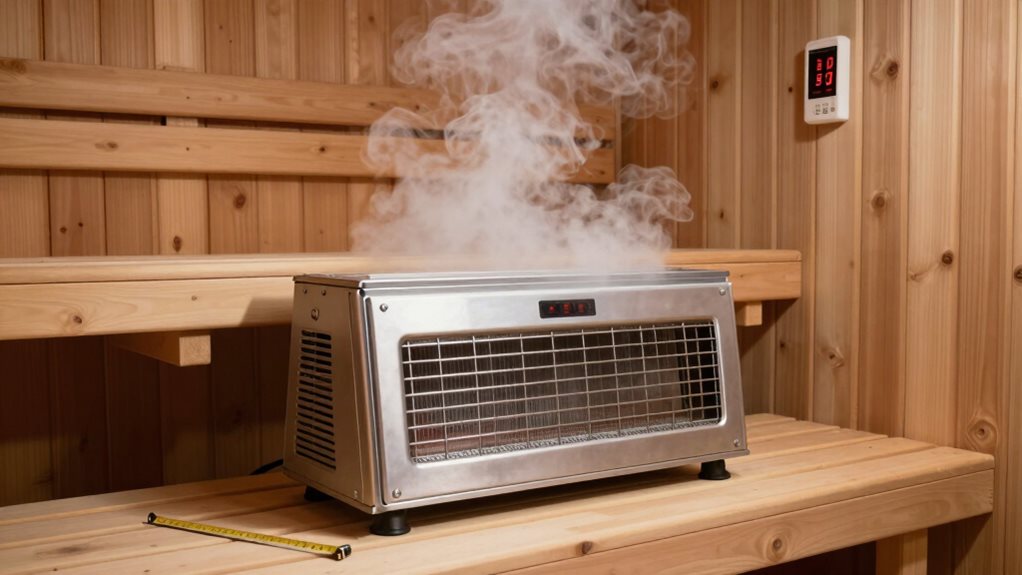
Just as undersized heaters can’t meet the demands of your sauna, oversized heating units create their own set of troublesome problems.
When your heater reaches 180°F in under 30 minutes, you’ll experience harsh, uncomfortable heat rather than the gradual, soothing warmth that makes saunas enjoyable.
Oversized units force you to constantly open doors or cycle the heater on and off, disrupting your relaxation time. They also cause premature component failure as thermal stress damages elements and controls.
You’ll face higher maintenance costs, more frequent repairs, and possibly voided warranties.
The safety risks are concerning too – from inaccurate temperature readings to increased burn hazards.
Add in higher energy bills from inefficient operation, and it’s clear that bigger isn’t better when selecting your sauna heater.
Using Online Calculators for Accurate Sizing
After determining your sauna’s specific heating needs, online calculators offer the most precise way to match your space with the ideal heater size.
These tools ask for vital details like your sauna’s dimensions, glass surface area, and construction materials to calculate the perfect power requirements.
You’ll need to input whether your sauna is indoor or outdoor, its insulation status, and if you’ve used heat-retaining materials like brick or concrete.
The calculator then adjusts for these factors, recommending appropriate heater sizes from 1.7 kW for tiny spaces to 10+ kW for large rooms.
For example, a standard 4×6 sauna (168 cubic feet) typically requires a 4.5 kW heater, while a spacious 6×8 room needs around 8.0 kW.
Using these calculators guarantees efficient heating, prevents energy waste, and assures the perfect sauna experience.
Expert Recommendations for Popular Sauna Dimensions
When selecting the perfect heater for your home sauna, understanding the relationship between room size and required power is essential for achieving ideal temperatures.
Industry experts have clear recommendations based on your sauna’s dimensions and volume.
Following industry-standard guidelines ensures your sauna heater delivers optimal performance for your specific space dimensions.
For common home sauna sizes, follow these guidelines:
- Small spaces (4×4): A 3.0 kW heater sufficiently heats 112 cubic feet with 7-foot ceilings and proper ventilation behind the heater.
- Medium rooms (4×6 or 5×7): Choose 4.5 kW for a 168 cubic foot space or 6.0 kW for a 245 cubic foot sauna, applying the 1 kW per 45-50 cubic feet rule.
- Larger saunas (6×8 or 8×10): Install 8.0 kW for a 336 cubic foot room, while expansive 560 cubic foot spaces require 10.5-12.0 kW heaters.
Remember to increase power if you have glass walls or poor insulation.
Frequently Asked Questions
How Long Should a Sauna Heater Last Before Replacement?
You’ll get 5-15 years from your sauna heater. Electric models last 5-10 years, while wood-burning versions can reach 20+ years with proper maintenance and moderate use.
Can I Upgrade My Heater Size Without Changing Electrical Wiring?
No, you can’t upgrade without checking wiring. Larger heaters typically require thicker cables and higher-amp breakers to handle increased load safely and meet electrical code requirements.
Do Infrared Saunas Follow the Same Sizing Guidelines?
No, infrared saunas don’t follow traditional volume-based sizing. You’ll need to focus on panel coverage and radiant area instead, guaranteeing proper panel placement for even heating of occupants.
How Does Ceiling Height Affect Heater Placement Requirements?
With taller ceilings, you’ll need to mount your heater lower, maintaining at least 44-48 inches of clearance above it, while guaranteeing it’s still 12 inches from seating for safety.
Are Wall-Mounted Heaters More Efficient Than Floor-Standing Models?
Wall-mounted heaters aren’t necessarily more efficient, but they’re ideal for smaller spaces. You’ll save floor space with them, while floor-standing models offer better heat retention and air circulation despite requiring more room.
Final Thoughts
By selecting the right size heater for your sauna, you’ll create a comfortable, efficient space for relaxation. Remember to measure your room carefully, account for materials and windows, and consider professional advice when needed. Don’t go too small or too large—balance is key! With proper sizing, your home sauna will provide years of consistent heat and enjoyment for you and your family.