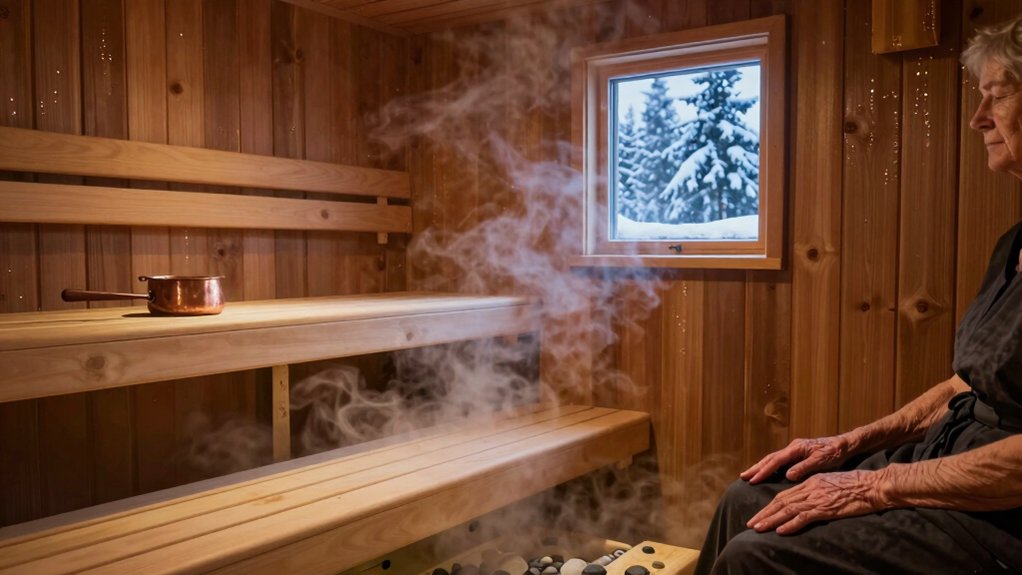

Yes, regular sauna use can substantially lower your dementia and Alzheimer’s risk, according to landmark Finnish research tracking over 2,300 men for 20 years. You’ll see the strongest protection, up to 66% lower risk, when you enjoy 4-7 sessions weekly, though even 2-3 weekly visits offer meaningful benefits.
Think of sauna as exercise for your blood vessels: the heat triggers repair proteins, boosts blood flow to your brain by 60-70%, and calms inflammation. While scientists can’t prove cause-and-effect yet, and most study participants started sauna as infants, the evidence spanning nearly 40 years remains remarkably consistent.
Sauna works best as a complement to proven strategies like exercise and healthy eating, not a replacement. Stick around, and you’ll discover exactly how much heat you need and whether starting later in life still protects your brain.
What 20 Years of Finnish Sauna Research Revealed
When you think about keeping your brain sharp as you age, you probably picture crossword puzzles or learning a new language, but what if sitting in a hot room could help, too? Finnish researchers tracked 2,315 men for over 20 years, and their findings might surprise you.
Men who hit the sauna 4-7 times weekly slashed their dementia risk by 66% compared to once-a-week users. That’s like getting two-thirds off a “bad news” bill you’d rather not pay. Even 2-3 sessions showed a 21% drop. The study, published in Age and Ageing, used Cox-regression modeling to analyze the data.
The numbers stayed strong after researchers factored out smoking, drinking, and other health habits. The same frequent sauna users also saw their Alzheimer’s risk fall by 65%, a nearly identical drop that suggests the brain benefits extend across multiple types of cognitive decline.
Think of it like this: your brain loves a good sweat session. While scientists can’t prove saunas cause the protection yet, the pattern is hard to ignore.
How Much Sauna Protects Against Dementia?
So you’re wondering how often you’d actually need to sweat it out to shield your brain. The sweet spot sits at four to seven sauna sessions weekly, delivering a striking 66% drop in dementia risk compared to just once weekly. Think of it like watering a plant, too little helps barely, but the right amount lets it flourish.
Two to three weekly sessions still matter, cutting risk by 22%.
Two to three weekly sessions still matter, cutting risk by 22%.
Even nine to twelve monthly sessions beat barely using the sauna at all, with a 21% reduction. Picture your brain as a muscle; regular heat exposure appears to strengthen it, much like exercise builds your body.
These numbers come from thousands of Finns tracked for decades, though your personal results may vary. Interestingly, pushing beyond 12 monthly sessions didn’t show additional benefits in one major study, suggesting more isn’t always better when it comes to heat therapy for brain health.
Why Finnish Sauna Culture Limits What We Know
You’ve probably noticed that most sauna research comes from Finland, and that’s no coincidence.
When you grow up with saunas as a normal part of life, starting from childhood and continuing through old age, your body experiences something researchers can’t easily replicate in short studies.
This lifelong, woven-into-daily-life pattern makes it tricky to know if occasional sauna use elsewhere would give you the same brain benefits.
UNESCO-recognized heritage status underscores how deeply sauna practice is embedded in Finnish national identity, meaning participants in studies have been shaped by centuries of cultural continuity rather than a wellness trend.
The sauna guardian spirits known as Saunatonttu reflect how Finnish sauna culture treats the space as sacred, with rituals of respect and mindfulness that accompany the physical practice—another layer of the holistic experience that short-term studies elsewhere rarely capture.
Lifelong Exposure Patterns
Because most of what we know about saunas and brain health comes from Finland, you’re looking at a pretty unique situation that doesn’t necessarily apply everywhere else. Finns typically start sauna bathing in childhood, making it as routine as brushing their teeth. This lifelong pattern creates a cumulative effect that’s tough to replicate elsewhere.
When researchers find that four to seven weekly sauna sessions protect your brain, they’re really studying people who’ve never known life without saunas. It’s like comparing someone who grew up swimming to someone who took lessons last month, their bodies respond differently.
You might wonder if starting saunas later in life delivers the same benefits. Unfortunately, nobody knows for sure. The science hasn’t caught up with your situation yet, leaving questions about whether occasional sauna use helps as much as Finland’s family tradition. With 3.3 million saunas for just 5.5 million people, Finland’s saturation of sauna access makes it nearly impossible to find true “non-sauna” control groups for comparison.
This cultural saturation also means sauna functions as a social equalizer in Finnish research populations, where the shared practice dissolves social hierarchies and creates uniform exposure conditions that would be difficult to replicate in societies where sauna use varies by socioeconomic status.
Cultural Context Matters
Finnish sauna culture runs deeper than you might expect, and that’s exactly why scientists struggle to apply their findings to the rest of us. You’re looking at a tradition that started 9,000 years ago, where families sweat together weekly from childhood through old age. It’s not just heat, it’s ritual, community, and identity woven into daily life. In fact, this practice is so integral to Finnish identity that UNESCO recognized it as Intangible Cultural Heritage in 2020, formally acknowledging what Finns have always known: the sauna is irreplaceable.
When researchers study sauna benefits, they’re measuring people who’ve absorbed this practice into their bones. You can’t easily separate the physical heat from the social bonding, the stress relief, or the lifelong habit. The ubiquity of this tradition is staggering—there are roughly three million saunas for a population of only about 5.5 million, meaning virtually every Finn has grown up with immediate, regular access from birth.
It’s like trying to study exercise while ignoring that your subjects also grew up playing team sports, bonding with teammates, and building community around movement. The sauna effect you read about? It might be the heat, the culture, or both working together.
Generalizability Concerns Remain
How much can we really trust what those Finnish studies are telling us? You need to know three big limits before you step into any sauna hoping for brain benefits.
- Everyone tested was a Finnish man. You won’t find women, kids, or people from other countries in that data, so nobody knows if you’d get the same results. The follow-up averaged 20 years, tracking middle-aged men into older age when dementia typically emerges.
- Saunas are everywhere in Finland. Since babies start sweating it out at six months old, you can’t find Finns who’ve never used one to compare against. It’s like trying to prove pizza’s healthy when everyone’s eaten it forever.
- Your sauna isn’t their sauna. Finnish rooms hit 80°C, way hotter than your gym’s steam room. Different heat means different effects, and nobody’s studied your version yet.
Can Sauna Help If You Start Later in Life?

Perhaps you’re wondering if it’s too late to start a sauna routine once you’ve already reached middle age, or if those promising dementia-reduction studies only apply to lifelong enthusiasts. Here’s the honest truth: nobody really knows yet.
The Finnish studies that found 66% lower dementia risk? Those participants grew up sweating in saunas from babyhood, literally starting at six months old. Their bodies adapted to heat stress over decades, like a tree growing strong roots through seasons of weather.
Researchers haven’t tested whether beginning at 50 or 60 delivers the same brain protection. No randomized trials exist, and observational data can’t prove causation. Starting later might help, but it’s uncharted territory.
The mechanisms connecting heat exposure to brain health remain mysterious, especially for late adopters.
How Sauna Heat Strengthens Brain Blood Vessels
When you step into a sauna, the heat triggers a powerful chain reaction in your brain’s blood vessels. Your body releases heat shock proteins, which act like tiny repair crews fixing damaged proteins and protecting your cells from stress.
This process improves your vascular endothelial function: the health of the inner lining of your blood vessels. It also boosts cerebral blood flow, fundamentally giving your brain the same circulation benefits as a brisk walk without moving a muscle.
Heat Shock Proteins
Your brain’s blood vessels face daily challenges, but regular sauna sessions might give them an unexpected advantage. When you step into that heated room, your body responds by producing heat shock proteins: tiny molecular guardians that protect your cells.
Here’s what these proteins do for you:
- HSP27 acts like a bouncer, blocking harmful actin buildup that weakens vessel walls and preserves the blood-br-brain barrier’s tight seals.
- HSP72 works as a repair crew, rescuing damaged junction proteins and keeping your brain’s security system intact after stress.
- Together, they reduce inflammation, preventing immune cells from storming into brain tissue where they don’t belong.
Think of these proteins as your brain’s maintenance team, fixing wear and tear before small problems become big ones.
Vascular Endothelial Function
Those molecular guardians aren’t working alone. They’re part of a bigger team keeping your brain’s supply lines open and flowing. Your blood vessels are like highways delivering oxygen and nutrients to your brain, and sauna heat helps keep those roads velvety and broad.
When you sit in that 60°C warmth, your blood vessels relax and expand through a process called vasodilation. It’s like opening extra lanes during rush hour: traffic flows better, and nothing gets stuck. Studies show just 15 minutes daily for two weeks improved how well participants’ vessels could widen, matching or even beating exercise benefits for some people.
This matters because stiff, narrow vessels struggle to feed your brain properly. By improving endothelial function, you’re basically maintaining the infrastructure that keeps your thinking sharp.
Cerebral Blood Flow
How exactly does sitting in a hot room get more blood pumping to your brain? When you heat your body, your heart works harder, boosting blood flow everywhere, including your noggin.
Think of it like turning up the water pressure in a garden hose: more flow means better delivery.
Here’s what happens upstairs when you sauna:
- Your brain gets a bath. Increased cardiac output sends 60–70% more blood coursing through your vessels, carrying oxygen and nutrients your gray matter craves.
- Vessels loosen up. Heat dilates arteries, reducing stiffness and improving the highways blood travels to reach your thinking center.
- The benefits stick around. Blood flow stays elevated 30 minutes after you leave, giving your brain extended support against decline.
Regular heat exposure builds stronger, more flexible vessels: protective infrastructure against dementia’s creep.
Where Sauna Ranks Among Dementia Prevention Tactics
Why should sauna matter when you’re already trying to eat right, exercise, and get enough sleep? Think of dementia prevention like building a house: exercise and diet are your foundation, but sauna use might be a sturdy extra wall.
Research shows 4-7 weekly sauna sessions cut dementia risk by 66%, comparable to exercise benefits. Sauna improves circulation and lowers blood pressure, much like a brisk walk does.
Sauna sessions matching exercise benefits: 4-7 weekly visits cut dementia risk by two-thirds through improved circulation and lower blood pressure.
However, experts still rank exercise higher because stronger evidence backs it up. Sauna currently sits below exercise, healthy eating, and not smoking in the prevention lineup.
Finnish studies are promising but observational, meaning we can’t prove saunas directly cause the benefits. Plus, most participants were lifelong sauna users, so results may not apply to newcomers.
Consider sauna a helpful teammate, not your star player.
How to Evaluate Sauna-Dementia Research Critically

So you’re wondering how to tell if sauna research is actually trustworthy? You need to dig deeper than headlines, and here’s how you can do it.
- Check who’s in the study, ask yourself: do these participants look like you? The Finnish studies only included people from one country, mostly men at first, so the results mightn’t apply to everyone.
- Look for what they missed, you should notice that researchers only asked about sauna habits once, decades ago. That’s like guessing someone’s diet from one meal, so things could have changed.
- Watch for “healthy user bias”, frequent sauna-goers often exercise more, smoke less, and generally take better care of themselves. You can’t always separate the sauna from the lifestyle.
What Sauna Research Still Needs to Prove
What exactly does sauna science still have left to figure out? You need to see what researchers still haven’t nailed down.
Right now, scientists only asked people about sauna habits once, then tracked them for decades without checking back. It’s like taking a single photo of your diet at age 20 and assuming you’ll eat the same way at 50, pretty unreliable, right?
One snapshot of sauna habits can’t capture decades of change—imagine guessing your 50-year-old diet from a single college photo.
You also won’t find any gold-standard randomized trials, since nearly everyone in Finland already saunas, making comparisons impossible. Studies only cover Finns, so you can’t be sure results apply to you.
Plus, doctors struggled to separate Alzheimer’s from other dementias, and they likely missed cases. Researchers still don’t know exactly how saunas might protect your brain, leaving the mechanism a warm, steamy mystery.
Should You Add Sauna to Your Routine?
How much would you pay for a therapy that might cut your Alzheimer’s risk by nearly two-thirds, costs almost nothing, and feels genuinely relaxing? Sauna bathing offers exactly that opportunity, and the research makes a compelling case for giving it a try.
Before you jump in, consider three practical points:
- Start smart, aim for 3-4 sessions weekly, about 20 minutes each, keeping temperatures below 80°C to stay safe.
- Build gradually, your body needs time to adapt, so begin with shorter sessions and increase slowly.
- Stay consistent, the biggest benefits come from regular, long-term habits rather than occasional use.
Think of sauna bathing like exercise for your blood vessels. You’re strengthening your cardiovascular system, calming inflammation, and giving your brain the oxygen boost it craves.
The evidence spans nearly 40 years, and the routine itself is surprisingly simple.
Frequently Asked Questions
Does Sauna Type (Infrared vs. Traditional) Matter for Brain Health?
Yes, it matters. Traditional saunas give you stronger evidence for dementia protection with long-term data, while infrared offers gentler benefits like reduced inflammation and mood boosts.
You’ll maximize brain health with traditional heat.
Can Sauna Use Interact With Dementia Medications?
You should consult your doctor before using saunas if you’re taking dementia medications.
Heat exposure can worsen side effects like dizziness, interact with blood pressure drugs, and increase dehydration risks with diuretics.
Is Evening or Morning Sauna Better for Cognitive Benefits?
You’ll benefit from morning saunas for sharper alertness and faster reaction times, or evening sessions for deeper relaxation and stress recovery.
Research hasn’t directly compared timing, so choose based on whether you need cognitive boost or restorative calm.
Does Sauna Help People Already Diagnosed With Dementia?
No one knows if sauna helps you after dementia diagnosis, research only studied prevention in healthy people, not treatment.
Doctors can’t recommend it yet since no trials tested actual patients like you.
Can Hot Baths or Showers Provide Similar Protection?
Yes, hot baths offer similar protection. You’ll gain comparable cardiovascular and stress-reduction benefits through regular immersion, which research links to reduced dementia risk.
Make it a routine habit for maximum effect.
Final Thoughts
You’ve seen the promising research, and it’s genuinely exciting! Finnish studies suggest regular sauna sessions could lower your dementia risk by protecting blood vessels and boosting heart health.
While we need more global research to be certain, the evidence is encouraging enough that adding sauna time makes sense, especially if you enjoy it. Think of it as another tool in your brain-health toolbox, alongside exercise, sleep, and good food.
Why not give it a try?