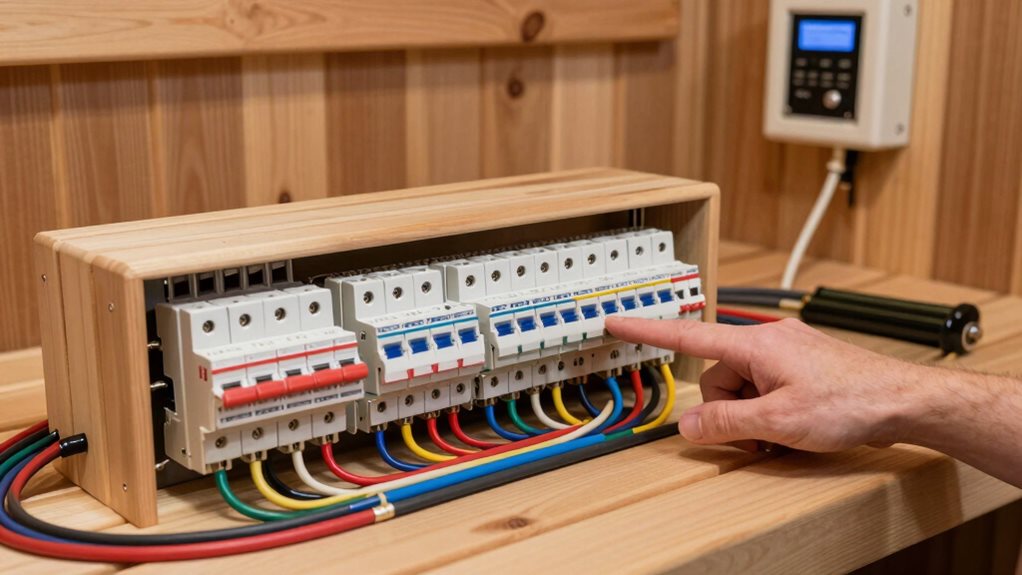

When wiring a multi-heater sauna, you’ll need dedicated circuits for each heating system. Infrared heaters typically require 120V/20A, while rock heaters need 240V/30-40A circuits. Use proper wire gauging (10-gauge for 30A, 8-gauge for higher amperages) and guarantee complete circuit isolation per NEC requirements. Calculate total amperage by adding individual heater loads to determine breaker sizes. Don’t forget GFCI protection and proper grounding for safety in these hot, moist environments. The right installation approach prevents dangerous electrical issues.
Understanding Multi-Heater Circuit Requirements
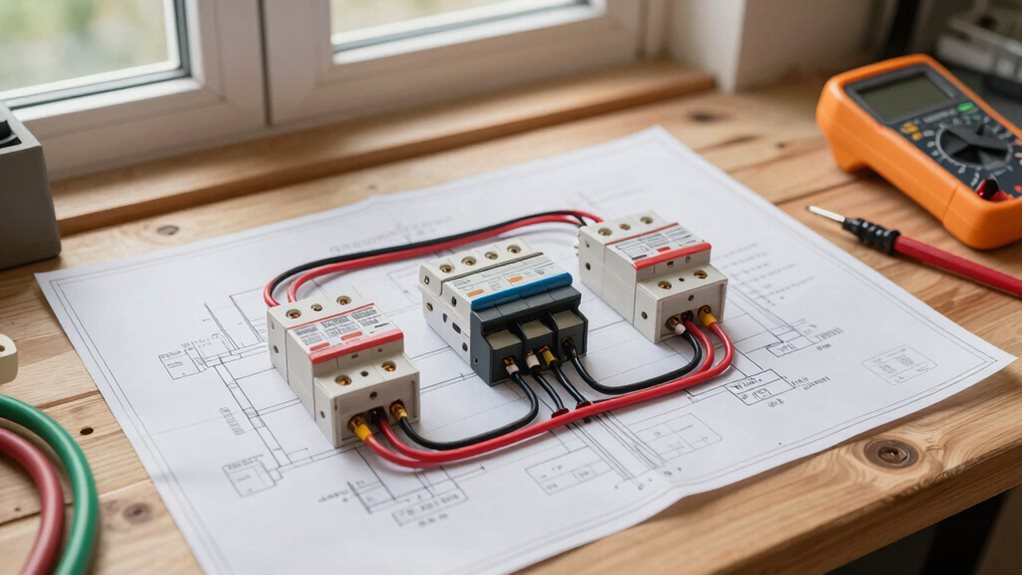
When planning a multi-heater sauna system, you’ll need to carefully consider the electrical requirements to ascertain safe and efficient operation.
Hybrid models typically require two separate circuits: a 120V/20A circuit for infrared panels and a 240V/30-40A circuit for traditional rock heaters.
Each heater in your sauna needs its own dedicated circuit to prevent overloading and ascertain consistent performance. The amperage requirements increase with the combined power rating—a 6kW system needs 30 amps, while 8kW or larger systems demand 40 amps or more. For commercial installations, you may need to use 208V/3PH configurations that are compatible with building infrastructure.
Your wiring must match these needs, with 10-gauge wire for 30A circuits and 8-gauge for higher amperage setups.
Before installation, check that your home’s electrical service can support 220-240V power, or you might need upgrades for multiple heaters.
Code Compliance for Dual Sauna Heater Installations
When installing dual sauna heaters, you’ll need to follow strict NEC requirements for circuit isolation, guaranteeing each heater has its own dedicated electrical pathway.
Your combined amperage calculations must account for both heaters’ full load ratings, with no sharing or reduction of capacity between units.
NEC grouping standards further dictate that the circuits must terminate at properly sized breakers in your main panel, with appropriately gauged copper wiring that can handle the high heat environment.
For optimal safety and performance, installation should always be completed by a licensed electrician who understands the complexities of multi-heater systems.
Circuit Isolation Requirements
Because sauna heaters draw considerable electrical power, proper circuit isolation isn’t optional—it’s mandatory for safety and code compliance.
When you’re installing multiple sauna heaters, each one must have its own dedicated circuit with nothing else connected to it—no lights, no outlets, no exceptions. This separation prevents overloads that could trip breakers or, worse, cause electrical fires.
You’ll need to run completely new wiring for each heater, sized according to the manufacturer’s specifications and protected by appropriately rated circuit breakers. Remember, you can’t tap into existing circuits, even if they seem to have extra capacity.
For outdoor installations, these requirements become even stricter, with weatherproof conduits and lockable disconnects adding crucial protection against the elements and unauthorized access.
Combined Amperage Calculations
Understanding combined amperage calculations forms the bedrock of code compliance for dual sauna heater installations.
When you’re planning to install two heaters, you’ll need to add their individual amperage requirements together to determine your total electrical load. For example, if you’re combining a 6 kW heater (25 amps) with a 7.5 kW heater (31.25 amps), you’re looking at a combined draw of 56.25 amps.
This calculation directly impacts your breaker sizing and wire gauge selection. You’ll need to use the next standard breaker size above your calculated amperage, with appropriate conductors to match.
NEC Grouping Standards
National Electrical Code (NEC) grouping standards form the backbone of compliant dual sauna heater installations.
When you’re working with single-phase heaters that require two circuits, you must group these circuits together and mark them clearly. This grouping isn’t just paperwork—it guarantees safety by indicating the multi-circuit supply.
Remember, you’ll need to calculate the total amperage draw by combining all circuits, including any accessory circuits.
For systems with contactor boxes, you’ll also need a separate 120V circuit.
Don’t forget that each sauna heater requires its own dedicated circuit with a precisely sized breaker.
Your local Authority Having Jurisdiction (AHJ) may have additional requirements beyond the NEC standards.
Always check local codes first, as they’ll supersede general guidelines for your dual heater setup.
Single-Phase Wiring Configurations
When designing your multi-heater sauna system, you’ll need to properly configure the single-phase wiring to guarantee safe operation.
Residential sauna heaters require 240V single-phase power, combining two 120V lines to meet higher power demands.
For your multi-heater setup, each heater will need the appropriate gauge wire based on its kW rating. A 6kW heater draws 25A and requires 10-8 AWG wire with a 30A double-pole breaker, while a 10.5kW unit needs 6 AWG wire and a 50A breaker.
Always connect two hot wires (L1 and L2) plus a ground wire for each heater.
Run all wiring through metallic conduit for protection, and verify your junction boxes are properly fixed and grounded. Having a professional complete the installation will ensure code compliance and provide peace of mind regarding safety.
Remember to maintain consistent wire colors between your relay and controls for easy troubleshooting later.
Three-Phase Wiring for Commercial Sauna Applications
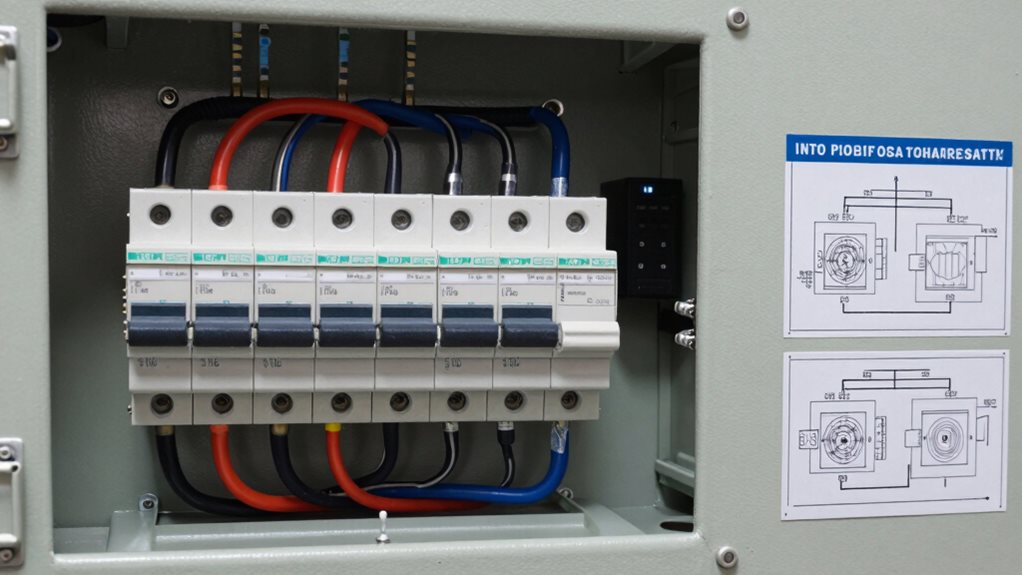
When wiring a commercial sauna with three-phase power, you’ll need to properly balance the electrical load across all three phases to prevent circuit overload and guarantee peak heater performance.
You must connect each phase wire (L1, L2, L3) to the corresponding terminals (U, V, W) on your heater units, following manufacturer-specific diagrams to avoid damage to the equipment.
Commercial installations require dedicated contactor boxes like the CB 17-3 or CB18-3, which serve as intermediaries between your breaker panel and heater units, providing crucial safety protections and meeting code requirements for high-power sauna systems.
Load Balancing Principles
Properly balancing electrical loads across all three phases represents the cornerstone of efficient commercial sauna installations. When you’re setting up a multi-heater system, you’ll want to distribute heaters evenly among the phases to prevent any single phase from carrying too much current. This balance helps avoid circuit overloads and maintains system stability.
For example, if you’re installing three 10.5kW heaters, connect each one to a different phase. This spreads the 29.2 amp load per heater across your system rather than concentrating it.
You’ll need to ascertain relatively equal amperage draws on each phase to prevent imbalance issues that could trigger breaker trips. Remember, your contactors will manage the switching of these balanced loads, but it’s your initial wiring configuration that creates the foundation for proper operation.
Proper Terminal Connections
Having established a balanced load across your three phases, you’ll now need to focus on connecting these power sources correctly at the terminal points.
Commercial sauna heaters use specific terminal designations where U, V, and W connect to L1, L2, and L3 phase circuits. Remember that proper grounding is crucial, with the PE wire connecting to the earth rail or grd terminal.
- Route your power cables through the designated bushings (typically 7, 8, and 9) to reach terminal strip c.
- Connect THHN stranded copper wire (sized according to your amperage) to each terminal.
- Verify your ground wire connects to the earth rail g for safety.
- Follow manufacturer diagrams for your specific heater model (Harvia BC/Wall series diagrams are common references).
Always confirm power supply specifications match your heater manual before making final connections.
Contactor Configuration Requirements
Contactors serve as the vital bridge between your circuit breakers and sauna heaters in three-phase systems, controlling the flow of electricity to your commercial sauna equipment.
When installing multi-heater setups, you’ll need specialized contactor boxes like the CB 17-3 or CB 18-3 models designed specifically for three-phase applications.
Position your contactors near the breaker panel or in an accessible junction box for easy maintenance.
Make sure to match the contactor’s amperage rating with your heater’s specifications, whether you’re working with 208V, 240V North American systems, or 400V European configurations.
The contactor’s remote control capability lets you manage heater activation from a distance, adding convenience to your commercial setup.
Control System Integration for Multiple Heating Units
The integration of control systems for multiple heating units forms the backbone of any efficient multi-heater sauna installation.
When you’re managing several heaters, you’ll need a central brain like the Miniserver to coordinate all components. This system connects your temperature sensors, contactors, and control panels into one seamless operation.
- Set up a central Miniserver to manage communication between all heaters and sensors
- Install UKU controllers for heaters up to 18kW, guaranteeing they’re connected to strong Wi-Fi
- Configure your app connections through systems like MyHarvia or Loxone for remote control
- Implement safety protocols including overheating protection and door sensors across all units
With proper integration, you’ll enjoy programmable profiles across different sauna types while maintaining precise temperature control throughout your multi-unit installation. Professional installation is mandatory to ensure all electrical connections comply with UK regulations and safety standards.
Load Calculation and Wire Sizing Guidelines
Proper load calculation and wire sizing serve as the foundation for any safe, efficient multi-heater sauna installation.
You’ll need to determine your total electrical load by adding your heater wattage to all supplementary components like ventilation, lighting, and control panels.
For example, a 7.5kW heater on 240V requires about 31.25 amps, while a 9kW unit needs approximately 37.5 amps.
If you’re installing multiple heaters, you must sum their individual requirements before selecting appropriate wire gauge and circuit breakers.
Your wire size directly depends on your calculated amperage and the distance from your electrical panel.
Don’t cut corners here—undersized conductors create fire hazards and void warranties.
For a 10.5kW installation, you’ll typically need a 50-amp breaker, while multiple units might require a 60-amp subpanel capacity with independent circuits for each heater.
Installation Best Practices for Safety and Performance
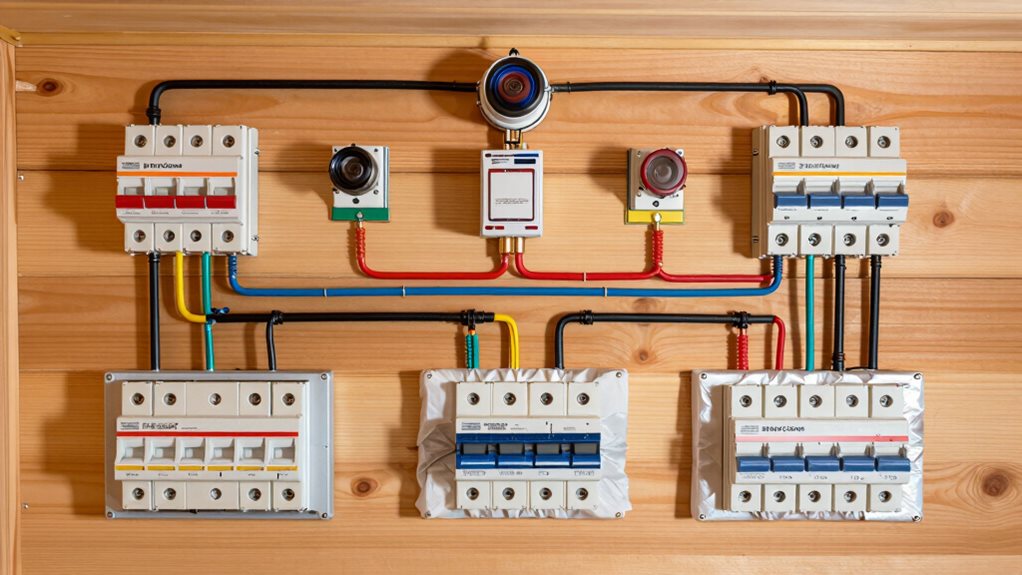
When installing a multi-heater sauna system, safety and performance go hand-in-hand, with each wiring decision directly impacting your sauna’s reliability and protection against potential hazards.
Always prioritize proper GFCI protection in these hot, moist environments to prevent shock risks.
- Install GFCI protection at the breaker panel or circuit start, using outdoor-rated disconnects for external saunas.
- Separate control panels from the heat source, mounting them outside the sauna with proper wire routing.
- Maintain minimum safety distances (10+ cm) between heaters and walls to prevent fire hazards.
- Use appropriate wiring methods: NM-B for indoor installations and weather-rated conduit with THWN conductors for outdoor applications.
Remember that proper grounding and bonding are crucial in all sauna types, preventing electrical faults in these challenging high-heat, high-humidity environments.
Frequently Asked Questions
Can I Mix Infrared and Traditional Heaters in One System?
Yes, you can mix infrared and traditional heaters in your sauna if your electrical system supports both power requirements. You’ll need a licensed electrician to guarantee proper wiring and safety.
How Do I Synchronize Temperature Controls Between Multiple Heaters?
Install a master controller that communicates with all heaters. You’ll need integrated thermostats, compatible control panels, and proper zoning configurations. Configure digital synchronization settings through your system’s central interface.
What’s the Maximum Distance Between Heater Units?
You should space your multiple heaters at least 3-6 inches apart, but can position them up to 82 feet from a central control unit with digital Wi-Fi models.
Are Surge Protectors Recommended for Sauna Electrical Systems?
No, you shouldn’t use surge protectors with saunas. They’re incompatible with high-amperage sauna systems and create fire risks. Instead, rely on GFCI protection and dedicated circuits installed by professionals.
How Do Heater Warranties Change With Non-Standard Wiring Configurations?
Non-standard wiring voids your sauna heater warranty immediately. Manufacturers require professional installation with proper wire gauge, dedicated circuits, and code compliance to maintain your coverage on components.
Final Thoughts
When you’re ready to wire your multi-heater sauna system, remember that safety comes first. Always follow local electrical codes, properly size your wiring, and install the appropriate circuit protection. Whether you’re working with single-phase or three-phase power, careful planning guarantees your heaters will function efficiently and safely. With the right control integration and attention to load calculations, you’ll create a reliable sauna system that delivers comfort for years to come.