
To scale sauna power needs, calculate your room’s cubic footage first—small saunas need about 1kW per 50 cubic feet. Traditional small saunas typically require 4-5kW heaters with 240V/20-40A circuits, while larger 6-8 person models demand 7-9kW with 40-60A service. Adjust upward by 10-15% for glass windows or outdoor installations. Infrared saunas use less power, requiring about 15 watts per cubic foot. Your proper electrical setup guarantees both safety and ideal heating performance.
Understanding Small Room Electrical Requirements
When planning a small sauna for your home, understanding the electrical requirements is crucial to guarantee safe, efficient operation. Most small saunas need about 1 kilowatt of heater power per 50 cubic feet of space. For example, a compact 3’×4’×7′ sauna typically requires a 4-5 kW heater.
Planning a home sauna? Remember: you’ll need about 1 kW of heater power for every 50 cubic feet of sauna space.
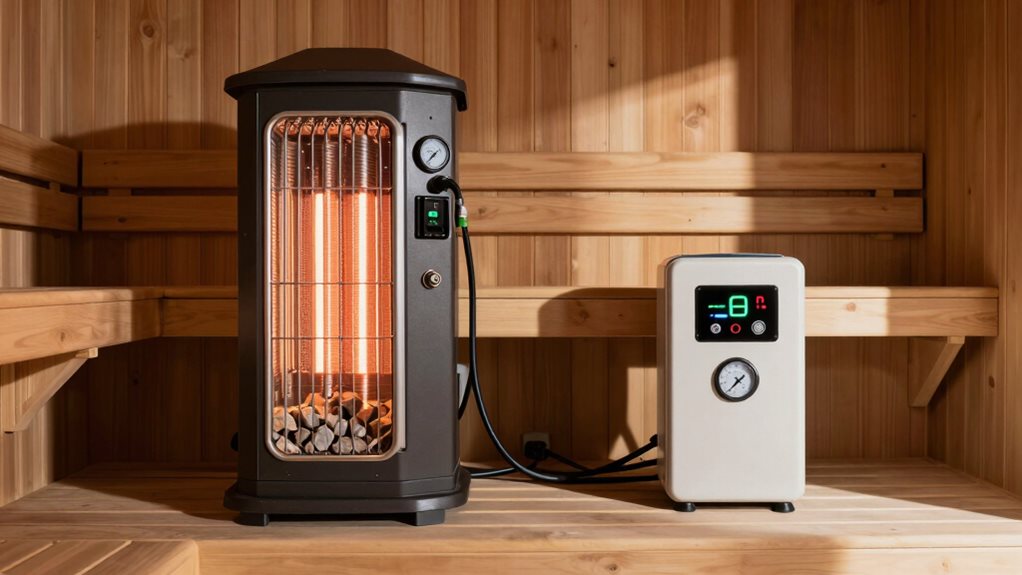
While traditional home saunas usually need 240 volts for reliable heating, very small or infrared models can run on standard 120-volt outlets. Amperage requirements vary too—infrared units typically need 15-20 amps, while traditional small heaters need 20-40 amps.
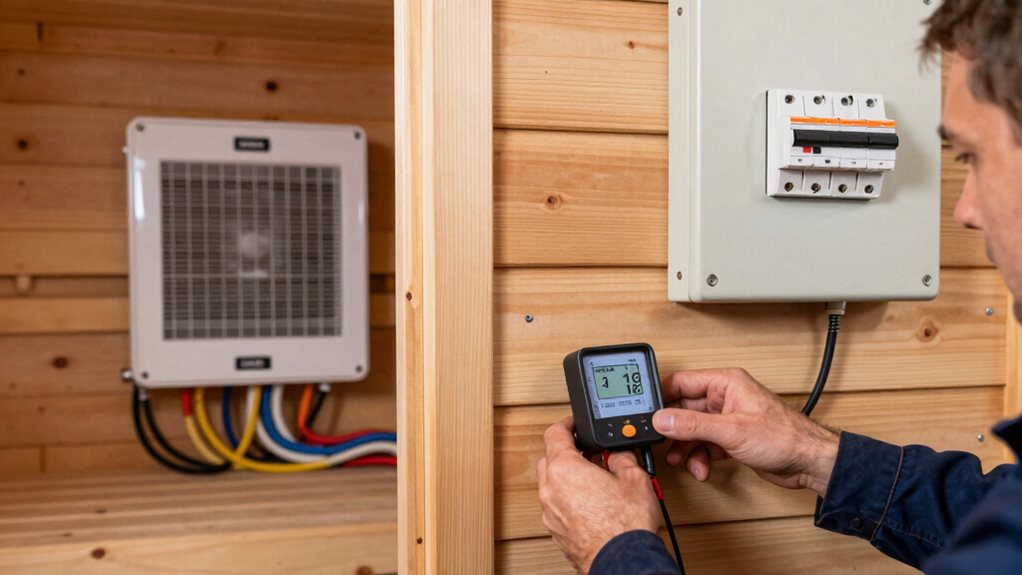
For safety, you’ll want a dedicated circuit with GFCI protection. Wire gauge must match your circuit amperage (12 AWG for 20A, 10 AWG for 30A).
Always consult with a licensed electrician to make sure your installation meets local codes.
Power Demands for Large Sauna Spaces
Unlike smaller home saunas, large sauna spaces demand considerably more electrical power to heat effectively and maintain desired temperatures.
You’ll need a 220-240V power supply for these larger installations, which enables faster heating and higher temperatures than standard household outlets.
For a 6-8 person traditional sauna, expect to use 40-60 amps and 7,000-9,000 watts of power.
Large infrared models typically require 30-50 amps and 3,000-6,000 watts.
You’ll need dedicated circuits with GFCI protection, using 8- or 10-gauge wiring connected to 30-60 amp breakers.
Commercial saunas often require three-phase 208V power for peak performance.
If your electrical panel is near capacity, you might need an upgrade before installation—always consult a licensed electrician for hardwired setups.
Calculating Power Needs Based on Cubic Footage
Determining the right power capacity for your sauna starts with understanding its actual size requirements.
You’ll need to multiply length by width by height to get the basic cubic volume – for example, a 4ft x 4ft room with 6.5ft ceiling equals 104 cubic feet.
Don’t stop there, though! You must account for non-insulated surfaces by calculating their area and applying the right coefficient. This often adds over 40% to your power needs.
For standard saunas, follow the 1 kW per 35 cubic feet rule after adjustments. Quality insulation quality dramatically impacts your heating requirements and can make the difference between efficient operation and constant power consumption.
For infrared saunas, multiply your room volume by 15 to determine total watts needed, then divide by 300 to calculate required panels.
A 104 cubic foot room needs about 1560 watts total, which means 6 infrared panels.
Matching Heater Size to Sauna Capacity
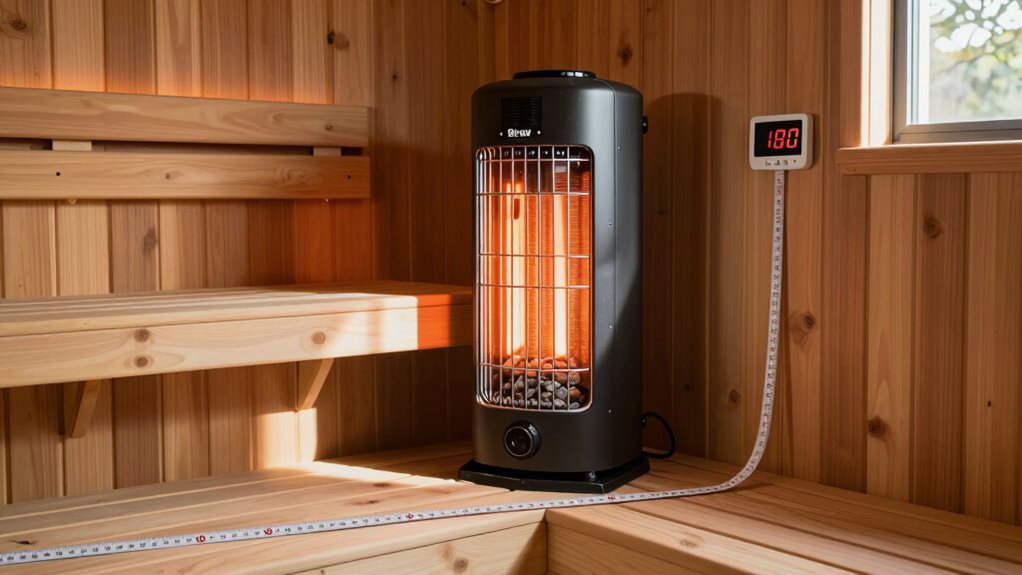
When selecting your sauna heater, you’ll need to match the power to both your room’s dimensions and the number of users.
You can easily determine the right heater size by calculating your sauna’s cubic footage and consulting the sizing charts, which typically recommend 1 kW per 45 cubic feet for well-insulated spaces. Different construction materials affect heat retention capabilities, with cedar generally holding heat better than pine.
Remember that factors like glass windows or outdoor installation may require you to increase your heater size by 10-15% to maintain peak performance. The shape of sauna can significantly impact heating efficiency, with cylindrical designs typically heating faster than rectangular ones.
Person-to-Heater Ratio
The perfect sauna experience depends heavily on matching your heater size to the number of people using the space. When planning your sauna, follow the cubic feet guidelines that determine appropriate heater power. A small 4×4 sauna (112 cubic feet) works well with a 3kW heater for one or two people, while larger groups require more powerful units.
Consider these key factors when determining your ideal person-to-heater ratio:
- A standard two-person sauna (4×6 feet) needs different ventilation than a six-person setup.
- Glass features add 1kW per 10 square feet of heat loss, requiring stronger heaters.
- Outdoor saunas need 15-20% more power to maintain comfortable temperatures.
Choosing the wrong size leads to frustrating problems – undersized heaters can’t warm up properly, while oversized ones create uncomfortable temperature spikes. Proper ventilation enhances the perceived heat, allowing for gentle heat breezes that improve the overall sauna experience.
Size-Based Power Selection
Proper sauna heater sizing transforms your relaxation experience from frustrating to fantastic.
You’ll need about 1 kW of power for every 45-50 cubic feet in a well-insulated sauna, but should add 10-15% more if your sauna has glass walls or poor insulation.
For small rooms (100-200 cubic feet), a 3-4.5 kW heater typically works well.
Medium spaces (210-450 cubic feet) generally require 5-6 kW, while larger saunas (350-700 cubic feet) need 8-10 kW heaters. Outdoor locations may require higher wattage heaters due to external temperature exposure.
For accurate calculations, our Sauna Heater Sizing Tool can help determine the perfect heater for your specific space dimensions.
Don’t undersize your heater—you’ll face hour-long warm-up times and uneven heating.
Conversely, oversized heaters create uncomfortable temperature spikes and wear out faster.
Finding that “just right” size guarantees your sauna heats efficiently and maintains the perfect temperature for your relaxation sessions.
Voltage and Amperage Considerations for Different Setups
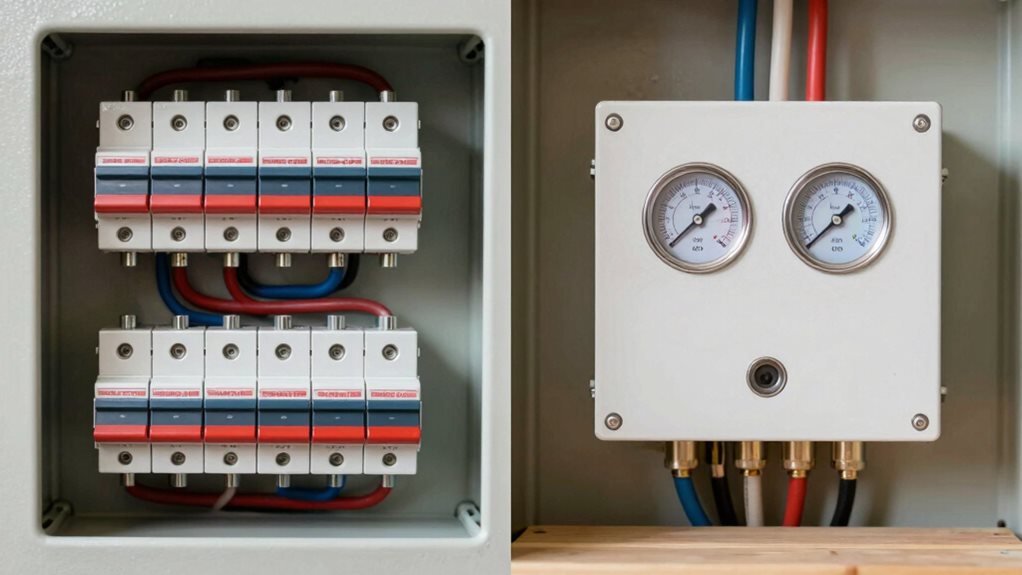
Selecting appropriate voltage and amperage for your sauna isn’t just about meeting minimum requirements—it’s about creating a safe, efficient heating system that matches your specific setup.
For smaller spaces, you’ll find that infrared or compact traditional saunas often work perfectly with standard 120V household circuits, typically drawing 15-20 amps.
However, when you scale up to medium or large traditional saunas, you’ll need to upgrade to 240V power with 30-60 amp capacity. Modern sauna heaters cannot operate efficiently on 120V as they require substantial power that single-line voltage simply cannot provide.
- A cozy 2-person infrared sauna humming quietly on a standard 15-amp circuit
- A family-sized 4-person traditional sauna drawing steady power through its dedicated 30-amp 240V line
- A spacious 8-person commercial sauna with a robust 60-amp circuit powering its high-capacity heater
Remember to match your electrical specifications to your sauna’s size—larger cubic footage demands more power to maintain those muscle-relaxing temperatures.
Energy Consumption Comparisons: Infrared vs. Traditional
Comparing energy consumption between infrared and traditional saunas reveals dramatic differences that’ll impact both your utility bills and environmental footprint.
Infrared models typically use just 1-3.5 kW per hour, while traditional electric saunas consume 3-9 kW hourly.
This efficiency gap becomes even more apparent when considering real-world usage. Your infrared sauna reaches usable heat in only 10-15 minutes, compared to the 30-45 minute preheat traditional models require.
A typical 30-minute infrared session might cost less than $0.50, while traditional sessions often run $0.50-$2.00. The 2-person infrared sauna offers an ideal balance of space and efficiency for most households.
Size matters too—a single-person infrared cabin uses about 1-1.8 kW, while large residential traditional saunas need 6-9 kW or more.
For frequent sauna users, these differences add up quickly!
Scaling Power Systems for Residential vs. Commercial Saunas
When scaling your sauna power system from residential to commercial use, you’ll need to steer through considerable differences in electrical requirements that impact installation costs, safety, and performance.
Residential saunas typically operate on 240V single-phase power with 30-40 amp circuits, while commercial installations often demand 208V three-phase configurations to handle heavier loads.
- A small 3’x4′ home sauna might need just a 4kW heater drawing 20 amps, similar to your kitchen range.
- Medium commercial saunas require 7-9kW heaters with dedicated 40-amp circuits, comparable to a small electric car charger.
- Large commercial installations demand up to 60 amps with specialized wiring, roughly equivalent to powering three electric dryers simultaneously.
Remember to match your circuit breaker size to your heater’s requirements – 40-50 amp double-pole breakers work for most setups, with appropriate AWG wiring.
Frequently Asked Questions
Can Outdoor Saunas Have Different Power Requirements Than Indoor Models?
Yes, your outdoor sauna will require more power than an indoor model due to greater heat loss, typically needing 15-25% more electricity, higher amperage, and weatherproof electrical systems.
How Do Insulation Materials Impact Sauna Power Consumption?
Quality insulation cuts your sauna’s power consumption by up to 40%. You’ll see better efficiency with Thermowood, PIR, or premium woods that trap heat and reduce your heater’s runtime.
Does Altitude Affect Sauna Heating Element Efficiency?
Yes, altitude considerably reduces your sauna heater’s efficiency. At high elevations, thinner air hampers heat production, requiring upgraded heaters with more powerful elements to maintain proper temperatures and performance.
Are There Power Solutions for Off-Grid or Solar-Powered Saunas?
Yes, you can power off-grid saunas using solar panels with battery storage, wind turbines, micro-hydro systems, or opt for traditional wood-burning stoves that don’t require electricity at all.
How Much Does Power Consumption Vary With Dry vs. Wet Sauna Use?
Your dry sauna uses 9-13 kWh per session while wet saunas consume more due to continuous steam generation, despite operating at lower temperatures. You’ll notice higher costs when adding humidity control to any setup.
Final Thoughts
You’ve now learned how to properly scale your sauna’s power needs, whether you’re building a cozy personal retreat or a spacious commercial facility. Remember, calculating cubic footage is your starting point, followed by selecting the right heater size and electrical setup. By matching your power system to your specific sauna dimensions, you’ll create an efficient, safe, and enjoyable heat experience that won’t overburden your energy bills.