

A sauna energy true-up bill balances your actual sauna electricity usage with payments made throughout the year. You’ll see your total kilowatt-hours used, any solar credits earned, and whether you owe additional money or have a credit. Traditional saunas typically cost around $75 annually (96 sessions at 6 kWh each), while infrared models use less. Your statement includes account summaries and energy breakdown charts to help you understand your consumption patterns. Smart energy strategies await below.
What Is a Sauna Energy True-Up Bill?

When you’ve been enjoying your sauna with a solar energy system, you’ll eventually receive a document that might seem confusing at first glance—your annual true-up bill. This important statement arrives on the anniversary of your solar system’s activation, summarizing your entire year of energy usage.
Your true-up bill reconciles all the electricity your sauna has consumed against the solar credits you’ve earned over the past 12 months. It shows total kilowatt-hours used, when energy was consumed versus generated, and calculates the final balance.
The statement includes fixed fees, grid connection charges, and any minimum billing requirements.
Think of it as your yearly energy report card that resets your net metering balance to zero, determining whether you’ll receive a credit or owe additional payment for your sauna’s operation.
How True-Up Calculations Work for Sauna Energy Usage
True-up calculations become much clearer when you understand exactly how your sauna consumes electricity throughout the year.
Your true-up bill reconciles your actual sauna energy use against what you’ve already paid in monthly installments.
Your annual true-up statement balances actual sauna electricity consumption with your previous monthly payments.
For a traditional sauna, the calculation typically includes your total sessions (say 96 annual sessions at 6 kWh each), multiplied by your utility’s rate (perhaps $0.13/kWh).
This gives you an annual cost of about $75, but your actual bill considers warm-up periods and maintenance heating.
Infrared saunas, being more efficient, might only accumulate 24-36 kWh monthly, resulting in lower true-up adjustments.
The formula accounts for both full-power warm-up periods and the half-power maintenance cycles that follow, giving you a complete picture of your sauna’s annual energy footprint.
The 2-person infrared sauna provides the ideal balance of space and energy use, consuming approximately 2.0 kW per hour.
Annual vs. Monthly True-Up Options for Sauna Owners
Choosing between monthly and annual true-up options can greatly impact your sauna’s energy billing experience. Monthly true-ups adjust your bill each cycle based on actual usage, preventing surprises and immediately crediting you for efficient use.
Annual true-ups offer predictable monthly payments with a single yearly reconciliation. For traditional saunas using around 225 kWh monthly, you’ll pay about $27 monthly or $324 yearly at $0.12/kWh. Infrared models cost considerably less at $14.40 monthly or $172.80 annually for the same rate.
If you’re budget-conscious or use your sauna irregularly, monthly true-ups help track patterns and optimize usage.
If you prefer simplicity and steady bills, annual true-ups work better, especially with efficient infrared models that can save you $70-$90 yearly compared to traditional saunas. Arizonans may want to consider monthly true-ups due to the state’s higher electricity rates of 16 cents per kilowatt-hour.
Reading and Interpreting Your Sauna True-Up Statement
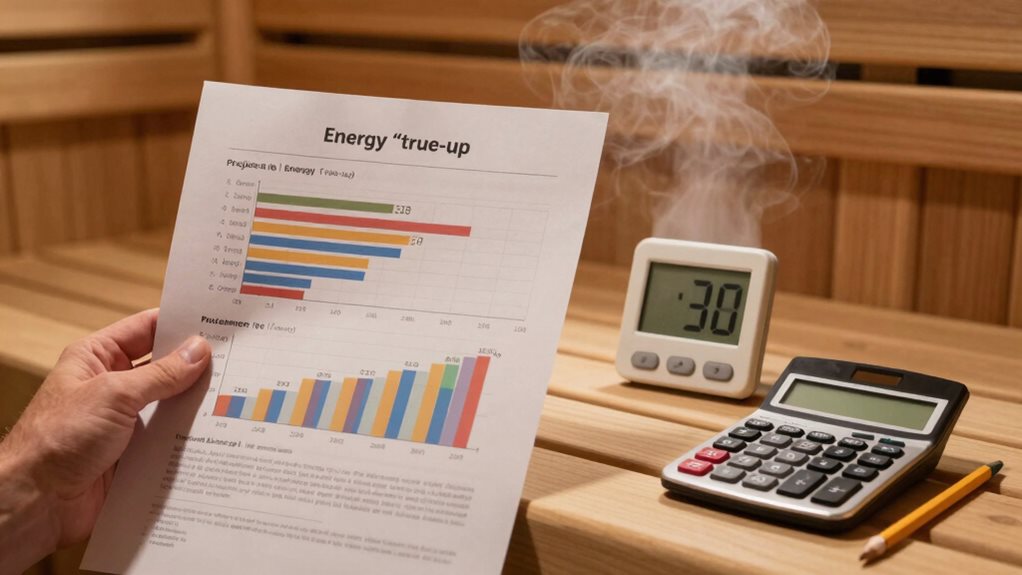
Understanding your sauna’s annual True-Up statement might initially seem as complex as deciphering a foreign language, but once you know what to look for, you’ll gain valuable insights into your energy consumption patterns.
Your statement contains several key sections worth examining. First, check the Account Summary for your total charges, payments, and final amount due.
Then, review the Monthly Net Energy Breakdown chart, which shows your sauna’s energy production versus consumption each month. Pay attention to Time-of-Use periods if applicable.
Several factors can impact your final balance, including changes in usage patterns, peak-hour energy draw, and any utility rate adjustments.
If you’ve produced more energy than you’ve used, you’ll see a “net surplus compensation” line, typically valued at 2-4 cents per kWh.
Strategies to Optimize Your Sauna’s Energy Balance
Now that you’re familiar with your sauna’s True-Up statement, you can take practical steps to reduce those energy costs.
Start by upgrading your insulation—add extra layers to walls and ceilings, seal gaps with aluminum tape, and install weatherstripping around doors. Regularly inspecting your insulation for signs of moisture or wear will help prevent heat loss and maintain efficiency.
Consider switching to infrared heaters, which use 40-60% less energy than traditional models. Pair these with programmable thermostats to prevent unnecessary heating.
Your usage patterns matter too! Schedule batch sessions instead of multiple heat-ups, and maintain moderate temperatures around 70 degrees rather than maximum heat.
Clean heater elements regularly and replace sauna stones annually for better efficiency. Regular maintenance not only extends the lifespan of components but also optimizes performance over time.
For ventilation, position fresh air intake near the heater at floor level, and keep vents closed except when needed to preserve valuable heat.
Frequently Asked Questions
Can I Dispute Errors in My Sauna True-Up Calculation?
Yes, you can dispute your sauna true-up bill by recalculating usage based on actual wattage, operating cycles, and correct rates, then submitting documentation to your utility provider.
What Happens if My Sauna System Is Damaged Mid-Cycle?
If your sauna system is damaged mid-cycle, you’ll see reduced energy production, higher grid imports, and potentially a larger true-up bill. Get repairs quickly and notify your utility about the damage.
Are Sauna True-Up Bills Tax-Deductible for Home Businesses?
You can deduct sauna true-up bills only for the business percentage of your home office. They’re treated as utility costs under regular home office deduction rules.
How Do Power Outages Affect My Sauna True-Up Balance?
Power outages prevent your sauna from exporting solar energy, increasing grid usage during blackouts. You’ll face higher true-up charges since outages create uncompensated consumption that accumulates throughout your billing year.
Can I Transfer Credits Between Multiple Sauna Installations?
You can’t transfer credits between multiple sauna installations. Each facility requires its own registration number and must undergo separate transfer processes according to Section 6418 regulations.
Final Thoughts
You’re now equipped to understand your sauna’s true-up bill! By tracking your energy usage, choosing the right billing cycle, and implementing smart energy practices, you’ll avoid surprising charges. Remember, your true-up statement isn’t just a bill—it’s a tool that helps you manage costs more effectively. With these strategies in hand, you can enjoy your sauna’s warmth while keeping your energy budget cool and balanced.