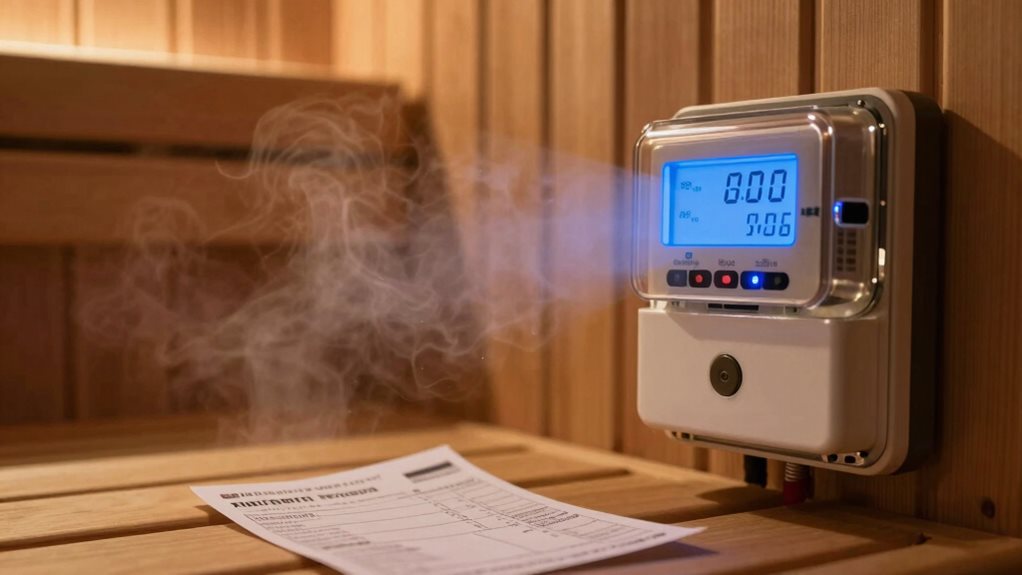

Your sauna’s electricity consumption directly impacts both efficiency and bills. Traditional models use 6-13 kWh hourly, while infrared options consume just 1-3.5 kWh, saving 50-75% on electricity costs. Proper insulation, appropriate heater sizing (1 kW per 35-50 cubic feet), and ideal temperature settings considerably reduce energy use. Monthly costs range from $7 for occasional traditional sauna use to $40 for daily sessions. Smart choices in sauna type and operation practices can profoundly lower your long-term energy expenses.
Comparing Energy Usage Between Traditional and Infrared Saunas
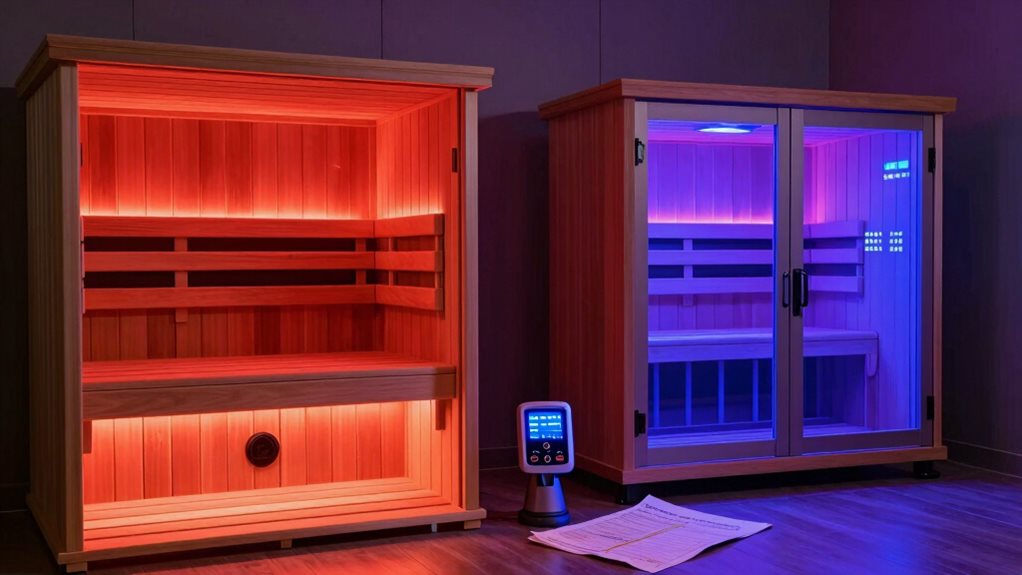
When comparing energy usage between traditional and infrared saunas, the differences are striking in both consumption and efficiency.
Traditional electric saunas typically draw 6-13 kWh per hour, while infrared models use just 1-3.5 kWh hourly—about 50-75% less electricity!
This efficiency gap translates directly to your wallet. At $0.12/kWh, a 40-minute infrared session might cost you between $1.80-$4.32, compared to $7.20-$15.60 for a traditional sauna session.
Over a month of daily use, you’re looking at approximately $14 for infrared versus $27 for traditional saunas.
The energy savings come from fundamental differences in how each works. Infrared panels heat your body directly at lower temperatures (110-140°F), while traditional saunas must heat the entire room to higher temperatures (160-200°F). This direct heating method provides a faster heat-up time of just 10-15 minutes compared to the 30-45 minutes required by traditional saunas.
Size Matters: How Sauna Dimensions Impact Power Consumption
The three most essential dimensions of your sauna—width, depth, and height—directly determine how much electricity it will consume.
Experts recommend about 1 kW of heater power for every 35-50 cubic feet of space, meaning larger saunas need considerably more electricity.
Undersizing your heater will save on peak power but actually increase overall energy use, as the unit must run longer to reach proper temperatures.
For reference, a cozy 1-2 person sauna (roughly 3×4 feet) typically needs only a 1.5-4 kW heater, while a family-sized 6×8 foot space might require 8-10 kW or more.
Remember that ceiling height matters too—even if your floor space stays the same, a taller ceiling increases your sauna’s volume and power requirements.
Proper insulation becomes even more vital as dimensions grow.
Choosing an infrared sauna can significantly reduce your energy consumption, using approximately 120 kWh monthly for daily sessions compared to traditional models that use substantially more.
The Real Cost of Heating: Warm-Up Times and Energy Efficiency
Understanding the true cost of heating your sauna requires looking beyond the heater’s power rating to examine how it performs during different phases of operation.
Traditional saunas consume considerable energy during warm-up, using 4-5 kWh in the first hour while running at full 6 kW capacity for 30-45 minutes before reaching target temperature. Once heated, power drops to 3-4 kW for maintenance.
By contrast, infrared saunas reach usable temperatures in just 10-15 minutes, consuming 75% less electricity with power ranges of 1-3 kW per hour.
You’ll save money by operating your sauna at 70-80°C rather than pushing it to 95-100°C.
For maximum efficiency, confirm proper insulation, correctly size your heater, use the sauna immediately after warm-up, and schedule back-to-back sessions when possible.
Monthly Electricity Expenses Based on Usage Patterns
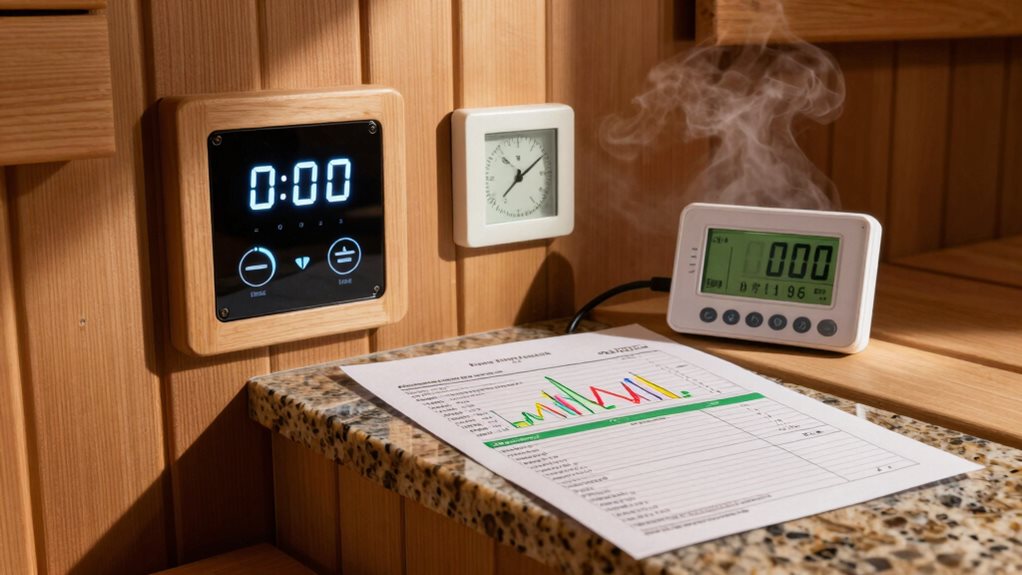
Many homeowners wonder exactly how much their sauna habit will impact their electricity bill each month. The answer depends largely on two factors: the type of sauna you own and how frequently you use it.
If you’re using a traditional sauna with a 6 kW heater three times weekly for 30-minute sessions, you’ll spend about $7 monthly.
Increase that to daily 90-minute sessions, and your bill jumps to $32-$40 per month.
Infrared saunas, with their lower power requirements, cost considerably less to operate. The same three-weekly pattern with an infrared model runs just $1.76 monthly, while daily 40-minute sessions average $14.40.
Your local electricity rates also matter—costs calculated at $0.12/kWh will increase proportionally in areas with higher rates like $0.15/kWh or the U.S. average of $0.17/kWh.
Smart Operating Strategies to Minimize Energy Costs
While operating a home sauna provides relaxation and health benefits, implementing smart usage strategies can greatly reduce your energy costs without sacrificing comfort.
Start by installing programmable timers that preheat your sauna only when needed, and consider Wi-Fi panels for remote control and monitoring.
You’ll save considerably by slightly reducing your sauna’s temperature to around 70 degrees, which maintains benefits while consuming less electricity.
Organize batch sessions where multiple people use the sauna consecutively, avoiding repeated heating cycles.
Don’t overlook insulation improvements—add heat-reflective foil behind wall panels and install proper weatherstripping around doors to keep heat inside. Choosing insulation with higher R-values will significantly improve your sauna’s heat retention and energy efficiency.
Regular maintenance is equally important: clean heater elements, restack stones periodically, and seal any gaps that might let precious heat escape.
Consider switching to infrared sauna technology which uses 40-60% less energy compared to traditional saunas while delivering similar health benefits.
The Long-Term Financial Impact of Sauna Type Selection
Your choice of sauna type will greatly impact your wallet over its lifetime, with the higher upfront cost of infrared models often paying off through dramatically lower monthly electricity bills.
When you compare a traditional electric sauna using 9-13 kWh per hour against an infrared model using just 1.5-3.5 kWh, you’ll see monthly operating costs can differ by $30-40 at average electricity rates.
The return on investment timeline typically shortens with frequent use, making energy-efficient models the smarter long-term financial choice for regular sauna enthusiasts.
Lifetime Operational Costs
Selecting the right sauna type doesn’t just impact your initial investment, but dramatically shapes the financial picture over the entire lifespan of your unit.
When you consider operational expenses over 10-20 years, the differences become substantial. Traditional electric saunas draw 6-8 kW, costing $0.90-$1.40 per hour, while infrared units use only 1.5-2 kW at $0.20-$0.35 hourly.
- Infrared saunas can save you $30-$50 monthly compared to traditional electric models
- Wood-burning saunas trade electricity costs for wood fuel ($5-$10 per session)
- Replacement parts like heater elements or stones add hundreds to your long-term budget
- Poor installation increases energy consumption, raising lifetime expenses
- Regular maintenance ($100-$200 annually) preserves efficiency and extends your sauna’s life
ROI Between Models
Three key factors determine whether your sauna investment will pay off: upfront costs, operating expenses, and usage patterns.
While infrared saunas typically cost 30-60% less upfront than traditional electric models, your long-term savings depend on how often you’ll use it.
For frequent users, the math is compelling. Traditional saunas consume 6-13 kWh per hour with 30-45 minute warm-up times, while infrared units use only 1.5-3.5 kWh per session and heat up in 10-15 minutes.
This translates to 40-60% lower electricity bills per session.
If you’re a daily sauna enthusiast in an area with high electricity rates (above $0.15/kWh), an infrared model could pay for itself within 3-8 years through energy savings alone.
Occasional users, however, might wait decades to see that return.
Insulation Quality and Its Effect on Electricity Requirements
Insulation quality stands as the single most critical factor determining your sauna’s electricity consumption. With proper insulation, you’ll trap heat inside your sauna, reducing the need for continuous heating and maintaining stable temperatures.
Proper insulation locks in heat, minimizes power usage, and maintains your sauna’s optimal temperature with remarkable efficiency.
Premium saunas with multi-layer insulation systems can achieve up to 30% greater energy efficiency compared to poorly insulated models, translating to notable savings on your electricity bills.
- High-quality materials like mineral wool, fibreglass, or Western Red Cedar provide excellent thermal properties.
- Indoor saunas are 15-25% more efficient than outdoor ones due to protection from temperature fluctuations.
- Thick wall insulation (minimum 2 inches) dramatically improves heat retention.
- Insulated glass doors and weather stripping prevent heat from escaping.
- Well-insulated saunas require less heater workload, recovering higher upfront costs through long-term energy savings.
Properly sealed foil vapor barriers with aluminum tape at all seams are essential for preventing moisture migration and maintaining thermal efficiency in your sauna.
Frequently Asked Questions
How Do Voltage Requirements Differ Between Sauna Types?
Traditional electric saunas need 240V (4.5-9kW), infrared saunas often run on 110-120V (smaller units) or 240V (larger units), while wood/gas saunas require only basic 120V for controls and lighting.
Can Solar Panels Effectively Power Home Saunas?
Yes, a 2-4 kW solar system can power your infrared sauna effectively. You’ll need a high-capacity solar generator for 1600-3000W draws, but you’ll enjoy free operation after payback.
Do Saunas Require Dedicated Electrical Circuits?
Yes, most electric saunas require dedicated circuits. Traditional 240V models need 30-60A dedicated circuits, while some smaller infrared saunas can use standard 120V outlets with manufacturer approval.
How Does Ambient Room Temperature Affect Sauna Energy Consumption?
Your sauna uses less energy when your room’s already warm. Higher ambient temperatures reduce warm-up time, lower heating requirements, and decrease heat loss through walls during operation.
Are There Seasonal Variations in Sauna Operating Costs?
Yes, you’ll pay more in winter due to higher electricity rates, increased heat loss, longer preheat times, and more frequent usage when it’s cold outside.
Final Thoughts
You’ll find your sauna choice considerably impacts both efficiency and electricity bills. By selecting the right type, size, and insulation quality for your needs, you can enjoy the health benefits without breaking the bank. Remember, infrared models typically cost less to run than traditional saunas, and smart usage habits like scheduling sessions and maintaining proper insulation will keep your energy consumption—and monthly bills—under control.