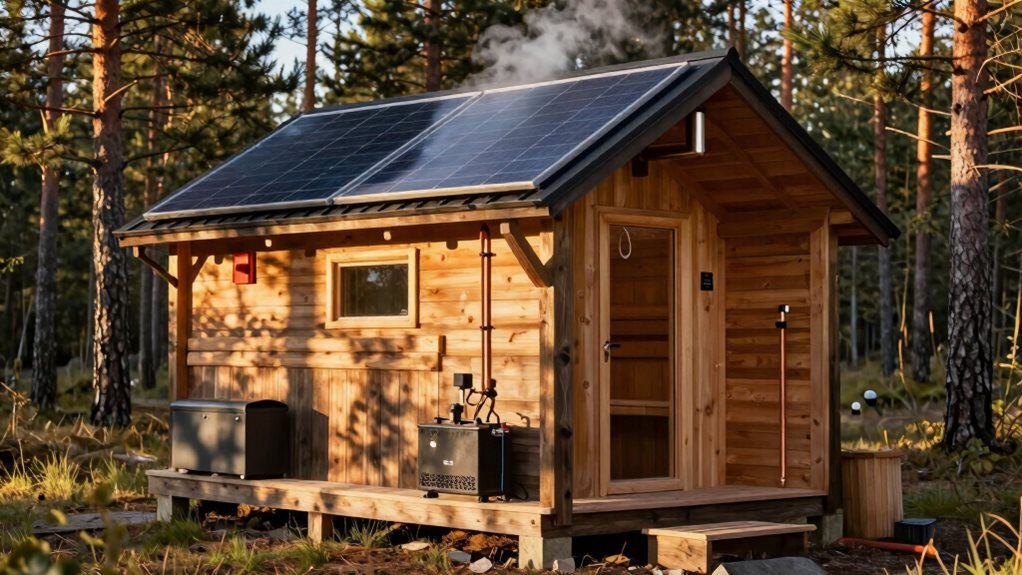

To power your off-grid sauna with solar, first calculate your energy needs—traditional saunas use 6-13 kWh per session while infrared models need only 1.5-3.5 kWh. Choose high-efficiency monocrystalline panels with MPPT controllers and pure sine wave inverters. LiFePO4 batteries offer the best balance of safety and longevity. Maximize efficiency with proper insulation and compact designs. The right system will keep you enjoying steamy relaxation regardless of your location.
Calculating Your Sauna’s Energy Requirements
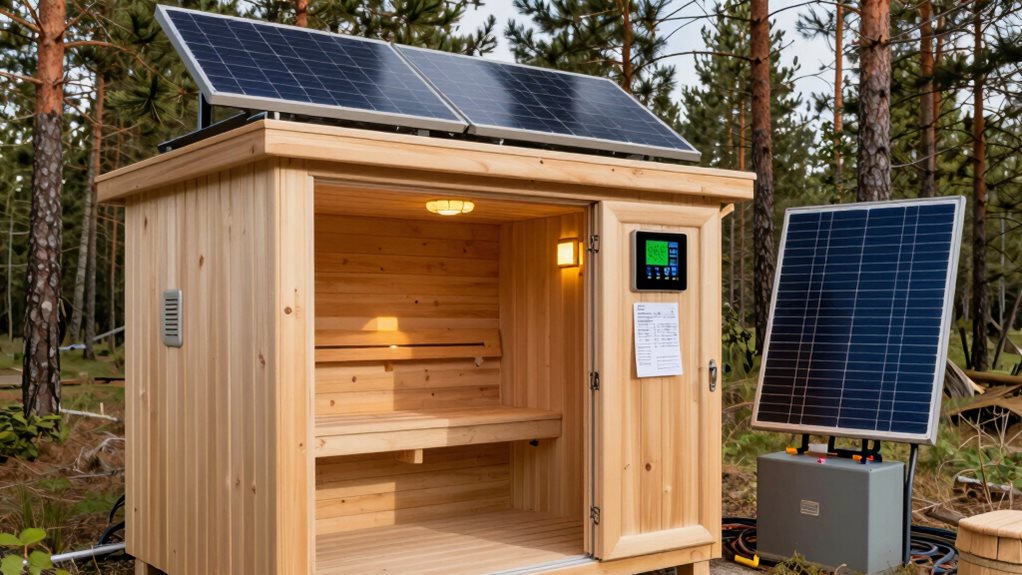
The first step in designing your off-grid sauna solar system is understanding exactly how much power you’ll need.
Different saunas have vastly different energy requirements, so calculate yours specifically.
Traditional saunas consume 9-13 kWh per hour, while infrared models are much more efficient at just 1.5-3.5 kWh per session. Your heater’s size, typically 4-10 kW for traditional or 1.5-2.5 kW for infrared, directly impacts your energy needs.
To calculate your monthly requirements, multiply your heater power (kW) by hours used per month. For example, a 6 kW traditional sauna used 15 hours monthly needs 90 kWh.
Don’t forget to account for warm-up times too—traditional saunas need 30-45 minutes (using 3-7 kWh), while infrared models need just 10-15 minutes (0.25-0.5 kWh).
Choosing the Right Solar Components for Your Setup
When selecting the right solar components for your off-grid sauna, you’ll need to carefully match your energy needs with appropriate equipment that can handle the unique demands of sauna power systems.
Choose high-efficiency monocrystalline panels, especially if your space is limited. For a typical 3.6 kW heater running 2 hours daily, you’ll need panels that can generate about 7.2 kWh, accounting for local sunlight and battery losses.
Always pair your panels with an MPPT charge controller rather than PWM—it captures more energy in variable conditions. For your inverter, select one with a pure sine wave output that can handle your heater’s continuous power needs.
Get maximum power with MPPT controllers and ensure reliable heat with pure sine wave inverters rated for your sauna’s needs.
When mounting panels, consider temperature impacts—provide adequate air gaps to prevent overheating, particularly if they’re installed near your sauna structure.
Battery Storage Options for Reliable Sauna Performance
Selecting the right battery storage forms the cornerstone of any reliable off-grid sauna system, determining how often you’ll enjoy steamy sessions regardless of weather conditions.
Lithium-iron-phosphate (LiFePO4) batteries offer the best combination of safety, longevity, and usable capacity for saunas, lasting through 2,000-5,000+ cycles with 80-90% depth-of-discharge capability.
While lead-acid options (AGM, flooded, or gel) cost less upfront, they require larger capacity since you’ll only use about 40-50% of their rated capacity.
When sizing your battery bank, calculate your sauna’s energy requirements by multiplying the heater’s power rating by your typical usage time, then add 10-20% for inverter inefficiencies.
Don’t forget to plan for multiple days of autonomy to handle cloudy weather.
Always house your batteries in weatherproof, ventilated enclosures with proper safety systems.
Energy-Efficient Sauna Design Strategies
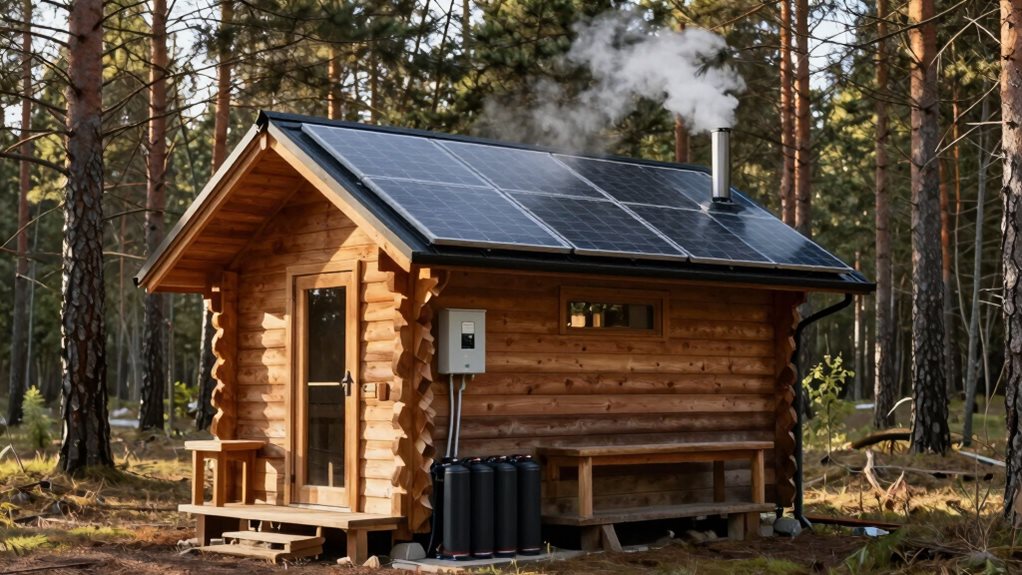
Beyond reliable power storage, your off-grid sauna’s energy efficiency will determine how much solar capacity you’ll actually need.
The smarter your sauna design, the less power you’ll consume, saving you money on solar panels and batteries.
When building your off-grid sauna, focus on these key efficiency strategies:
- Use 4-6 inches of mineral wool or fiberglass insulation in walls and double layers in the ceiling to trap heat effectively.
- Install a properly sized heater that matches your sauna’s dimensions to avoid wasting energy.
- Choose a compact barrel design over traditional shapes for better heat circulation and retention.
- Add a foil vapor barrier with sealed seams to reflect heat back into the sauna and prevent moisture issues.
- Consider an infrared sauna system that provides effective heating while using 40-60% less energy compared to traditional sauna heaters.
- Perform regular inspections of insulation and seals around doors and windows to maintain optimal thermal resistance throughout your sauna’s lifetime.
Installation and Safety Considerations for Off-Grid Systems
Installing a solar system for your off-grid sauna requires careful planning and attention to safety details. Always follow local electrical codes and consider hiring a licensed electrician for final connections.
Your system needs proper grounding, GFCI protection, and appropriately sized breakers to prevent shock hazards in the humid sauna environment.
When mounting components, create a dedicated, ventilated space for your batteries, especially if using lead-acid types that release gases. Keep batteries away from the sauna’s heat and install a battery management system for lithium batteries to prevent overcharging.
Don’t forget surge protection for your solar array to guard against lightning strikes. Position emergency shutoffs where they’re easily accessible outside the sauna, and maintain proper clearances around heaters according to manufacturer specifications to prevent fire risks. Choose the appropriate heater type based on your power availability when designing your off-grid solar system.
Frequently Asked Questions
Can I Run My Sauna Directly From Solar Panels Without Batteries?
Yes, you can run your sauna directly from solar panels without batteries if you use it during peak sunlight and install an oversized PV array with a suitable off-grid inverter.
How Does Extreme Cold Affect Solar-Powered Sauna System Performance?
Your panels will gain 10-15% efficiency in cold weather, but snow accumulation will block sunlight. You’ll need steeper installation angles (30-45°) to promote natural snow shedding.
What Maintenance Is Required for a Solar-Powered Sauna System?
You’ll need to regularly clean solar collectors, inspect electrical connections, check heater elements, rotate sauna stones, and maintain wood surfaces while guaranteeing ventilation systems remain unobstructed for ideal performance.
Are There Tax Incentives for Solar-Powered Sauna Installations?
Yes, you’ll qualify for the 30% Federal Residential Clean Energy Credit through 2025 if your sauna’s solar system is owned, installed, and operational in the claiming tax year.
Can I Upgrade My Existing Sauna to Solar Power Incrementally?
Yes, you can upgrade incrementally. Start with portable solar kits, add small panel arrays, then integrate battery storage. Pair with your existing grid power before shifting to a full hybrid system.
Final Thoughts
You’ve learned how to create a sustainable, off-grid sauna that harnesses the sun’s power. By calculating your energy needs, selecting appropriate components, and implementing efficient design, you’ll enjoy relaxing heat without utility bills. Remember to prioritize safety during installation and maintenance of your solar system. With these DIY solutions, your sauna can operate reliably year-round while minimizing environmental impact. Enjoy your eco-friendly retreat for years to come!