
Electrifying a sauna costs more than just the initial purchase price ($750-$3,000 for heaters). You’ll need to budget for installation ($300-$4,000), permits ($100-$2,000), and possibly electrical upgrades ($1,000-$3,000). Monthly operating costs vary greatly between traditional (6-9 kW) and infrared (1.5-2 kW) models, with location-based electricity rates creating considerable differences. Your usage pattern will determine if you’ll spend $8-$32 monthly, while proper maintenance extends your investment’s lifespan.
Initial Purchase Price Breakdown for Electric Saunas

The three major components of an electric sauna’s purchase price make a substantial impact on your budget planning.
First, the heater unit itself ranges from $200 for basic models to over $4,000 for commercial-grade systems, with most home units falling between $750-$3,000 depending on power rating.
Second, materials for the sauna cabin typically cost $2,000-$7,000 for DIY builds, with premium woods like western red cedar commanding higher prices. Glass doors and panels add another $150-$600 to your total.
Finally, don’t overlook controls and accessories. Digital control panels ($100-$700), safety components ($50-$300), and comfort features like ergonomic backrests and LED lighting ($100-$1,000) complete your setup.
Remember that heater power must match your room size—an underpowered unit might require costly upgrades later.
Installation Costs: From Permits to Professional Services
When planning your electric sauna installation, you’ll quickly discover that the initial purchase price is only part of the equation. Permits and inspections can add $100-$2,000 depending on your municipality, with potential delays affecting your project timeline.
The electrical work forms a substantial portion of your budget. Electric heaters typically require 240V dedicated circuits, with wiring costs ranging from $300-$1,500. If your home’s electrical panel lacks capacity, expect to pay an additional $1,000-$3,000 for an upgrade.
Professional labor costs will vary based on your project’s complexity. Installers typically charge $50-$100+ per hour, contributing $300-$4,000 to your total.
You’ll likely need multiple trades involved—electricians for wiring, carpenters for assembly, and possibly HVAC contractors for ventilation considerations.
Understanding Kilowatt-Hour Calculations for Sauna Heaters
To calculate your sauna’s electricity costs, you’ll first need to check your utility bill for your rate per kilowatt-hour, which can vary dramatically depending on your location.
You can save money by running your sauna during off-peak hours, when electricity rates are often 30-50% lower than during high-demand times.
The size of your heater is the biggest factor in your energy consumption, with larger 8-9kW units consuming noticeably more electricity than standard 4.5-6kW models typically found in home saunas. Remember that heaters typically operate at full capacity initially, then reduce to about 50% power when maintaining temperature. A standard sauna session with a 6 kW heater will typically consume 7-9 kWh over a two-hour period.
Determining Your Rate
Understanding how your electric sauna converts power into heat isn’t just fascinating—it’s essential for managing your utility bills. To calculate your actual costs, you’ll need to find your electricity rate, typically listed as cents per kilowatt-hour on your utility bill.
Your sauna’s power consumption depends on its size and type. Traditional saunas with 6-9 kW heaters use more electricity than infrared models (1.5-2.5 kW) or portable units (1-1.5 kW).
Remember, heaters don’t run at full capacity the entire time—they work hard during warm-up (30-40 minutes), then cycle to maintain temperature at roughly 50% power.
When tracking costs, consider a typical 6 kW sauna uses about 4-5 kWh for the first hour and 3-4 kWh for the second hour, totaling 7-9 kWh for a complete session.
Peak vs. Off-Peak
During the course of a day, your electric bill’s meter doesn’t just count kilowatt-hours—it tracks when you use them, and that timing can greatly impact your sauna costs.
Peak demand hours, typically late afternoon to early evening, can increase your sauna operation costs by 20-50%. A traditional sauna drawing 6kW might cost $8.19 for 12 monthly hours at peak rates, while the same usage during off-peak periods could save you considerably.
Your sauna consumes the same electricity regardless of timing—traditional models use 7-9 kWh for a two-hour session, while infrared units use just 1.5-3.5 kWh.
However, shifting usage to early morning or late night can release substantial savings, comparable to what you’d pay for streaming services each month.
Heater Size Matters
When selecting a sauna heater, size dramatically impacts your electricity consumption and operating costs. A typical home sauna heater ranges from 3 kW to 9 kW, with 6 kW being standard for a 3-4 person Finnish sauna.
Understanding the math is straightforward: a 6 kW heater running for one hour consumes 6 kWh of electricity, while a 9 kW unit uses 9 kWh.
During the initial heat-up phase (30-60 minutes), your heater runs at full capacity. Afterward, it shifts to maintenance mode, using only 40-50% of its maximum power.
For example, a two-hour session with a 6 kW heater typically consumes 7-9 kWh total: 4-5 kWh during heat-up and 3-4 kWh during maintenance.
If you’re using your sauna twice weekly, that’s approximately 48 kWh per month.
Comparing Traditional vs. Infrared Sauna Energy Consumption
The energy consumption differences between traditional and infrared saunas greatly impact your monthly electric bills and overall operating costs.
Energy efficiency isn’t just about the environment—it’s about keeping more money in your pocket month after month.
Traditional saunas demand 6-9 kW of power and consume 9-13 kWh per hour, while infrared models use just 1.5-2 kW for a two-person unit, using only 1-3 kWh hourly.
You’ll wait 30-45 minutes for a traditional sauna to heat up, compared to just 10-15 minutes with infrared options. This shorter warm-up time, combined with infrared’s direct body-heating technology, means you’ll save 40-60% on energy costs overall.
The lower operating temperatures of infrared saunas contribute notably to their efficiency. While traditional saunas need high heat to warm the entire room, infrared panels work effectively at lower temperatures by directly penetrating your body.
Monthly Operating Expenses Based on Usage Frequency
Your sauna’s monthly electricity cost depends largely on how often you use it, with typical patterns ranging from occasional to daily sessions.
If you enjoy just three weekly sessions in a 6kW traditional sauna, you’ll spend about $8-$10 monthly at average US rates.
On the other hand, daily 75-minute sessions could increase your bill by $27-$32.
Infrared saunas offer a more economical option at approximately $14-$15 monthly for daily use, making them worth considering if you’re budget-conscious but want regular heat therapy.
In Arizona, where electricity costs 16 cents per kilowatt-hour, residents will pay substantially more than the national average for their sauna operation.
Calculating Typical Usage Patterns
Estimating your sauna’s monthly operating costs starts with understanding typical usage patterns and how they translate to your electric bill.
For infrared saunas, a daily 30-40 minute session usually consumes 60-90 kWh per month, costing about $7-$11 at average U.S. electricity rates ($0.12/kWh).
Traditional electric saunas use more power, with daily hour-long sessions adding up to 225-270 kWh monthly, or roughly $27-$32.
If you’re a less frequent user, three weekly sessions considerably reduce costs.
Infrared users might spend just $5-$15 monthly, while traditional sauna enthusiasts can expect $12-$32 depending on session length and heater size.
Low vs. High Frequency
Usage frequency dramatically impacts your sauna’s monthly operating costs, creating notable differences between occasional and daily use patterns.
If you’re using your infrared sauna just 3-4 times weekly for 30-minute sessions, you’ll only add $10-$15 to your monthly bill. That’s a considerable savings compared to daily use.
Daily sessions, especially in traditional saunas, quickly multiply your expenses. A daily 90-minute session with a 6 kW heater will consume 270 kWh monthly, costing about $40.50 at typical rates.
Infrared options remain more economical even with frequent use, consuming 75% less electricity than traditional models (1-3 kWh versus 6-9 kWh per hour). The 2-person infrared model offers the best balance of space and energy efficiency for most households.
For budget-conscious sauna enthusiasts, consider back-to-back scheduling with family members during less frequent weekly sessions to minimize preheating costs.
Long-Term Energy Costs: 5-Year Projection Analysis
When planning for the long-term financial impact of your sauna, a 5-year projection provides a clearer picture of what you’ll actually spend beyond the initial installation costs.
Looking at the numbers, infrared saunas are dramatically more cost-effective, with 5-year totals ranging from $150-$225 (used 3x weekly) to $468 (used daily) in the US.
Traditional saunas cost substantially more, reaching $475-$650 over five years even with moderate use. The difference becomes even more notable with frequent use.
International users face higher costs, with UK residents potentially spending £738 for daily infrared use or up to £3,900 for electric traditional models over five years.
The formula to estimate your own costs is simple: multiply your sauna’s kW rating by monthly hours used and your electricity rate.
If you’re considering solar integration, you’ll see near-zero costs after year 7.
Hidden Costs and Maintenance Requirements
Beyond the obvious power consumption costs, maintaining your electric sauna involves several hidden expenses that can greatly affect your budget over time.
You’ll need to perform regular heater inspections, checking electrical connections quarterly and looking for frayed wires monthly.
Sauna stones aren’t permanent fixtures—they’ll need replacement every 6-12 months in commercial settings, or after about 300 hours of use in home saunas.
Don’t forget about cleaning costs; you’ll need supplies for wiping down the heater exterior and scrubbing benches.
The maintenance schedule differs considerably between commercial and home setups.
While commercial saunas require daily cleaning and weekly inspections, home units can manage with monthly checks.
To protect your investment, use your home sauna at least twice weekly to prevent efficiency loss and mildew development.
For optimal performance, apply specialized wood treatment annually to prevent drying and cracking of wooden components in your sauna.
Energy-Saving Strategies for Lower Operating Expenses
You’ll greatly reduce your sauna’s operating costs by implementing timer-based systems that prevent wasteful heating when the sauna isn’t in use.
Upgrading your insulation with mineral wool or foam board creates a thermal envelope that keeps heat inside, allowing your sauna to warm up faster and maintain temperature with less energy.
Heat recovery methods, like ventilation systems that capture and recirculate warm air, can cut your electricity consumption by up to 40% while maintaining the perfect sauna environment. Choosing an infrared sauna can provide significant savings as they consume 40-60% less energy compared to traditional models. Installing a proper vapor barrier is essential for preventing moisture buildup that can compromise insulation effectiveness and increase energy demands.
Timer-Based Operation Systems
Although a sauna’s warmth feels luxurious, its energy consumption can quickly heat up your electricity bill. Installing programmable timers is one of the smartest investments you’ll make for your sauna, reducing operational costs by £0.50 to £1.50 per hour compared to non-timed systems.
Your options include:
- Digital timers with precise settings and smart home integration
- Mechanical dial timers for basic, reliable 60-minute control
- Seven-day programmable timers ideal for commercial installations
- Smart timers for remote control via your smartphone
With timer-based systems, you’ll preheat only when necessary, maintain ideal temperatures without wasteful overheating, and never worry about forgetting to turn off your sauna.
Many modern timers also track your energy usage, helping you identify patterns and enhance your sauna’s efficiency over time.
Insulation Upgrade Benefits
While timer systems control when your sauna operates, proper insulation determines how efficiently it runs. Upgrading to high-performance materials like PIR insulation can dramatically reduce your energy costs, as it provides twice the thermal resistance of rock wool at half the thickness.
You’ll notice immediate benefits after improving your insulation: your sauna will heat up faster, maintain temperature longer, and use less electricity. Higher R-values translate directly into significant energy savings when heating your sauna space.
Look for materials with high R-values and low K-values, which indicate superior heat retention. Don’t forget to install foil vapor barriers sealed with aluminum tape to trap heat and block moisture.
Complete coverage matters too—insulate walls, ceilings, and floors thoroughly without gaps.
These upgrades might cost more initially but will save you money for years through reduced operating expenses and quicker heating times.
However, avoid using polyisocyanurate (PIR) insulation as it releases toxic products when exposed to high temperatures, making it hazardous for sauna applications despite its thermal properties.
Heat Recovery Methods
Heat recovery methods can considerably reduce your sauna’s operating costs while maintaining peak performance.
Modern systems capture and reuse heat that would otherwise escape, creating a more efficient heating cycle. Plate heat exchangers transfer thermal energy from sources like geothermal groundwater or solar-heated water to maintain comfortable temperatures with minimal energy input. Proper airflow design significantly enhances both comfort and sustainability, preserving heating elements and wooden interiors for longer lifespans.
- Advanced heat exchangers achieve close temperature approaches, maximizing recovery while guaranteeing steady conditions.
- High flow rates enable self-cleaning functionality, reducing maintenance and downtime.
- Proper ventilation improves heater efficiency by enabling even heat distribution throughout your sauna.
- Solar integration works seamlessly with heat recovery systems, making operation more cost-effective by minimizing fossil fuel dependency.
When implemented correctly, these recovery methods can dramatically lower your monthly utility bills while supporting sustainability goals—making your sauna investment smarter in the long run.
Regional Cost Variations: How Location Affects Your Bottom Line
Your geographical location plays a surprisingly considerable role in determining the total cost of electrifying your sauna.
Electricity rates can quadruple your operational expenses, with Hawaii residents paying $61.20 monthly compared to Idaho’s $16.20 for the same 6kW sauna used 30 minutes daily.
Installation costs fluctuate dramatically across states too.
New Yorkers face average costs of $4,500 for a standard four-person sauna, while Arizona residents pay around $3,300. These variations stem from local labor rates, permit requirements, and building codes.
The distance from your house to an outdoor sauna location greatly impacts your budget.
Installations within 50 feet typically cost $500-$1,200, but extending beyond that can push costs to $2,000-$3,000 with required underground conduit protection.
Return on Investment: Health Benefits vs. Financial Expenditure
Although the initial costs of electrifying a sauna may seem substantial, evaluating the return on investment requires considering both financial expenditures and noteworthy health benefits.
When you compare the upfront costs against the potential health gains, your sauna investment becomes more compelling.
- Your cardiovascular health improves dramatically, with regular users enjoying up to 83% reduced risk of heart problems and stroke.
- Blood pressure benefits begin immediately, lasting hours after each session and reducing hypertension risk by 46% with frequent use.
- Pain management improves naturally, especially for chronic conditions like arthritis and back pain.
- Mental health flourishes with reduced stress, better sleep quality, and even a 60% lower risk of developing dementia.
These health advantages represent considerable value beyond the electricity bills and installation costs you’ll incur.
Frequently Asked Questions
How Does Sauna Use Impact Home Insurance Premiums?
Your sauna increases premiums due to fire and water damage risks. Insurers classify them as high-risk features, similar to pools. You’ll face higher rates unless you implement safety measures.
Can Solar Panels Offset an Electric Sauna’s Energy Consumption?
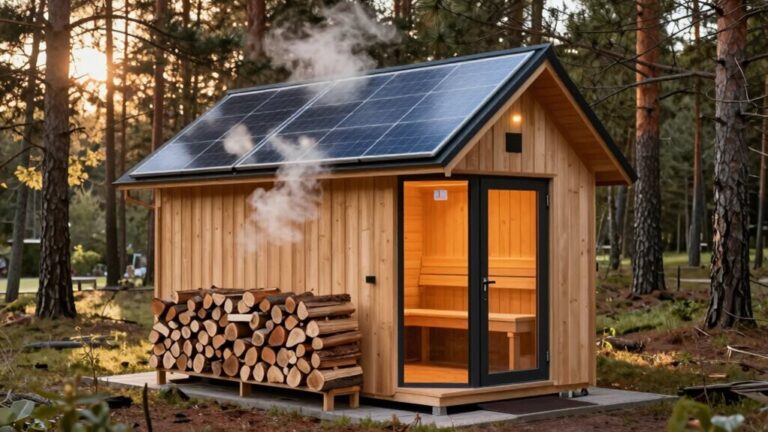
Yes, solar panels can offset your sauna’s energy needs. With 8-10 panels producing 300W each, you’ll generate enough power for typical 2-hour sauna sessions.
Are There Tax Incentives for Energy-Efficient Sauna Installations?
Yes, you’ll qualify for federal tax credits up to 30% of costs if you incorporate heat pumps or efficient electric systems into your sauna installation. Documentation is crucial for claiming these benefits.
How Does Water Quality Affect Electric Sauna Maintenance Costs?
Poor water quality increases your maintenance costs through mineral buildup on heating elements, requiring $50-$100 annual descaling, plus potential $150-$600 component repairs and more frequent $20-$100 element replacements.
What’s the Resale Value Impact of Adding an Electric Sauna?
You’ll recoup about 50% of your sauna investment at resale, with potential home value increases of $4,000. It’s especially valuable in wellness-oriented markets where 42% of buyers find saunas highly desirable.
Final Thoughts
You’ve now got all the tools to calculate your sauna’s true cost. By understanding purchase price, installation fees, energy consumption, and maintenance needs, you’ll avoid surprise expenses. Remember, your location and usage patterns greatly impact overall costs. While the initial investment might seem steep, the health benefits and potential energy savings you’ll enjoy over time often make electrifying your sauna a worthwhile investment for your home and wellbeing.