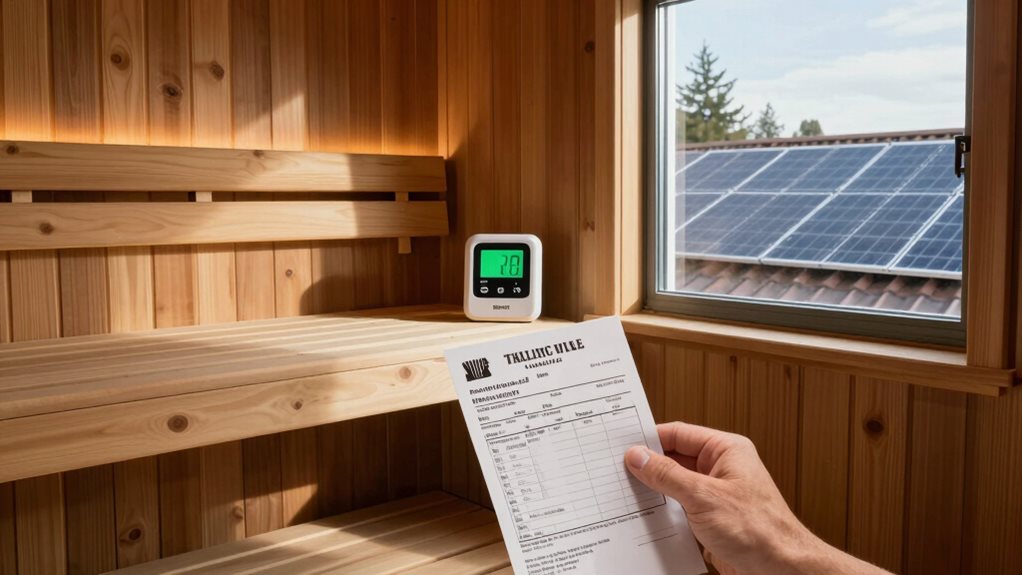

To slash your sauna utility bills, consider infrared models that use 40-60% less energy than traditional Finnish saunas. Run your sauna during off-peak hours for 20-50% savings per kilowatt-hour, and schedule back-to-back sessions to minimize reheating. Lower temperatures (150-160°F for traditional, 120-130°F for infrared) still provide benefits while using less electricity. Proper insulation with mineral wool and aluminum foil vapor barriers dramatically reduces energy needs. These simple adjustments will transform your sauna from an energy drain into a cost-efficient sanctuary.
Choosing Energy-Efficient Sauna Types
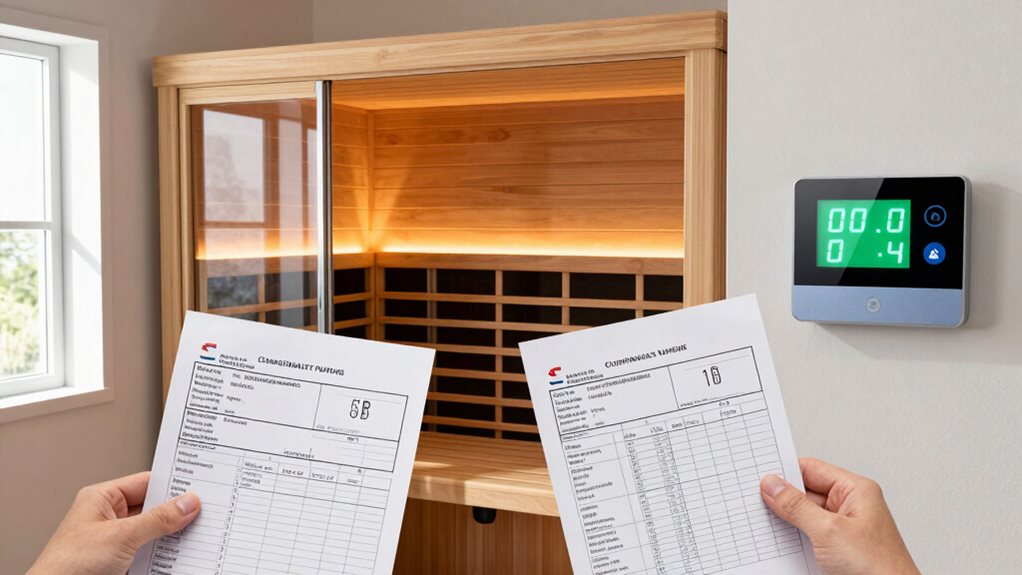
When selecting a home sauna that won’t inflate your utility bills, understanding the energy efficiency of different types is crucial.
Infrared saunas are typically your most economical choice, using only 1-2.5 kW per session—about 40-60% less energy than conventional options. They heat your body directly rather than warming the entire air volume, reducing both warm-up time and overall consumption.
Traditional Finnish saunas, while beloved for their authentic experience, draw considerably more power (6-9 kW) during operation.
Steam saunas consume even more energy due to continuous steam generation. If you’re torn between options, consider a hybrid model that lets you switch between infrared mode for energy savings and traditional mode for classic sauna experiences.
For maximum efficiency, verify proper sizing—an oversized room with an underpowered heater will run longer and cost you more in the long run.
Professional installation is recommended to ensure proper wiring and connections, as both infrared and electric saunas have wiring complexities that can affect performance and safety.
Monthly operation costs for infrared saunas typically average around $10 per month, significantly less than the $20+ required for traditional steam saunas.
Strategic Timing and Usage Patterns
You’ll save considerably on your sauna’s operating costs by running it during off-peak utility hours when electricity rates are lower.
Scheduling back-to-back sessions for family members or friends reduces total energy consumption by spreading the initial heat-up costs across multiple users.
Instead of heating your sauna multiple times throughout the week, try batching your sessions on the same day to maximize efficiency and minimize repeated warm-up phases.
Smart usage patterns can reduce your infrared sauna’s electricity costs by 40-60% through these optimization strategies.
Off-Peak Operation Savings
Strategic timing of your sauna sessions can dramatically reduce your utility costs, especially if you’re operating under a time-of-use electricity plan. By shifting your sauna use to off-peak hours (typically 9 PM-7 AM), you’ll pay 20-50% less per kilowatt-hour.
- Schedule smartly – Run your sauna during weekends and late evenings when electricity rates drop considerably, saving up to $1.08 per hour for a 6 kW traditional sauna.
- Use timers effectively – Program your sauna to preheat during off-peak periods, then maintain heat through your session without running during expensive peak times.
- Combine strategies – Stagger multiple family sessions back-to-back during off-peak windows to reuse heat, and consider slightly lower temperatures to reduce overall consumption. This approach is especially beneficial for Arizona residents facing 16 cents per kilowatt-hour electricity rates, which are higher than the national average.
Session Batching Benefits
Beyond shifting your sauna use to off-peak hours, you’ll discover even greater energy savings through session batching – the practice of scheduling multiple users during a single heating cycle.
When your family coordinates sauna sessions back-to-back, you’ll greatly reduce energy consumption. Instead of heating the sauna multiple times, one heating cycle serves everyone, cutting your per-person energy costs remarkably.
For example, what might cost 5 kWh for a solo session could average just 2.5 kWh per person when two people use it consecutively. Smart temperature controls with programmable timers allow you to pre-schedule these batched sessions effectively.
To maximize these benefits, establish a family schedule with quick changes between users. Enter immediately after the previous person exits to capitalize on residual heat.
Using timers helps coordinate these shifts precisely, preventing the sauna from running empty. Remember, every consecutive user makes your sauna more cost-effective without requiring proportionally more energy.
Optimal Temperature Settings
When managing your home sauna for ideal energy efficiency, setting the right temperature is crucial to balancing comfort with utility costs.
Finding the sweet spot can greatly reduce your electricity consumption while still delivering the therapeutic benefits you expect. Remember that the Rule of 200 suggests an optimal balance between temperature and humidity for maximum comfort.
- Lower temperatures save more – Operating your traditional sauna at 150-160°F rather than 195°F can cut energy usage considerably, while infrared saunas are most efficient at 120-130°F.
- Match temperature to your purpose – For relaxation, set to 140-158°F; for post-workout recovery, keep it at 120-150°F; only use higher temps when specifically needed.
- Consider duration tradeoffs – A moderate-temperature session (150°F) for 20 minutes often provides similar benefits to a short high-temperature session while using less energy overall.
Location Planning for Efficiency
Where you place your sauna can dramatically affect its energy efficiency and your utility bills.
You’ll save money by installing an indoor sauna, particularly in basement or interior rooms where heat can be shared with the rest of your home.
If you opt for an outdoor installation, choose a spot with natural wind protection and adequate shade to minimize heat loss and energy consumption.
Interior Vs Outdoor Placement
Choosing between an indoor or outdoor sauna installation greatly impacts your long-term utility costs and energy efficiency.
Indoor saunas typically offer better energy performance due to their integration with your home’s existing insulation and protection from weather elements. Meanwhile, outdoor options require additional weatherproofing but separate heat and humidity from your home’s HVAC system.
Consider these key differences:
- Indoor saunas cost less initially ($1,000+ for basic infrared models) and require minimal maintenance, while outdoor installations need weather-resistant materials like cedar and annual maintenance costing $150-$400.
- Outdoor units consume more energy in winter but don’t affect your home’s cooling needs in summer.
- Infrared models use considerably less electricity (120 kWh monthly) than traditional saunas (225 kWh monthly) regardless of placement.
Basement Vs Main Floor
Why does your sauna’s location within your home matter so much for your utility bills?
Basements offer natural advantages that translate directly to cost savings. Your basement already maintains cooler, more stable temperatures and benefits from existing insulation, requiring less energy to heat your sauna compared to main floor installations.
When you install a sauna in your basement, you’ll avoid the heat bleed that occurs on your main floor, which can raise cooling costs in summer and warm bedrooms unnecessarily.
Basements also typically offer easier access to electrical panels, saving you $500-$1,500 in installation costs. The natural moisture control and proper vapor barriers in basement installations protect your home’s structure while containing humidity, especially important for traditional steam saunas.
For maximum utility savings, choose basement locations with pre-existing insulation near utility connections.
Insulation and Heat Retention Strategies
Proper insulation serves as the foundation for any energy-efficient sauna, dramatically reducing the electricity needed to maintain ideal temperatures.
Effective insulation forms the cornerstone of sauna efficiency, slashing energy costs while maintaining perfect heat levels.
The strategic layering of insulation materials creates a thermal envelope that keeps heat inside where you want it. For maximum efficiency, you’ll need different approaches for each part of your sauna structure. This careful design helps extend your heater’s lifespan by reducing how frequently it needs to cycle on.
Here are three key strategies to maximize heat retention:
- Install mineral wool in walls (at least 40mm thick) for superior heat resistance and soundproofing, making sure you fill all cavities completely to prevent temperature gaps.
- Use thicker insulation for ceilings (R-26 to R-30 rating) with foil-faced foam boards that reflect escaping heat back into your sauna.
- Apply a proper aluminum foil vapor barrier throughout, overlapping seams and sealing with heat-resistant tape to create an airtight moisture barrier that doubles as a heat reflector.
Smart Controllers and Timers
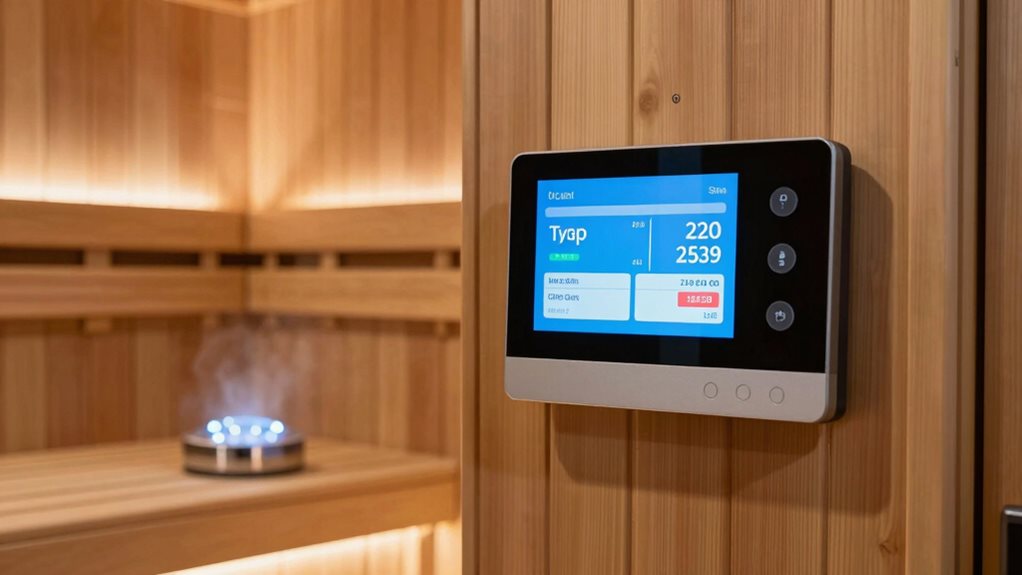
How dramatically can a smart controller transform your sauna’s energy efficiency? With AI-driven adaptive systems and WiFi controllers, you’ll see immediate savings on your utility bills.
These smart devices learn your usage patterns, preheating the sauna only when you typically use it while reducing energy during off-peak times. Machine learning algorithms analyze your behavior to optimize settings and temperature control, creating a more efficient sauna experience.
You can control your sauna remotely through smartphone apps, setting precise temperatures and scheduling sessions ahead of time. The Harvia Fenix smart timer, for example, learns your sauna’s performance and notifies you when it reaches your desired temperature.
No more wasting energy heating an empty room! Integration with Alexa or Google Home even allows voice commands to start preheating while you’re finishing work.
With automatic safety shut-offs, you’ll never again worry about accidentally leaving your sauna running all day.
Maintenance Practices to Minimize Energy Waste
Even the most energy-efficient sauna will drain your wallet if it’s not properly maintained, making regular upkeep essential for minimizing utility costs.
Regular cleaning and proper stone arrangement guarantee your heater works efficiently without wasting electricity or fuel.
Consistent maintenance ensures your sauna delivers maximum heat without maximum utility bills.
Here’s how to keep your sauna running at peak efficiency:
- Re-stack your sauna stones at least once yearly to improve air circulation, which helps your sauna heat faster while using less energy.
- Check door seals and insulation regularly, replacing worn weatherstripping to prevent heat from escaping and causing your heater to work harder.
- Clean heater elements and air vents monthly to remove dust and debris that force your system to consume more power to achieve the same temperature.
Inspect your Harvia heater quarterly for damage to identify potential electrical issues that might increase energy consumption while also ensuring optimal performance.
Frequently Asked Questions
Does Voltage/Amperage Affect Sauna Energy Consumption?
Voltage/amperage combinations determine power (watts), but don’t directly affect energy use. Your sauna consumes the same energy at 120V or 240V if the wattage and runtime remain identical.
Can Solar Panels Offset Sauna Electricity Costs?
Yes, you can offset sauna electricity costs with solar panels. They’ll generate power to run your sauna, especially if you’ve sized the system to match your specific usage patterns.
How Do Ventilation Systems Impact Energy Efficiency?
Proper ventilation systems reduce your energy costs by preventing heat stratification, maintaining ideal humidity levels, and reducing heater strain. You’ll see greater efficiency when airflow is balanced at 5-8 air changes hourly.
Do Water-Pouring Rituals Significantly Increase Energy Costs?
No, your water-pouring rituals don’t substantially increase energy costs. They use the sauna’s existing heat without drawing additional power, regardless of whether you’re using traditional or infrared models.
Are There Tax Incentives for Energy-Efficient Sauna Installations?
You can claim a 30% tax credit for biomass sauna stoves with 75%+ efficiency (up to $2,000) or for solar water heating systems that power your sauna through 2032.
Final Thoughts
You’ve now got all the tools to enjoy your home sauna while keeping energy costs in check. By selecting an efficient model, using smart timing, maintaining proper temperatures, and following good maintenance practices, you’ll maximize relaxation without shocking bills. Remember, small adjustments like proper insulation and strategic placement make a big difference. With these strategies, you can sweat away stress—not your budget!