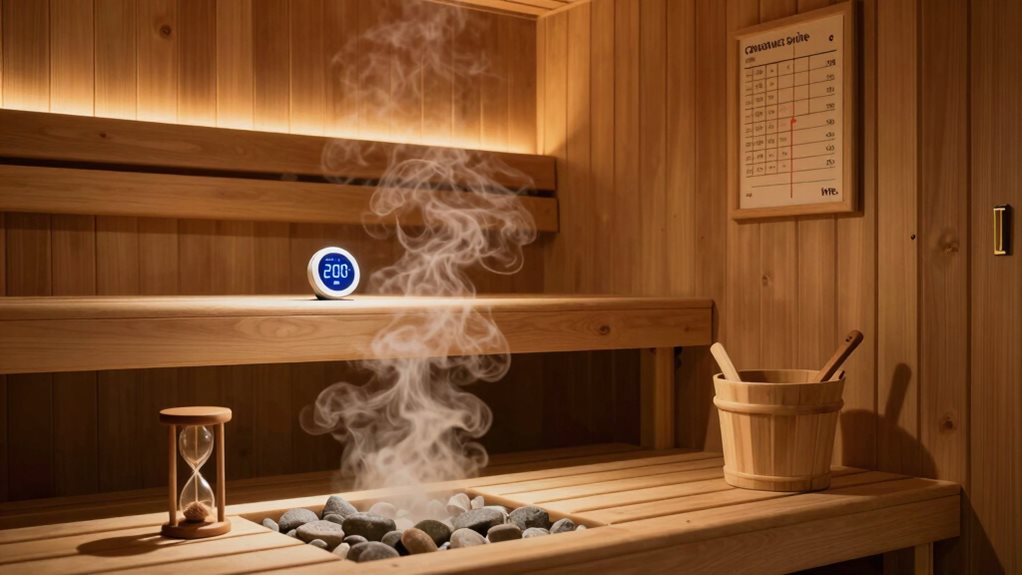

The 200 Rule for saunas suggests that your sauna’s temperature (in Fahrenheit) plus humidity percentage should equal approximately 200 for ideal comfort and safety. For example, if you’re enjoying a 170°F sauna, aim for about 30% humidity. This Finnish-inspired guideline helps you avoid both uncomfortably dry conditions and excessive steam that could strain your cardiovascular system. Following this balance maximizes therapeutic benefits while preventing overheating risks, especially important in traditional and steam saunas where conditions can change quickly.
Understanding the 200 Rule: Basic Formula and Definition
The 200 Rule provides a simple but powerful formula for creating the perfect sauna environment.
At its core, this guideline states that when you add the temperature in Fahrenheit to the humidity percentage, the sum should equal approximately 200. For instance, if your sauna is 170°F, your ideal humidity should be around 30%.
This balanced approach guarantees your sauna session isn’t uncomfortably dry or oppressively steamy.
The rule emerged from Finnish traditions where sauna masters understood that proper heat-humidity balance creates the most therapeutic experience. This practice aims to prevent the risks of overheating while still allowing users to enjoy the full benefits of sauna bathing.
In Finnish tradition, sauna masters discovered the perfect balance of heat and humidity unlocks the sauna’s deepest therapeutic potential.
Regular monitoring of both temperature and humidity levels with appropriate instruments helps ensure you maintain the proper balance throughout your sauna session.
Whether you’re using a traditional Finnish sauna at 180°F with 20% humidity or an infrared model at 130°F with 70% humidity, following the 200 Rule helps you maintain safe conditions while maximizing relaxation and health benefits.
The Science Behind Temperature and Humidity Balance
Understanding why saunas make you feel hot involves more than just looking at the temperature reading on the wall.
When humidity rises, your body’s natural cooling system—sweating—becomes less effective, making the environment feel markedly hotter even if the temperature hasn’t changed.
This temperature-humidity relationship explains why the 200 Rule works so well:
- High humidity at 140°F can feel more uncomfortable than dry heat at 180°F because sweat can’t evaporate from your skin.
- In small saunas, adding water to stones creates more intense humidity spikes than in larger rooms.
- Heat rises, creating temperature layers—it’s always hotter near the ceiling than at bench level.
- Your body responds differently to dry versus humid heat, which is why balancing these factors matters for both comfort and safety.
Proper sauna design features tiered bench seating that allows bathers to choose their preferred temperature zone. Traditional Finnish saunas typically use convection currents to distribute heat throughout the space as hot air naturally rises from the heater.
How the 200 Rule Enhances Safety in Sauna Sessions
Safety doesn’t just come from knowing the right temperature settings—it’s about balancing multiple factors to protect your health while enjoying sauna benefits.
The 200 Rule provides a simple formula to prevent dangerous conditions that could lead to hyperthermia or cardiovascular strain. By keeping the combined temperature (°F) and humidity percentage below 200, you’ll reduce risks of dizziness, rapid heartbeat, and other warning signs of overheating. This is especially important if you’re new to saunas or have health concerns. The rule, which originated in Finnish sauna traditions, helps create an optimal balance between heat intensity and moisture levels.
Using a thermometer and hygrometer helps you monitor conditions in real-time, allowing for adjustments before problems arise.
Remember to limit sessions to 10-20 minutes, drink water before and after, and exit immediately if you feel unwell. Traditional sauna temperatures typically range between 140-200°F, with most users preferring 150-175°F for comfort and safety. These practices, alongside the 200 Rule, create a safer environment for your sauna experience.
Applying the Rule Across Different Sauna Types
The 200 Rule works differently depending on which type of sauna you’re enjoying.
In traditional Finnish saunas, you’ll balance high temperatures (160-195°F) with lower humidity (5-20%), while steam rooms flip this equation by combining lower temperatures (110-120°F) with nearly saturated humidity (90-100%).
Infrared saunas operate under different principles altogether, typically running at 110-140°F with very low humidity, which means they naturally stay well below the 200 threshold without much adjustment needed. Safety should always be prioritized by monitoring your comfort level and personal tolerance to heat during each session.
Traditional vs. Infrared Application
While the 200 rule provides a helpful guideline for traditional saunas, it applies differently when comparing traditional and infrared sauna experiences.
Traditional saunas operate at higher temperatures (150-195°F) where the rule becomes essential for managing comfort and safety. In contrast, infrared saunas typically run at lower temperatures (110-140°F) with minimal humidity, so the sum rarely approaches 200.
- Traditional saunas heat the air around you, making humidity a key factor in how hot it feels.
- Infrared saunas primarily heat your body directly through radiant energy, not the air.
- Adding water in a traditional sauna quickly increases humidity, requiring monitoring with a hygrometer.
- For infrared users, following manufacturer temperature guidelines is often sufficient, though the 200 rule remains a safe reference point if humidity increases.
Steam Room Adaptations
Although traditional saunas follow the 200 rule quite closely, steam rooms require specific adaptations of this guideline due to their naturally higher humidity levels.
In steam rooms, you’ll typically experience temperatures of 110-120°F with humidity approaching 100%, which technically exceeds the 200 rule. The specific respiratory health benefits of steam rooms make them worth considering despite this deviation from the ideal 200 combination for respiratory health. To apply the concept safely, focus on shorter sessions (10-15 minutes) and guarantee proper hydration before and after your steam.
Some facilities offer hybrid spaces with adjustable settings, allowing you to experience beneficial moist heat while staying closer to the 200 target. Look for rooms that maintain moderate temperatures (120-140°F) with controlled humidity (30-60%). Digital thermometers designed for high humidity environments provide the most accurate readings in these conditions.
Remember that accurate measurements matter—sensors should be placed at head height and rated for high humidity to give you reliable readings in these steamy environments.
Measuring and Maintaining Optimal Conditions
To accurately monitor your sauna’s conditions, you’ll need a high-temperature thermometer and hygrometer placed at head level, away from direct steam sources.
You can control humidity by adding water to the hot rocks when the environment feels too dry, or increasing ventilation when it becomes uncomfortably steamy.
Checking your readings after the sauna has been running for 30-60 minutes guarantees you’re getting accurate measurements that reflect the stable conditions you’ll experience during your session.
Essential Monitoring Equipment
Three key monitoring devices form the backbone of any properly equipped sauna setup.
You’ll need reliable temperature sensors placed at head height, away from direct heater radiation to accurately measure what your body experiences. For complete monitoring, consider adding integrated temperature-humidity instruments mounted at bench level to track both essential metrics simultaneously.
Your control unit ties everything together, managing temperature setpoints while providing critical safety cutoffs if things get too hot. The HUUM UKU Temperature Sensor offers precise real-time readings that help maintain consistent sauna heat while preventing dangerous overheating conditions.
- Choose NTC thermistors for analog systems or PT100/PT1000 RTDs when precision matters
- Select sensors rated for at least 120°C (248°F) with ±0.5°C accuracy
- Look for IP65-rated devices that can withstand harsh sauna conditions
- Install redundant systems like dual sensors or mechanical high-limit thermostats for safety
Humidity Control Techniques
Effective humidity control begins with understanding the Rule of 200—a critical guideline where the sum of your sauna temperature (°F) and relative humidity (%) shouldn’t exceed 200.
For example, if your sauna is 160°F, you’ll want to keep humidity around 40% or less to maintain safe conditions.
To manage humidity effectively, use the incremental ladle method—add one ladle of water to the stones, then wait 30-60 seconds to observe changes before adding more.
Position your humidity sensor at breathing height for accurate readings, and check readings throughout your session, especially after adding water.
Remember that stone quality matters; dense, sauna-rated stones produce more predictable steam.
For safety, avoid pouring water directly onto electric elements, and adjust your ventilation to help control moisture levels when needed.
Temperature Equilibrium Checks
While sauna enthusiasts often focus solely on heat intensity, proper temperature equilibrium checks are essential for both comfort and safety during your sessions.
To accurately measure conditions, place your thermometer at breathing level (36-54 inches above the floor) and away from direct heat sources that could skew readings.
For reliable temperature monitoring:
- Mount sensors on walls opposite the heater to avoid radiant heat bias
- Use sauna-rated thermometers capable of handling extreme temperatures (up to 185°F)
- Apply the “200 Rule” by adding temperature (°F) and humidity (%) – aim for a sum around 200
- Track temperature stability before starting your session to confirm conditions have plateaued
Remember to calibrate your instruments regularly using ice-point and boiling-point checks to maintain accuracy, replacing any device with deviations greater than 3-5°F.
Cultural Origins: Finnish Traditions and Western Adaptations
Despite its mathematical precision, the 200 rule wasn’t born in a Finnish laboratory but emerged from centuries of sauna tradition and modern wellness interpretation.
The Finnish Sauna Society recommends temperatures between 80-100°C (176-212°F), which naturally aligns with the 200 rule when paired with the typically low humidity of traditional Finnish saunas.
You’ll notice that authentic Finnish practice emphasizes a different approach than strict adherence to numbers—Finns traditionally focus on the rhythm of heat and cooling, using periodic water tosses (löyly) to temporarily boost humidity.
Western wellness industries later adopted and popularized the 200 formula as an easy-to-market guideline, particularly in commercial settings where customers expect consistency.
This transformation from cultural practice to numerical standard illustrates how ancient traditions often become simplified when crossing cultural boundaries.
Practical Examples: Adjusting Your Sauna Experience
Applying the 200 rule becomes intuitive once you’ve seen it in action across different sauna settings.
When customizing your session, you’ll adjust temperature and humidity to keep their sum at or below 200 while considering your experience level and comfort.
- For a classic Finnish experience, try 160°F with 40% humidity (160 + 40 = 200), giving you balanced heat and steam.
- If you prefer intense dry heat, set your sauna to 180°F with just 20% humidity (180 + 20 = 200).
- For a gentler, steam-focused session, lower the temperature to 120°F while allowing up to 80% humidity (120 + 80 = 200).
When sharing a public sauna, remember the sum changes when others throw water on rocks—monitor conditions and adjust your stay accordingly.
Health Benefits of Following the 200 Guideline
Following the 200 rule doesn’t just create a comfortable sauna experience—it reveals specific health benefits through precisely controlled heat exposure.
When you stick to this guideline, you’re giving your cardiovascular system a predictable workout that can lower blood pressure, improve blood vessel function, and reduce arterial stiffness over time.
Regular sauna sessions within this thermal dosing framework have been linked to impressive long-term outcomes—fewer cardiovascular events and lower all-cause mortality rates.
The controlled heat exposure also promotes positive metabolic changes, including improved cholesterol profiles and reduced inflammation markers like hsCRP.
When to Modify the Rule: Special Considerations and Limitations
While the 200 rule offers a helpful framework for most sauna users, there are important situations when this guideline needs modification or shouldn’t apply at all.
Remember that different versions exist—some sources define it as temperature (°F) + humidity (%) ≤ 200, while others use temperature (°F) + time (minutes) ≤ 200. Be clear about which version you’re following to guarantee safety.
- Medical conditions matter: If you have heart disease, are pregnant, or take certain medications, you’ll need stricter limits than the standard rule provides.
- Age considerations: Children and older adults typically require lower temperatures and shorter sessions due to different thermoregulation capabilities.
- Sauna type affects readings: Infrared saunas operate differently than traditional ones, so the rule may not apply equally.
- Measurement location changes everything: Temperature varies by height in the sauna—specify whether readings are taken at head or bench level.
Frequently Asked Questions
Is the 200 Rule Legally Required for Commercial Sauna Installations?
No, the 200 rule isn’t legally required for commercial sauna installations. While building codes mandate ADA compliance, fire safety, and ventilation requirements, they don’t enforce the temperature-humidity sum as a regulatory standard.
Can Children Safely Use Saunas That Follow the 200 Rule?
The 200 rule doesn’t guarantee child safety. You’ll need additional precautions: limit children’s exposure time, maintain adult supervision, keep temperatures lower (around 150-160°F), safeguard proper hydration, and consider their individual health conditions.
Does Altitude Affect the Application of the 200 Rule?
No, altitude doesn’t affect the 200 Rule’s application. You’ll still follow the same temperature plus humidity calculation regardless of elevation. The rule remains consistent whether you’re using a sauna at sea level or in mountains.
How Quickly Can Exceeding the 200 Rule Become Dangerous?
Danger can develop within 5-15 minutes with mild symptoms like lightheadedness. You’ll face moderate heat illness in 15-60 minutes and risk severe heat stroke within 30-90 minutes if you don’t exit and cool down.
Are There Smartphone Apps That Monitor the 200 Rule Automatically?
No, there aren’t any smartphone apps that automatically monitor the 200 Rule. You’ll need to rely on manual thermometers and hygrometers to track temperature and humidity levels in your sauna sessions.
Final Thoughts
By following the 200 rule for saunas, you’ll create a safer, more enjoyable experience. Remember that temperature plus humidity should equal about 200, giving you flexibility to customize your sessions. Whether you prefer Finnish traditions or modern adaptations, this guideline helps you maintain balance. Adjust settings based on your health needs and preferences, and you’ll maximize benefits while minimizing risks. The 200 rule isn’t just tradition—it’s your pathway to ideal sauna wellness.