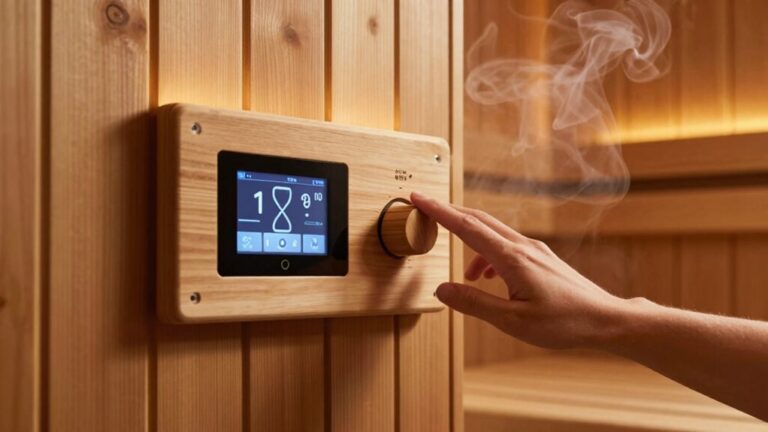
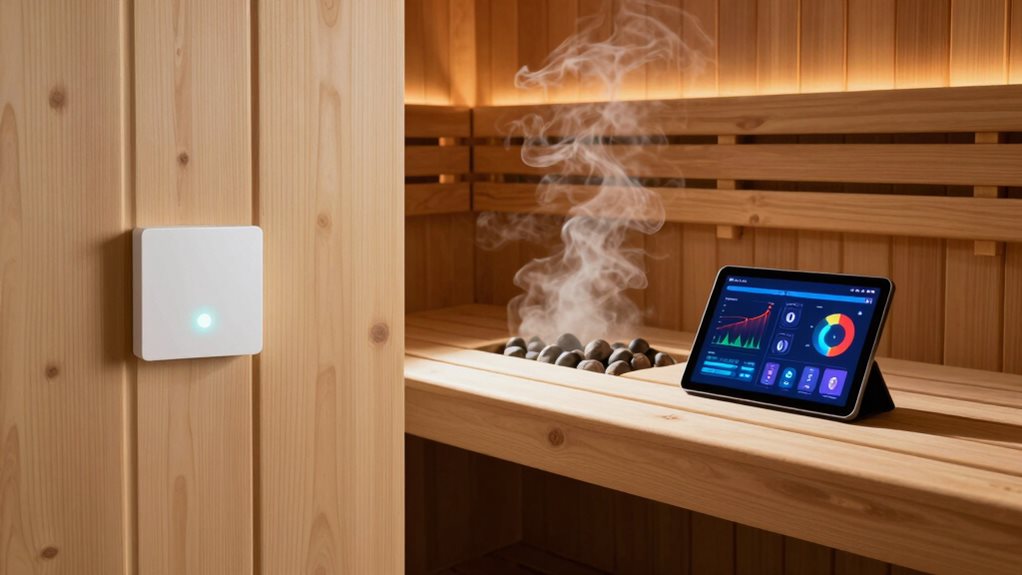

Smart relays offer a DIY approach with custom automation through SMS commands or Home Assistant, requiring technical skills for installation. In contrast, commercial sauna apps provide user-friendly interfaces with pre-programmed timers and improved convenience features like pre-timing. Smart relays are more affordable but demand hands-on work, while commercial systems include dedicated control units that handle higher power loads with integrated safety features. Your choice depends on your budget, technical comfort, and desired convenience level.
Key Differences in Setup and Installation
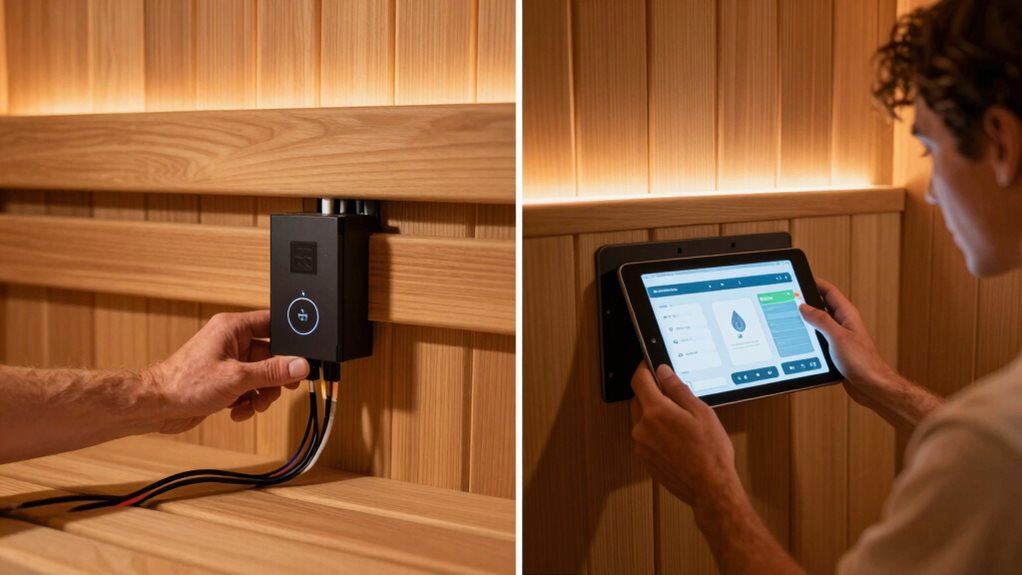
When comparing smart relay systems to commercial sauna apps, the setup and installation process reveals substantial differences that impact both difficulty and flexibility.
Smart relay setups require more hands-on work, including soldering ESP32s and mounting relay modules under benches with proper sealing. You’ll need to drill through timber for cable routing and connect RJ10 telephone wires to existing heater ports.
Smart relay installations demand technical skills—soldering, drilling, and proper sealing to ensure system reliability despite sauna conditions.
Commercial apps, on the other hand, come with dedicated control units that you simply hang on projecting wood screws. These systems feature specific terminal arrangements on circuit boards and use standard mounting procedures.
While commercial units need shielded LIYLY-O cables for oven sensors, both options require attention to sensor placement and cable separation. Smart relays typically use 12V AC-DC adapters, while commercial setups handle higher power loads up to 9kW.
Control Capabilities and Remote Access Methods
You’ll find smart relays provide hands-on control through SMS commands or direct integration with Home Assistant, while commercial apps typically require Wi-Fi connectivity and their dedicated interfaces.
With smart relays, you’re able to create custom automation schedules based on your usage patterns, often with more flexibility than the pre-programmed timer options in commercial solutions.
Both systems offer remote access to your sauna, but they differ in how you’ll interact with them—smart relays favor technical customization while commercial apps prioritize user-friendly interfaces with guided settings. Commercial sauna apps like those from HUUM provide enhanced convenience features such as pre-timing, remote operation, and programmable schedules that simplify the sauna experience.
Direct Control Methods
The heart of any sauna control system lies in its ability to precisely manage temperature and provide convenient access options.
You’ll find two main approaches to controlling your sauna: direct hardware methods and app-based solutions.
With relay-based systems, you can precisely control temperature between 40-110°C using ceiling-mounted sensors that monitor both heat and humidity levels.
These systems work even during power outages thanks to built-in batteries that maintain monitoring capabilities.
For remote access, you can choose between SMS commands via GSM networks, Wi-Fi control through mobile apps, or browser-based interfaces like pronet.
Safety features including overheating protection, door sensors, and motion detection guarantee your sauna automatically shuts off in emergencies or when unattended for too long, giving you peace of mind while enjoying your relaxation time.
Scheduling Flexibility Compared
Beyond direct control methods, scheduling flexibility represents a key difference between smart relay systems and commercial sauna apps.
With commercial solutions like SaunaLogic2 and Helo Elite, you’ll enjoy extensive scheduling options through dedicated mobile apps. You can set daily, weekly, or even monthly sauna sessions, with SaunaLogic2 offering pre-start delays up to 24 hours.
These systems often support multiple user profiles and family accounts, making shared sauna management easier.
Smart relay systems like Shelly Pro and iSocket offer more basic scheduling through web dashboards or SMS commands. While they’ll perform actions at predetermined times, they typically lack the user-friendly interfaces of dedicated sauna apps.
However, smart relays have an advantage during power outages—iSocket can operate on battery backup, guaranteeing your schedules remain intact even when the power goes out.
Temperature Management Systems Compared
While comparing sauna temperature management systems, you’ll find noteworthy differences in both precision and reliability across various controllers. Premium models offer impressive precision, controlling temperatures from 40°C to 110°C, while some UKU models are limited to the 60-90°C range.
Sensor placement matters greatly in temperature accuracy. Ceiling-mounted sensors in Loxone systems provide reliable monitoring, while iSocket supports up to five external sensors for multi-point temperature tracking.
Many controllers include bench temperature correction to adjust for variations between ceiling and seating areas.
For power independence, iSocket stands out with its built-in Li-ion battery that continues monitoring during outages. Meanwhile, Loxone offers power-independent precise control of your heater.
Remote capabilities vary too, with options ranging from app-based control in Loxone to Wi-Fi enabled touch screens in Tulikivi controllers.
Safety Features and Emergency Protocols
When you’re installing a sauna control system, you’ll need to understand the difference between local safety features and remote monitoring capabilities.
Smart relays typically include built-in protections like overheating shutoffs and load monitoring that work even during internet outages, while app-based systems might offer more sophisticated remote alerts but depend on connectivity.
Your sauna’s safety setup should include multiple layers of protection, from temperature limiters that cut power at 220°F to motion sensors that detect if someone has fallen or remained motionless for too long.
Local vs. Remote Failsafes
Safety systems in saunas must function reliably regardless of whether you’re present or away from the facility. Local failsafes provide immediate protection with emergency buttons that cut power directly to the heater through dedicated circuits.
You’ll find these safety switches positioned inside the sauna, usually above the heater for quick access during emergencies.
Remote failsafes, in contrast, connect to monitoring centers or attended areas. They’ll trigger alarms and emergency communications to alert staff when problems occur.
Building-wide isolation switches outside the sauna guarantee access during evacuations.
Smart relay systems offer advanced protection with motion sensors that detect if you’ve fallen, while commercial apps enable remote adjustments and emergency protocols via Wi-Fi.
However, remember that local buttons don’t depend on networks, making them consistently reliable when technology might fail.
Sensors and Circuits
The heart of a sauna’s safety system lies in its network of sensors and specialized circuits that work together to prevent accidents.
You’ll find ceiling-mounted temperature sensors that continuously monitor heat levels, while safety temperature limiters (STLs) cut power when temperatures reach dangerous levels around 220°F.
Motion sensors add another layer of protection, shutting down the system if you’re inactive for too long – perfect if someone falls asleep or experiences a medical issue.
Door sensors prevent wasted energy and overheating by disabling the heater when the door is left open.
All these components connect through relays and circuits that are TÜV-tested for reliability.
Both smart relay setups and commercial apps utilize these sensors, but commercial systems often integrate multiple failsafes with continuous monitoring to keep you safe during your sauna experience.
Power Handling and Equipment Compatibility
Power requirements for sauna systems represent a critical consideration when choosing between smart relays and commercial control apps.
Your options range from basic smart relays that can handle up to 63A to specialized sauna controllers designed for specific power needs. For residential saunas, you’ll typically need a controller that supports up to 9kW, while commercial installations may require systems handling up to 33kW with three-phase power.
When selecting your control system, you must match the amperage rating to your heater’s demands.
Smart relays like BLEBOX SAUNABOX support 16A per output with a maximum of 3.68kW at 230V, sufficient for most home saunas.
Commercial heaters over 9kW will require dedicated controllers like the Narvi C-2003, which can handle the higher power demands and connect properly to three-phase electrical supplies.
Connectivity Options and Network Requirements
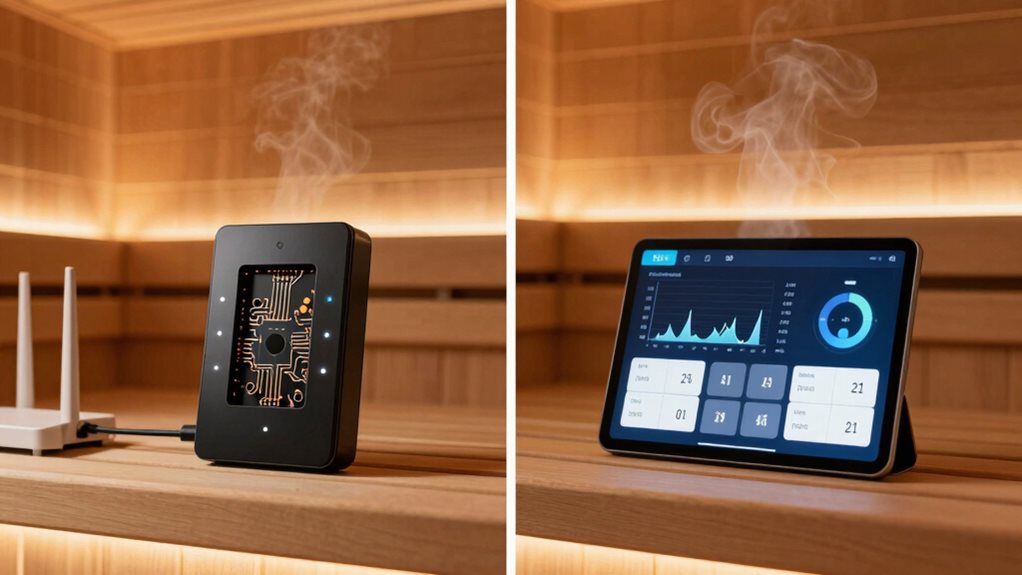
When selecting control systems for your sauna, connectivity options can make or break your experience, especially if you’re planning to manage settings remotely. Most commercial sauna apps require a stable 2.4GHz Wi-Fi network, with controllers from brands like UKU, Huum, and Tulikivi connecting wirelessly to your home network.
For greater reliability, consider Z-Wave switches or wired solutions like the iSocket Smart Relay, which offers six output relays for connecting to contactors. These options work well when Wi-Fi signals are inconsistent, particularly in outdoor installations where router placement becomes challenging.
Remember that smart systems require proper electrical setups – including dedicated 220-240V circuits with appropriate amperage breakers.
Safety features like disconnect switches are mandatory when implementing remote control capabilities, guaranteeing your smart sauna remains both convenient and code-compliant.
Cost Analysis and Long-Term Value
Understanding the true cost of your sauna goes far beyond the initial price tag, especially when comparing smart relay systems to commercial sauna apps.
While high-end smart saunas might cost $4,000-$10,000 upfront, they can save you money in the long run.
Smart technology in your sauna isn’t just luxury—it’s an investment that pays dividends through years of efficient operation.
Smart controllers like the Finlandia XENIO start at $1,266, but their energy efficiency features offset electricity costs over time.
Far infrared models use just $11-$27 monthly compared to traditional steam saunas at $25-$60 per month.
The maintenance equation also favors smart systems.
Traditional saunas require $1,500-$3,200 in replacements over ten years, while far infrared options need virtually no replacement parts.
Smart controllers with scheduled maintenance features help you extend your sauna’s lifespan, ultimately providing better value despite higher initial costs.
Frequently Asked Questions
Can Smart Relays Integrate With Existing Voice Assistants?
Yes, you’ll find smart relays integrate with voice assistants like Google Assistant, Amazon Alexa, and Apple Siri through compatible hubs or direct connections, depending on the relay brand.
What Happens to Sauna Controls During Internet Outages?
During internet outages, you’ll still have full local control via your sauna’s physical panel. Xenio and EOS systems maintain basic functions, preserve settings, and allow manual temperature adjustments without WiFi connectivity.
How Difficult Is DIY Installation for Non-Electricians?
You’ll find smart relay DIY installation manageable if you’re comfortable with basic wiring. Commercial app installation is more complex, requiring careful sensor placement and cable routing through structural elements.
Are There Subscription Fees for App-Based Sauna Control Systems?
Yes, most app-based sauna control systems charge subscription fees, typically $75-750 monthly depending on features. You’ll pay for software access, booking capabilities, and payment processing services.
Can Multiple Users Access Controls With Different Permission Levels?
Yes, many systems offer multi-user access with different permission levels. You’ll get administrator privileges while other users can have limited control capabilities depending on the specific app’s design.
Final Thoughts
You’ve seen how smart relays and commercial sauna apps differ in notable ways. Whether you choose a DIY relay setup or a polished app depends on your needs, budget, and technical skills. Smart relays offer more customization and cost savings, while commercial apps provide convenience and user-friendly interfaces. Consider your priorities carefully, and you’ll find the right control solution to enjoy your sauna experience with confidence.