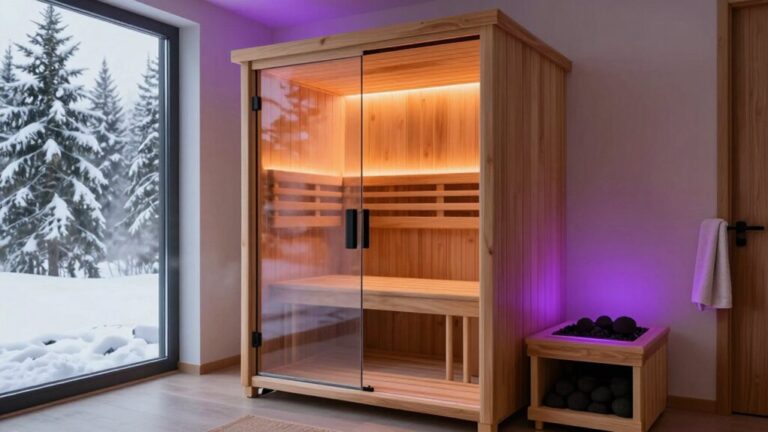
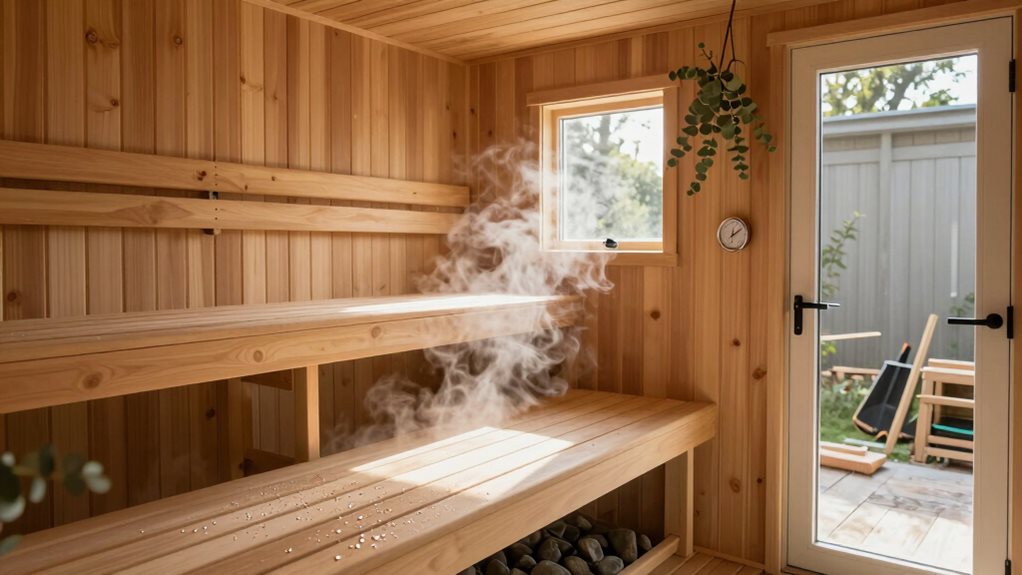

Adding a sauna to your home creates a personal wellness sanctuary that boosts heart health, lowers blood pressure, and reduces stress. You’ll choose between traditional saunas (150-185°F) or infrared models (120-140°F), with costs ranging from $3,000 to $34,000 depending on type and installation. Indoor options work well in basements or bathrooms, while outdoor installations offer placement flexibility. Your investment typically recoups 50-80% while delivering daily health benefits for years to come.
Health Benefits of Regular Sauna Use

Heat therapy has transformed from ancient ritual to modern wellness practice, with saunas offering notable health benefits backed by scientific research.
Your cardiovascular system benefits enormously from regular sessions, with studies showing that 4-7 weekly visits can considerably lower your risk of heart problems and stroke. You’ll experience immediate effects similar to moderate exercise: increased heart rate and improved blood vessel function.
Adding sauna sessions to your exercise routine can boost your fitness results and lower blood pressure more effectively than working out alone. Just 15 minutes post-exercise, three times weekly, makes a measurable difference. Studies suggest frequent sauna use is associated with a 47% decreased likelihood of developing hypertension.
Your body also responds to the heat by releasing beneficial hormones and proteins that may reduce inflammation and improve glucose control. Regular sauna bathing can help reduce your total cholesterol, with a 10% reduction potentially decreasing heart disease risk by 30%. For maximum benefits, aim for multiple sessions per week.
Indoor vs. Outdoor Sauna Installation Options
When deciding between indoor and outdoor sauna placement, you’ll need to weigh how the space integrates with your existing home layout against the foundation and weatherproofing requirements of an exterior installation.
Your indoor options might include basement corners or bathroom additions that require vapor barriers and ventilation adjustments, while outdoor installations offer more placement flexibility but demand proper foundations and utility connections.
The cost differences can be substantial, with indoor saunas typically requiring less ongoing maintenance but potentially more upfront renovation work, whereas outdoor units might cost more initially but give you freedom from home modification concerns.
Space and Integration Factors
Deciding between indoor and outdoor sauna placement represents one of your most vital early choices in the renovation process. Your available space dimensions must accommodate not only the sauna itself, but also clearances for safe bench spacing and door swing.
When evaluating your options, consider these critical integration factors:
- Foundation requirements – Indoor saunas typically use existing floors (possibly with reinforcement), while outdoor installations need dedicated concrete slabs, gravel pads, or piers to prevent settling.
- Utility connections – Indoor placement simplifies electrical hookup, while outdoor locations beyond 50 feet from your panel increase trenching and conduit costs.
- Moisture management – Indoor saunas need vapor barriers and proper ventilation to protect your home’s structure, whereas outdoor units primarily require weatherproofing and drainage solutions.
Cost-Benefit Analysis Comparison
Understanding the true cost implications of your sauna project requires a detailed comparison between indoor and outdoor options.
While indoor saunas typically cost $3,000-$9,000 compared to outdoor’s $3,000-$6,000, they often demand additional ventilation systems ($250-$4,000) and higher labor costs (30-50% of total).
You’ll find monthly operating expenses surprisingly similar, with infrared models running about $14.40 monthly and traditional electric units around $27. The wood-burning outdoor option costs more at $40-$50 monthly when used twice weekly.
Though outdoor installations generally save you about $3,000 upfront, indoor saunas offer better energy efficiency and home value improvement.
Your choice ultimately depends on whether you prioritize initial savings (outdoor) or long-term integration and efficiency benefits (indoor).
Types of Saunas and Their Unique Features
The world of saunas offers a diverse range of options, each with distinctive features designed to meet specific wellness preferences.
Explore the sauna spectrum—where diverse heating methods and designs converge to elevate your personal wellness journey.
Traditional saunas heat the air to temperatures between 150-185°F, sometimes reaching 230°F, creating an intense, social experience in larger spaces like the Almost Heaven Morgan barrel design.
Infrared saunas, developed in the 1960s, directly warm your body at lower temperatures (120-140°F) using light technology rather than heating the air.
When choosing your perfect sauna, consider these key differences:
- Heat intensity – traditional saunas operate at higher temperatures than infrared
- Space requirements – traditional models accommodate multiple people while infrared units are typically more compact
- Moisture options – traditional saunas can be either wet (steam) or dry, while infrared provides only dry heat
Budgeting for Your Home Sauna Project
Transforming your home with a sauna requires thoughtful financial planning, from initial purchase and installation costs to long-term operating expenses.
You’ll need to budget between $3,000 and $11,000 for a mid-range option or potentially $11,000 to $34,000+ for a high-end custom build, while also accounting for monthly electricity costs ranging from $14 to $50 depending on your chosen type.
Smart shoppers can reduce costs through strategic choices like self-installation when appropriate or selecting more affordable wood species that still deliver the therapeutic benefits you’re seeking.
Initial Cost Planning
Budgeting wisely for your home sauna project starts with understanding the substantial cost variations based on type, size, and installation approach.
You’ll want to account for both materials and labor, which typically represents 30-50% of your total investment. A basic two-person infrared model might cost as little as $2,500, while luxury outdoor units can reach $60,000.
To create a realistic budget, consider these key factors:
- Size requirements – a standard two-person sauna (16 sq ft) costs $800-$3,200, while a four-person unit (40 sq ft) ranges from $2,000-$8,000.
- Installation method – DIY kits ($1,500-$5,000) can save up to 50% on labor costs compared to professional installation ($300-$2,500).
- Type selection – prefab models ($2,300-$14,500) versus custom designs ($4,300-$34,000+).
Ongoing Expense Management
While your initial investment sets the foundation for your home sauna project, ongoing expenses will determine its true cost over time.
You’ll need to budget for annual maintenance, which typically runs $150-$350 depending on your sauna type, with infrared models on the lower end and hybrids costing more.
Your energy costs will vary considerably by sauna type. Traditional models average $15-$30 monthly, while eco-friendly infrared saunas cost just $3-$5 per month to operate.
Each session adds about $1 to your electricity bill, making regular use surprisingly affordable.
Don’t forget professional service fees when needed. Basic inspections run $75-$200, while specialized services like mold remediation can cost $150-$400.
Your location matters too—urban areas typically command higher rates for professional maintenance services.
Smart Financing Options
When you’re ready to bring your sauna dreams to life, finding the right financing approach can make all the difference between a stressful splurge and a well-planned wellness investment.
With home saunas typically costing between $2,500 and $10,000, it’s worth exploring your options carefully.
Consider these financing paths based on your situation:
- Personal loans – Quick approval for $3,000-$50,000 with 2-7 year terms, but higher interest rates since they’re unsecured.
- Home equity loans/HELOCs – Lower interest rates because they’re secured by your property, with flexible draw periods of 5-10 years.
- Cash-out refinance – Rolls sauna costs into your mortgage at mortgage rates, but extends your loan term and increases principal.
Remember to budget 10-20% extra for unexpected expenses that almost always crop up during installation!
Space Requirements and Optimal Placement
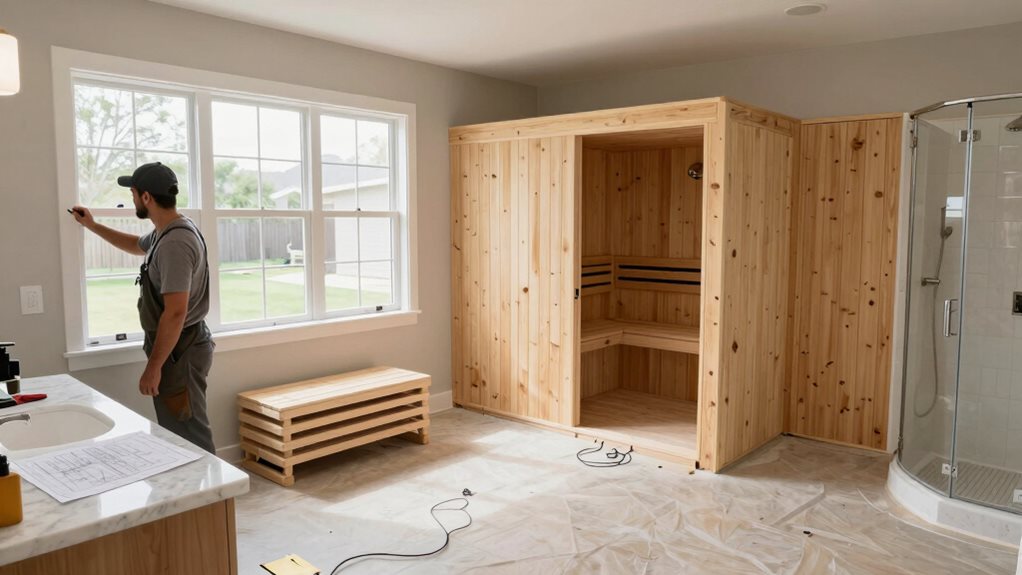
Before adding a sauna to your home, understanding the spatial dimensions needed for your wellness retreat is crucial. For a one-person sauna, you’ll need at least a 4×4 foot floor space, while a family-sized unit requires 7×8 feet or larger.
Don’t forget the ceiling height—aim for at least 77 inches, though 7 feet is ideal for comfortable air circulation.
Remember to plan for proper clearance: 6 inches on the sides and back for ventilation, and 32-36 inches in front for door swing.
Square shapes distribute heat more evenly than rectangles, so consider this when choosing your location. Infrared sauna blankets provide a space-saving alternative for those with extremely limited room.
Whether you’re converting a bathroom corner or building outdoors, measure carefully and allow 4-6 square feet per person for a relaxing, safe experience.
Popular installation locations include bathrooms with their existing ventilation systems, spare bedrooms, basements, large closets, and properly insulated garages.
Energy Efficiency and Operating Costs
Understanding the energy consumption and costs of your sauna is essential if you’re planning to enjoy it regularly without shocking electricity bills.
Different sauna types have vastly different energy needs – infrared saunas typically use about one-third the electricity of traditional electric models, costing around $14.40 monthly compared to $27.00 for daily use.
Your operating costs will depend on three key factors:
- Sauna type – infrared uses 1.5-2.5 kW while traditional electric saunas need 6+ kW
- Insulation quality – well-insulated saunas can be 30% more efficient
- Usage patterns – smart scheduling and back-to-back sessions can save hundreds of kWh annually
With proper design and usage habits, you’ll enjoy your wellness retreat without the financial stress.
Programmable timers and right-sized heaters matched to your sauna’s volume will maximize efficiency.
In Arizona, where electricity rates average 16 cents per kilowatt-hour, sauna operating costs can be significantly higher than the national average.
Most heaters operate at full power initially and then reduce to about 50% of their capacity to maintain temperature, resulting in lower actual consumption than the rated wattage suggests.
Selecting Materials for Durability and Aesthetics
Selecting the right materials for your sauna goes beyond simple aesthetics—it’s crucial for creating a durable, safe, and enjoyable wellness space that’ll last for years.
Cedar and hemlock are top choices, offering excellent moisture resistance and pleasant aromas that improve your experience. Softwoods like cedar are ideal for saunas as they can withstand high temperatures without warping. If you’re budget-conscious, pine provides good insulation, though it’s less resistant to moisture.
Don’t overlook proper insulation—aim for R12 in walls and R16 in ceilings with fiberglass batts and a foil-faced vapor barrier.
For windows and doors, tempered glass is non-negotiable, while stainless steel fasteners prevent rust in the humid environment.
Finish your sauna with preservative oil or wax applied twice yearly to protect surfaces.
For added character, consider thermally modified wood, which offers a beautiful golden-brown color and superior resistance to moisture.
Traditional Nordic White Spruce is another excellent option that provides authentic sauna experience while maintaining durability in high-heat environments.
Return on Investment for Home Saunas
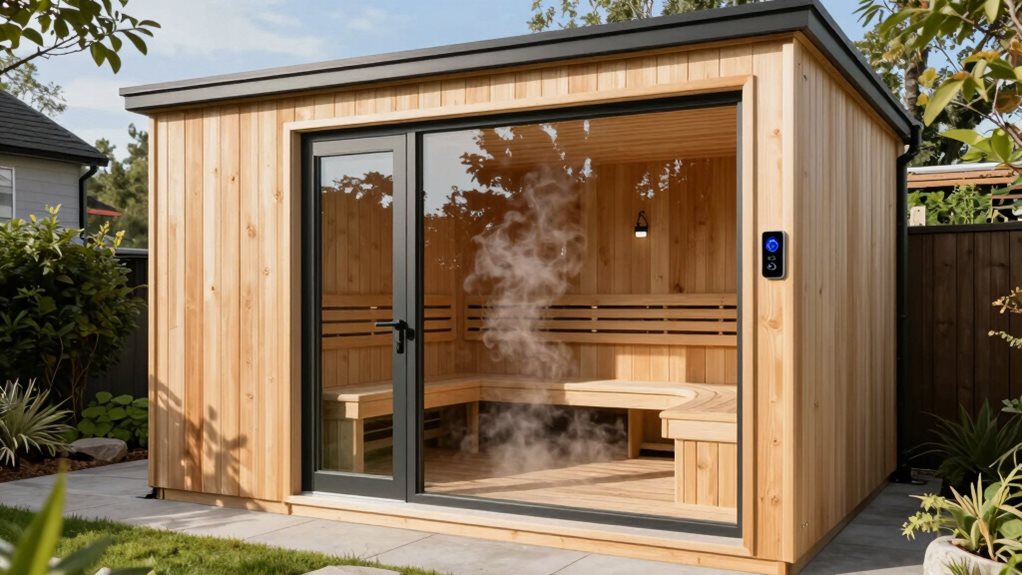
While quality materials create a beautiful sauna experience, smart homeowners also consider the financial benefits of this wellness upgrade. Your sauna investment can pay off in multiple ways, with home value increases typically recouping 50-80% of installation costs.
This wellness feature appeals to 42% of potential homebuyers, especially those seeking luxury spa-like amenities.
For short-term rental properties, the return can be even more impressive:
- Premium pricing – properties command $40-50 higher nightly rates
- Faster payback – many owners recoup costs in 12-24 months
- Notable ROI – some investment-grade suburban properties achieve up to 301% ROI within 7 months
Operating costs remain reasonable, with infrared saunas costing less to run than traditional models, while annual maintenance averages under $160.
Frequently Asked Questions
How Long Does a Typical Sauna Installation Take?
You’ll need 1-2 days for prefab sauna kits, just a few hours for infrared models, or 3-7 days for custom-built options. Electrical work and site prep may extend your timeline.
Can Saunas Be Installed on Upper Floors of Multi-Level Homes?
Yes, you can install saunas on upper floors, but you’ll need structural assessment first. Consider weight distribution, moisture barriers, proper ventilation, and reinforced flooring to prevent damage and safety issues.
What Permits Are Required for Adding a Sauna?
You’ll typically need building permits for outdoor saunas over 120 sq. ft. and electrical permits for 240V installations. Indoor prefab saunas under 120 sq. ft. are often exempt from building permits.
How Often Should Sauna Wood and Components Be Replaced?
You’ll need to replace sauna stones annually, inspect wood components yearly, and plan for major refurbishment every 5-10 years. Maintain your sauna quarterly to extend component life.
Are There Financing Options Specifically for Wellness Home Improvements?
Yes, you’ll find specialized financing through home equity options, personal loans, manufacturer programs, and even government grants for wellness improvements like saunas, especially when they improve energy efficiency.
Final Thoughts
You’ve seen how a home sauna can transform your wellness routine, space, and property value. Whether you choose an indoor infrared model or traditional outdoor Finnish sauna, careful planning guarantees you’ll create a retreat that fits your budget and lifestyle. By weighing installation costs against long-term benefits, you’re now ready to make an informed decision. Your path to relaxation, better health, and increased home value starts with this rewarding investment.