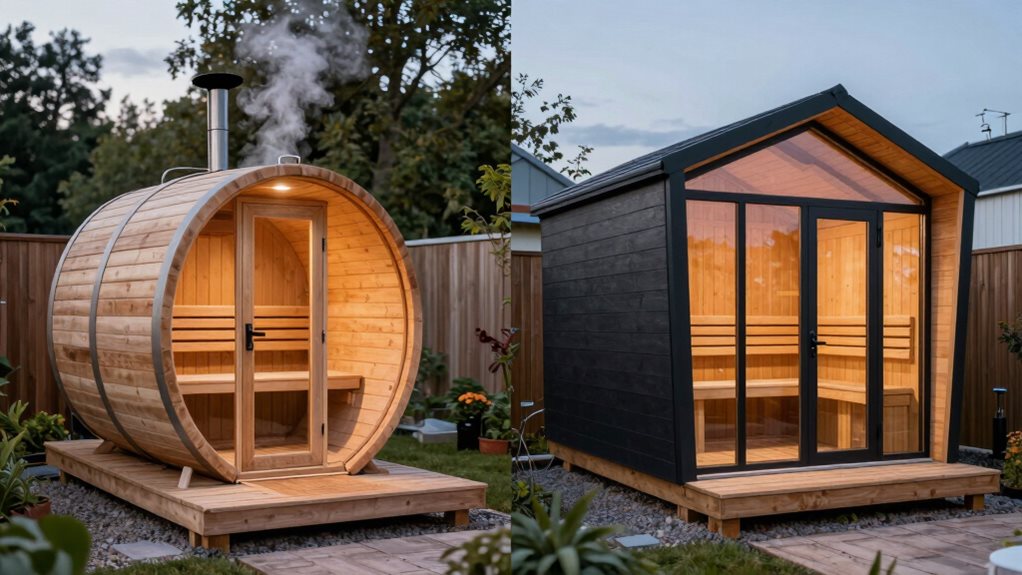

Barrel saunas offer better heating efficiency, heating up 23% faster with lower operating costs ($0.70-$1.50/hour) compared to square designs. You’ll enjoy simpler installation with barrel models, often completed in 1-2 days without extensive permits. Square saunas provide more customization, consistent headroom, and flexible seating arrangements, while barrel designs excel in weather resistance with natural water-shedding properties. Your choice depends on whether you prioritize rustic charm and efficiency or modern aesthetics and spaciousness. Each option presents unique advantages beyond their distinctive shapes.
The Science Behind Barrel Sauna Heating Efficiency
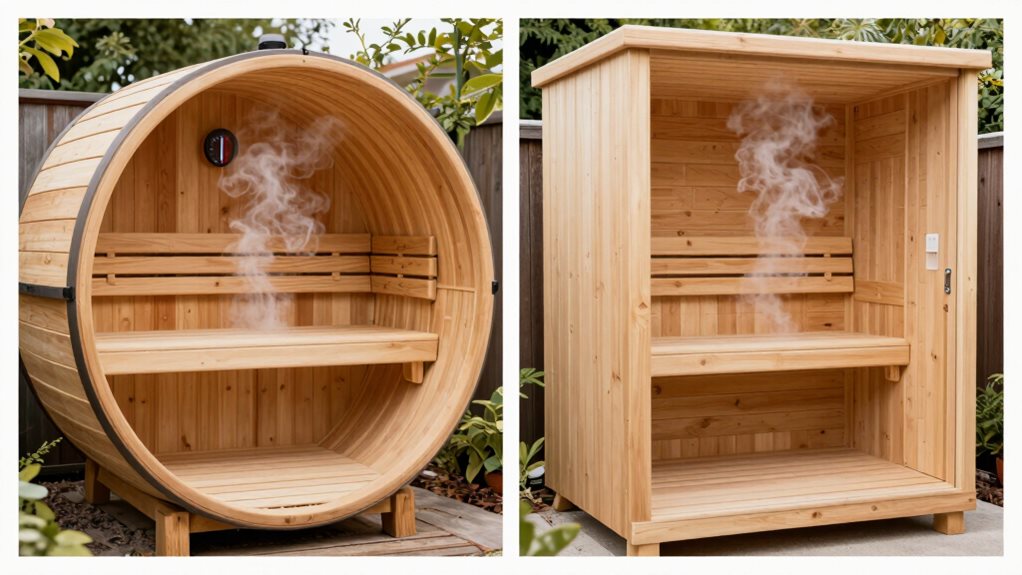
While many sauna shoppers focus on aesthetics and size, the barrel shape actually offers remarkable heating efficiency that’s grounded in basic physics.
The cylindrical design reduces interior space by 23% compared to square saunas, requiring less air to heat and using energy more effectively.
When your barrel sauna heats up, the curved walls create a natural convection cycle. Hot air rises to the top, then rolls along the curved ceiling and walls, pushing cooler air upward from the bottom.
This self-sustaining circulation eliminates cold spots that typically form in corners of traditional box saunas. The result? Your barrel sauna heats up 23% faster, often reaching ideal temperatures in under 30 minutes compared to the longer warm-up times of square models.
You’ll enjoy consistent heat throughout the space while saving on energy costs.
Space Optimization in Square vs. Barrel Designs
When you’re considering a sauna for your home, headroom becomes an essential factor in your comfort level, especially if you’re taller than average.
Your bench placement options differ greatly between designs, with square saunas offering more flexible arrangements for sitting or reclining compared to barrel models’ curved constraints.
You’ll need to weigh these space tradeoffs carefully, as barrel saunas sacrifice some vertical clearance and seating flexibility in exchange for their distinctive aesthetic appeal.
Maximizing Limited Headroom
Despite their compact exteriors, barrel and square saunas present dramatically different headroom experiences that impact your comfort and mobility.
In barrel saunas, you’ll find 6-7 feet of headroom at the center, but this quickly drops to 4-5 feet as you move toward the curved sides. Taller users often need to hunch when moving away from the centerline, limiting full-body stretching.
Square saunas offer a more consistent experience with 6-7 feet of clearance throughout the entire space.
You won’t have to worry about where you’re standing or sitting to avoid bumping your head. This flat-ceiling design reduces claustrophobia risk and supports multi-level benches with adequate overhead space for everyone.
If you’re planning for flexibility of movement and comfort for users of varying heights, this consistent headroom becomes a notable advantage.
Bench Placement Tradeoffs
The fundamental difference between square and barrel saunas becomes immediately apparent when considering bench placement options.
Square designs favor L-shaped configurations that maximize both seating and reclining options, while barrel saunas utilize curved walls for wrap-around seating that eliminates wasted corner space.
When planning your sauna benches, consider these key differences:
- Square saunas require two-tier benches (upper at 40-45 inches, lower at 18-24 inches) to improve heat zones, while barrels often limit to two tiers due to curved walls. Square designs should ideally maintain an 18-inch gap between upper and lower benches for comfortable seating and optimal heat stratification.
- You’ll need at least 2000mm of straight bench length for comfortable reclining in square designs, whereas barrels offer continuous curved seating.
- Barrel designs naturally promote air circulation along curves, while square designs need strategic placement to avoid cold spots in corners. The standard 7 to 8 feet ceiling height in square designs helps maintain proper heat distribution, preventing the uncomfortable sensation of hot heads and cold feet.
Installation Requirements and Timeline Considerations
When you’re ready to install your sauna, you’ll need to prepare different foundations depending on whether you’ve chosen a barrel or custom design.
Barrel saunas offer flexibility with simple foundation options like compacted gravel or pavers, while custom saunas typically require concrete foundations and must comply with local building codes.
You’ll notice a notable difference in timeline too—barrel saunas can be assembled by two people in just 1-2 days, whereas custom sauna installations might stretch over weeks or even months due to their complex framing and permit requirements.
Foundation and Site Preparation
Proper foundation and site preparation represent four critical elements that will determine your sauna’s longevity, structural integrity, and overall performance.
Whether you’re installing a barrel or custom sauna, you’ll need a completely level surface that can support up to 1,400 pounds while managing moisture effectively.
Your foundation options include:
- Concrete pads (at least 4 inches thick) – offering maximum stability for permanent installations
- Compacted gravel bases (4-6 inches deep) – providing excellent drainage and working particularly well for barrel saunas
- Reinforced wood decks – guaranteeing aesthetic appeal while requiring additional structural support
Don’t underestimate the importance of proper drainage!
Water pooling around your sauna will lead to rot and mold over time.
Remember to extend your foundation at least 2 feet beyond your sauna’s footprint to facilitate equipment access and guarantee proper water runoff.
Selecting an ideal location with good sunlight exposure helps create a more comfortable and enjoyable sauna experience.
Electrical and Ventilation Setup
Setting up electrical and ventilation systems for your sauna involves crucial safety considerations that directly impact both installation timeline and long-term performance.
You’ll need to match power requirements to your sauna type, with barrel saunas typically requiring 220-240V circuits while smaller infrared models might work with standard 120V outlets.
Your breaker needs vary greatly based on sauna size—smaller units need 15-20 amp circuits, while larger traditional saunas demand 40-60 amp dedicated circuits.
You’ll absolutely need a licensed electrician for this work, especially for outdoor installations requiring weather-rated conduit and proper trenching.
Don’t overlook ventilation planning alongside electrical work. Proper air circulation around your heater isn’t just about comfort—it’s vital for safety and efficient operation, with components needing high-temperature rated materials throughout.
Assembly Time Differences
The substantial difference in assembly time between barrel and custom saunas might surprise you when planning your wellness investment.
Barrel saunas offer remarkable efficiency, typically requiring just 6-8 hours with two people over a single weekend. Their pre-cut staves eliminate complex framing work, making them accessible even if you’re not a carpentry expert. These prefabricated kits are designed for straightforward installation without requiring a foundation. Pre-reading instructions and organizing materials can reduce assembly time significantly while ensuring proper construction.
Custom saunas, however, demand considerably more time and coordination:
- Requires 7-8 weeks when integrated with home renovations
- Involves multiple phases including 2-week rough-in and 2-week systems integration
- Necessitates professional oversight for electrical and HVAC inspections
Weather Resistance and Long-Term Maintenance
Weather resistance and ongoing maintenance represent critical factors when choosing between barrel and custom saunas for your outdoor wellness space.
Barrel saunas offer natural advantages with their curved walls that shed water and snow, preventing damaging poolation. Their cylindrical shape also handles wind efficiently, while steel bands maintain structural integrity during exposure to the elements. The high-quality wood construction of barrel saunas contributes significantly to their overall durability in various weather conditions.
Custom saunas require more protection against outdoor conditions. Their flat surfaces accumulate snow unless you invest in improved roofing, and they typically need concrete foundations in snowy regions, adding $800-$2,000 to your costs.
Both sauna types can last 15-25 years with proper care, though maintenance needs differ. You’ll spend $200-400 annually on a barrel sauna for band tightening and wood treatments, while custom saunas demand regular staining and foundation checks.
Design Flexibility and Aesthetic Integration
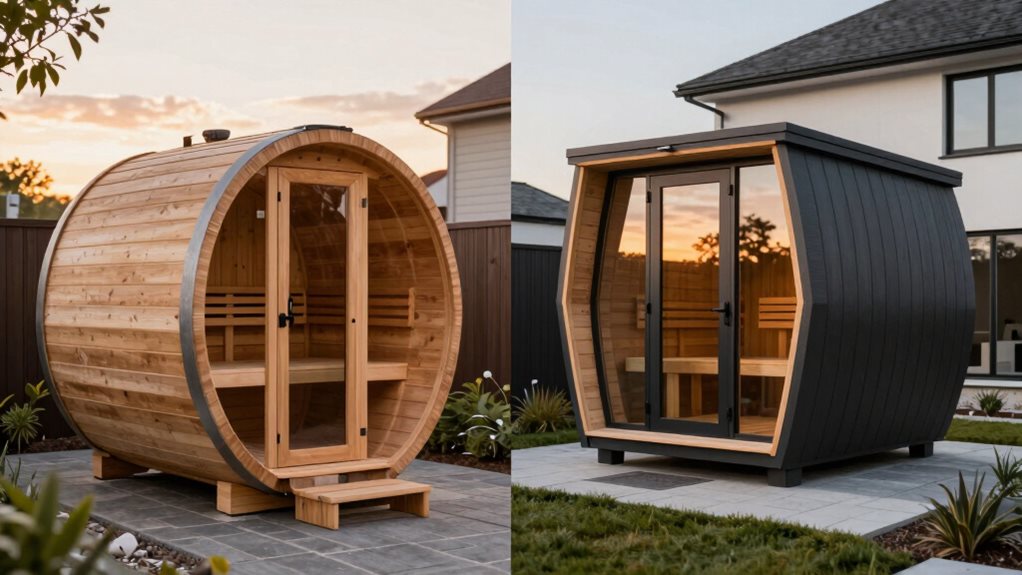
Design flexibility sets barrel and custom saunas apart in dramatic ways that extend beyond weatherproofing concerns.
When choosing between these styles, you’ll find that square saunas offer greater customization options for your home, while barrel designs deliver that eye-catching rustic appeal.
Consider these key differences:
- Interior space – Barrel saunas have fixed curved walls limiting layout changes, while square designs support multi-level benches and varied seating arrangements.
- Integration options – Square structures blend seamlessly with indoor spaces and modern architecture, while barrel saunas become charming focal points in outdoor settings.
- Personalization potential – Custom square saunas accommodate windows, sound systems, and flexible heater placement, whereas barrel designs maintain their distinctive wine-barrel aesthetic with fewer modification options.
Your choice ultimately depends on whether you prioritize distinctive outdoor charm or versatile indoor functionality.
Energy Consumption and Operating Costs
When comparing energy costs between sauna styles, barrel-shaped models consistently outshine their square counterparts in efficiency metrics that directly impact your wallet.
The curved design creates natural heat circulation that eliminates cold spots and hot corners, meaning you’ll enjoy a more comfortable experience while using less energy.
Your barrel sauna will heat up faster too, reaching ideal temperatures in less time than traditional square designs. This translates to shorter waiting periods and lower electricity bills, with typical operating costs between $0.70-$1.50 per hour for electric models.
Though custom saunas require a higher initial investment ($5,000-$15,000), barrel options offer quicker installation and better long-term savings due to their superior heat retention and energy efficiency, making them an economical choice for regular sauna enthusiasts. Many homeowners appreciate that barrel saunas can be completed as a DIY weekend project, similar to prefab installations that typically take only 4-8 hours to assemble.
Comfort Features and Seating Arrangements
Comfort considerations play a crucial role when deciding between barrel and custom saunas, affecting your overall relaxation experience.
Barrel saunas offer ergonomically contoured seating with naturally arched backrests, but they limit headroom and accommodate just 2-6 people in fixed arrangements.
While barrel saunas feature ergonomic curved seating, their restricted headroom and fixed layouts limit comfort for groups larger than 2-6 people.
Custom square saunas provide markedly more flexibility and space for your comfort:
- You’ll enjoy full standing height throughout the entire sauna, letting you move freely without stooping.
- Multiple bench arrangements at varying heights can be customized to fit your body type and preferences.
- The spacious design allows for comfortable recumbent positions, making longer relaxation sessions more enjoyable.
Your comfort during sauna sessions directly impacts how frequently you’ll use it, making these considerations worth careful thought before purchasing.
Building Code Compliance and Structural Considerations
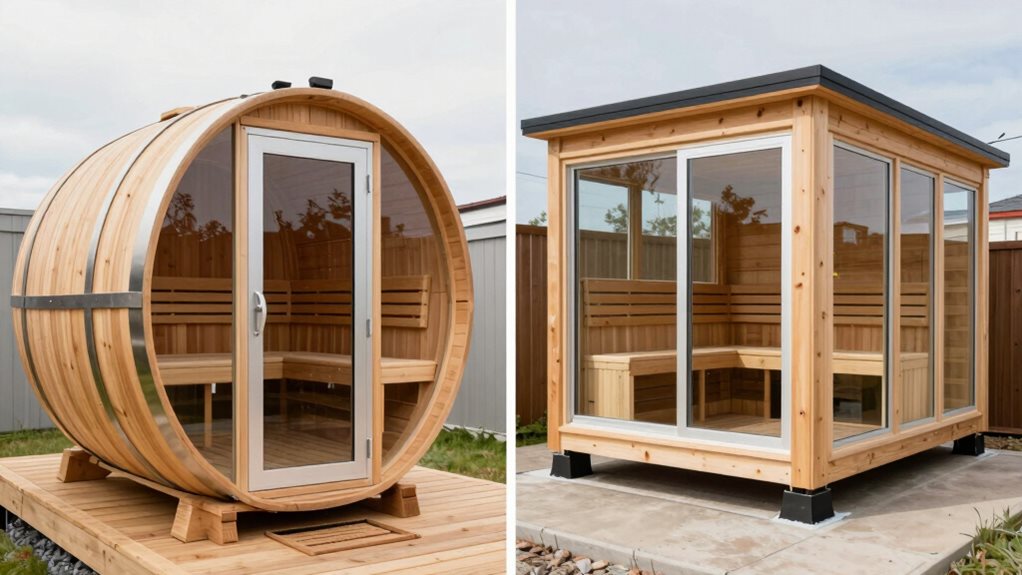
Maneuvering building codes and structural requirements presents a considerable difference between barrel and custom saunas that you’ll need to take into account before making your purchase decision.
Barrel saunas often fall under the 120 sq. ft. exemption threshold, meaning you might avoid structural permits altogether. Their standardized design typically comes pre-approved for electrical compliance. An inspection from local authorities might still be required during or after installation to ensure all safety standards are met.
Custom saunas, meanwhile, require more extensive permitting, especially when built indoors where modifications to your home’s structure are necessary. You’ll need to submit detailed plans showing electrical circuits, ventilation, and fire-resistant materials. Both designs must incorporate wheelchair turning space if intended for commercial settings to ensure proper accessibility for all users.
Both types must comply with accessibility standards if they’re for commercial use, including 32″ doorways that open outward.
Remember that outdoor installations of either style may require zoning approval, particularly if you’re placing them near property lines or easements.
Frequently Asked Questions
Can Barrel Saunas Be Partially Buried for Better Insulation?
No, you shouldn’t partially bury a barrel sauna. This traps moisture, warps the structure, and compromises the wood’s ability to breathe. It’s better to use proper ventilation and raised placement.
How Do Electrical Requirements Differ Between Sauna Types?
Your electrical needs vary dramatically between sauna types. Traditional electric models require 240V/30-60A dedicated circuits, while infrareds use standard 120V/15-20A outlets. Hybrids need both systems, and wood-fired saunas need minimal electricity.
Are Financing Options Available for Higher-End Custom Saunas?
Yes, you’ll find financing for high-end custom saunas through manufacturer partnerships with Hearth, Bread, or Affirm, offering 0% APR options and payment terms up to 36 months.
What Accessories Work With Both Barrel and Custom Saunas?
You’ll find heater systems, thermometers, hygrometers, water buckets, LED lighting, backrests, towel hooks, floor kits, crucial oils, salt panels, and sauna rocks compatible with both barrel and custom saunas.
Can Existing Hot Tub Spaces Be Converted Into Saunas?
Yes, you can convert existing hot tub spaces into saunas with proper structural assessment, foundation preparation, electrical rewiring, and vapor barrier installation to manage the different moisture conditions.
Final Thoughts
Whether you choose a barrel sauna or custom design, you’ll need to balance your budget, available space, and aesthetic preferences. Barrel models offer excellent heat efficiency and faster installation, while custom structures provide more design flexibility and potentially better space utilization. Consider your climate, maintenance capabilities, and local building codes before making your decision. Both options can provide years of relaxation and health benefits when properly selected and maintained.