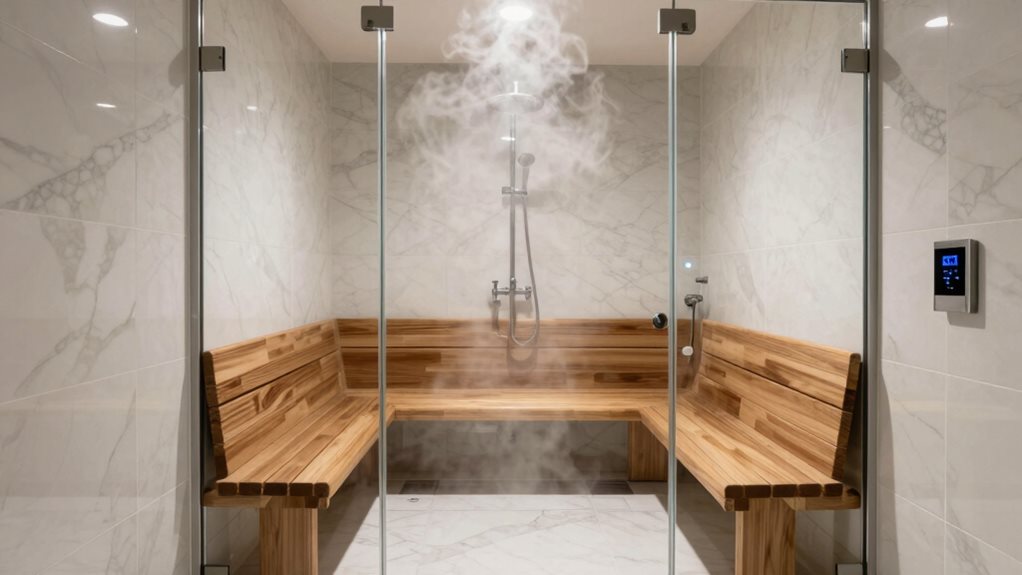

You’ll typically spend $3,000 to $10,000 to add a steam room to your house, with most homeowners paying around $4,300. Prefabricated units run $2,900 to $6,800 installed, while custom options range from $4,000 to $16,500. Your total cost depends on whether you convert an existing shower ($2,300-$11,700) or build from scratch. Location matters too—West Coast installations cost considerably more than Southern projects. The right material choices can dramatically impact both initial expenses and long-term value.
Average Steam Room Installation Costs Explained
Four key price points define the steam room market for homeowners considering this luxury addition. The national average falls between $3,000 and $10,000, with most homeowners paying around $4,300.
Homeowners seeking steam room luxury can expect to pay around $4,300, with most projects falling between $3,000 and $10,000.
You’ll find prefabricated units at the lower end, ranging from $2,900 to $6,800 installed. If you’re dreaming of a custom steam shower, expect to invest between $4,000 and $16,500.
Converting your existing shower is another option, costing between $2,300 and $11,700 depending on your bathroom’s current setup. Installing a steam generator in your existing shower stall is typically more cost-effective than building an entirely new enclosure.
Remember that labor typically accounts for 25% to 35% of your total cost, and you’ll need multiple professionals—plumbers, electricians, and possibly tile installers. Many homeowners should also factor in permit fees which may apply based on local building regulations.
Local labor rates, material choices (porous vs. non-porous), and additional features like stone surfaces will all influence your final price tag.
Prefab vs. Custom Steam Room: Price Comparison
When choosing between prefab and custom steam rooms, your budget plays a major role in the decision-making process.
Prefabricated units offer a more affordable entry point, typically ranging from $1,500 to $6,000 for the base unit, with total installation costs between $3,000 and $8,000 after adding site prep, electrical work, and professional setup. The overall cost can vary significantly based on location factors, as urban areas typically have higher labor and material costs. These options generally provide faster setup, allowing installation within a day or two compared to custom builds.
Custom steam rooms, while pricier, provide bespoke solutions that perfectly fit your space and preferences.
You’ll invest between $6,000 and $15,000 for a standard custom build, with luxury versions exceeding $15,000. This higher price reflects the personalized materials ($2,000-$12,000), specialized labor ($1,500-$7,000), and premium generators ($1,500-$5,000).
While custom builds cost more upfront, they often add greater home value, potentially offsetting your long-term investment.
Steam Generator Costs and Sizing Guide
Your steam generator’s size directly impacts its price, with more powerful units costing considerably more to accommodate larger shower spaces.
You’ll need to take into account your shower room’s dimensions, wall materials, and features when selecting a generator, as factors like glass walls or marble surfaces require up to twice the capacity.
Most homeowners can expect to spend between $950 and $5,000 for a quality steam generator, with specialized models like the Mr. Steam MS225E (perfect for rooms up to 161 cubic feet) priced around $3,125.
Using non-porous materials like ceramic or porcelain for your walls won’t add to the cubic feet calculation, unlike natural stone options.
Installing a steam generator is best handled by experienced professionals to ensure safety and optimal performance.
Generator Sizing Factors
Selecting the right steam generator for your home spa involves several crucial calculations that determine your exact power needs.
Start by measuring your steam room’s dimensions and multiply length × width × height to find the cubic footage. For a 5′ × 6′ × 8′ room, you’d have 240 cubic feet.
Next, adjust for materials. Ceramic tile requires 1.35× more power, while natural stone needs 2× more power.
Then, factor in exterior walls—one wall needs 1.1× more power, two walls need 1.2×. Don’t forget ceiling height adjustments for ceilings taller than 8 feet.
After applying all multipliers, match your adjusted cubic footage to the appropriate generator: 7.5kW (101-250 cubic feet), 10kW (251-450), 12kW (451-550), or 15kW (551-675). Choosing the wrong size can lead to disappointing performance, with insufficient steam delivery in underpowered units or wasted energy in oversized ones.
Windows and skylights may require you to select the next largest generator size to compensate for additional heat loss.
Always round up for peak performance.
Price vs. Power Output
As you explore steam room options for your home, understanding the relationship between power and price becomes crucial for budgeting effectively.
Generally, higher power output correlates directly with higher costs, as these units can heat larger spaces more efficiently.
Budget-conscious shoppers can find low-power options (4-7.5kW) ranging from $350 for a basic CGOLDENWALL to around $3,125 for a quality Mr. Steam unit.
Mid-range generators (9-12kW) typically cost between $1,719 and $3,483, suitable for average-sized steam rooms. The popular Mr. Steam Ms Itempo Square Steam Generator Package offers 9kW power with Square iTempo Control included in its $4,760 price point.
If you’re outfitting a larger space, high-power models (24kW+) will run $3,236 to $7,294.
Remember that investing in a properly sized generator pays off long-term.
While you might save upfront with a smaller unit, an underpowered generator working overtime can lead to higher maintenance costs down the road.
For optimal performance, consider that most small generators are suitable for shower spaces up to 85 cubic feet, which accommodates typical home installations.
Labor Expenses Breakdown for Professional Installation
When you’re planning your steam room, you’ll need to budget for labor costs that typically range from $1,000 to $5,000, representing about 25-35% of your total project cost.
Your installation team will likely include multiple professionals—plumbers charging $45-$200 hourly, electricians at $50-$150 hourly, and possibly tile installers and carpenters for custom features.
Where you live greatly impacts these costs, with urban areas and regions with higher costs of living commanding premium rates for skilled trades compared to rural locations.
Contractor Rate Variables
The overall cost of your steam room installation depends heavily on contractor rates, which can vary dramatically based on several key factors.
Plumbers typically charge between $45 and $200 per hour, while electricians run $50 to $100 hourly. Your location greatly impacts these rates—a contractor in Des Moines, Iowa might charge around $30 per hour, while professionals in major cities command much higher fees.
Project complexity also drives costs. For a prefab steam shower, you’ll pay just $500-$780 in labor, compared to $3,000-$6,000 for a custom unit.
Tile installers charge $3-$15 per square foot, with rates increasing for intricate patterns or specialty materials.
Remember that contractors often include job supplies, setup, cleanup, and protection in their basic charges, plus a markup (around $450) for project management and coordination.
Installation Team Composition
Installing a steam room requires a team of skilled professionals, each handling specific aspects of your project.
You’ll need plumbers ($45-$200 hourly) to manage water supply and drainage connections, while electricians ($50-$100 hourly) handle the generator installation and control systems.
For extensive projects, you’ll likely work with tile specialists who manage waterproofing and tiling ($1,000-$5,000), plus general laborers for assembly, mounting, and cleanup.
If you’re hiring through a general contractor, expect them to add 13%-22% overhead for project supervision.
The combined plumbing and electrical labor typically costs $500-$2,000, while total installation labor ranges from $1,000-$5,000 for most steam rooms.
Remember that accessibility issues or upper-floor installations may increase labor time and costs due to the additional challenges they present.
Regional Cost Differences
Depending on where you live in the United States, your steam room installation costs will vary greatly due to regional factors affecting labor rates and building requirements.
In the West Coast, you’ll face the highest expenses ($10,000-$18,000) with plumbers charging $75-$200 hourly, especially in San Francisco and Los Angeles.
The Midwest offers more moderate pricing ($6,000-$12,000) with plumbers at $45-$200 per hour.
You’ll find the best deals in the South, where installations run $5,000-$11,000, with Houston averaging $4,825 and San Antonio just $3,239.
The Northeast sits between these extremes but spikes in urban centers like New York, where contractor oversight alone can reach $10,000.
Material Requirements and Associated Pricing
Several key material components will drive the cost of your home steam room, with each selection affecting both functionality and your overall budget.
Wall and floor surfaces represent notable investments, with ceramic and porcelain tiles running $5–$16 per square foot installed, while natural stone options will substantially increase your costs.
Durable tile materials form the foundation of your steam room, with premium options commanding significantly higher prices.
Don’t overlook critical infrastructure elements like waterproofing membranes and vapor barriers ($200–$2,000), which prevent moisture damage to your home.
Your door choice matters too—tempered glass doors typically cost $500–$2,000 installed.
For seating, built-in benches range from $200 for basic options to $2,000+ for custom stone finishes, with heated versions adding another $200–$1,200.
The steam generator itself will likely be your largest single expense, with residential units priced between $500–$3,500 depending on power and features.
Essential Electrical and Plumbing Considerations
When you’re planning your home steam room, proper electrical and plumbing setups aren’t just technical details—they’re critical safety requirements that will make or break your project.
Most steam generators need 240V or 208V power with a dedicated circuit breaker (typically 30-amp). You’ll need specific wiring: 10/2 wire for 4.5-6.0kW heaters, upgrading to 8/2 wire for 8.0kW units or installations over 30 feet from the breaker.
For plumbing, you’ll need a 3/8″ water line (brass or copper only) connected to your steam generator, a 1/2″ steam line to the room, and a 1/2″ drain line.
Never use PVC or PEX for these connections. Install threaded unions on all connections for future maintenance access, and reduce incoming water pressure to 15-25 PSI with a pressure reducing valve.
Space Requirements and Their Impact on Costs
Beyond the electrical and plumbing systems, the physical dimensions of your steam room directly influence both your comfort and your budget. The minimum functional space starts at 3×3 feet, but most residential installations range from 4×4 to 6×8 feet, depending on how many people you’ll accommodate.
Your space dimensions affect costs in three key ways:
- Larger rooms require more powerful (and expensive) steam generators.
- Ceiling height above 8 feet increases generator size by one level.
- Surface materials multiply volume calculations (natural stone by 1.5, acrylic by 0.6).
For most homeowners, a 4×5 foot steam room balances cost efficiency with comfort.
Remember that every cubic foot you add increases both material requirements and the generator size needed, so planning your dimensions carefully helps control your overall investment.
Luxury Features and Add-ons Worth the Investment
Transforming your home steam room from basic to extraordinary depends largely on the premium features you’ll incorporate into your design.
Heated floors deliver even warmth throughout your space, creating that spa-like comfort as you move around barefoot. Smart technology integration, like touchscreen controls and voice-activated features, lets you adjust temperature and steam levels without lifting a finger.
Experience the ultimate indulgence—warm floors beneath your feet, sophisticated controls at your command, all without breaking your relaxation state.
Consider investing in premium seating with multi-level bench configurations that give you choices for heat intensity.
For the ultimate experience, add entertainment options such as waterproof speakers or even a small smart TV for relaxing sessions.
Advanced lighting makes a dramatic difference—color-changing LEDs or fiber optic star ceilings create an ambiance that enhances your steam room from functional to magical, turning each session into a truly luxurious escape.
Cost-Saving Tips for Your Steam Room Project
Although creating a luxurious steam room can seem financially challenging, you’ll find numerous strategies to reduce costs without compromising quality.
Start by obtaining multiple quotes from contractors to compare prices and potentially negotiate better deals, especially if you’re bundling your steam room installation with a larger bathroom remodel.
Consider these budget-friendly approaches:
- Choose a prefabricated kit ($2,500-$7,000) instead of custom builds ($4,000-$30,000+), reducing both material costs and installation time.
- Optimize your steam room’s size—smaller spaces require less expensive generators and lower ongoing energy expenses.
- Handle appropriate DIY tasks like assembly while leaving specialized work (electrical, plumbing) to professionals.
Smart material choices like vapor-proof tiles and proper insulation will save money upfront while reducing long-term maintenance and energy costs.
Frequently Asked Questions
How Long Does a Steam Shower Installation Typically Take?
You’ll wait 1-5 days for a simple prefab steam shower installation or 1-2 months for a custom tile version. Your timeline depends on materials, generator placement, and coordination between multiple contractors.
What Ongoing Maintenance Costs Should I Expect for Steam Rooms?
You’ll spend $150-300 annually on routine cleaning and servicing, plus $40-60 monthly for utilities. Budget for occasional repairs and consider systems like AutoFlush ($1,220-1,250) to reduce long-term maintenance costs.
Do Steam Showers Increase Home Resale Value?
Yes, steam showers typically increase your home’s resale value. You’ll likely recoup 60-70% of installation costs, and listings mentioning steam showers sell for about 29% above expected values with shorter market time.
Can Steam Rooms Be Installed in Any Bathroom?
No, steam rooms can’t be installed in any bathroom. You’ll need adequate space (minimum 3’x3’x7′), proper plumbing for steam lines, 240V electrical capacity, and non-porous materials that can handle high heat and humidity.
How Much Does a Steam Room Increase Monthly Utility Bills?
You’ll typically see your utility bills increase by $20-50 monthly. Your electricity costs rise from running a 2-6 kW generator, while water usage adds a modest $5-20 depending on your session frequency.
Final Thoughts
You’re looking at a total investment of $5,000-$25,000 for your home steam room, depending on whether you choose prefab ($5,000-$10,000) or custom ($15,000-$25,000+). Remember, proper waterproofing, ventilation, and regular maintenance are vital to protect your investment. While it’s a considerable expense, the health benefits and luxury experience you’ll enjoy for years to come make it worthwhile for many homeowners. With careful planning, you can create your perfect at-home wellness retreat.