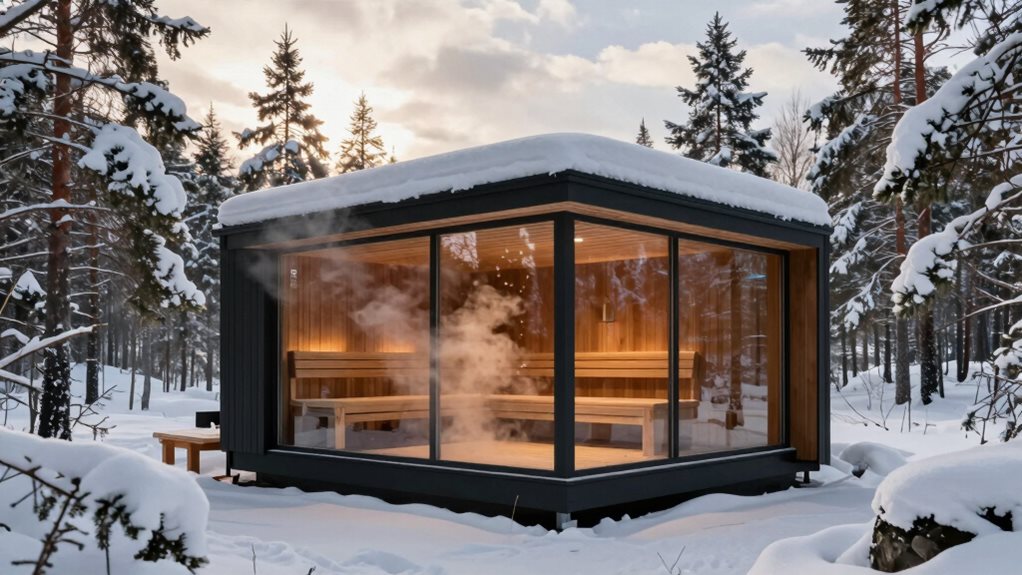

Your climate directly affects every sauna design choice you’ll make. In cold regions, you’ll need thicker insulation (R-19 for walls), moisture-resistant woods like cedar, and powerful heaters (8-12 kW). Humid areas require special ventilation systems and corrosion-resistant hardware, while hot climates benefit from reflective materials and smaller heaters. Proper vapor barrier placement is crucial everywhere to prevent moisture damage. The perfect sauna balances these elements to create your ideal retreat.
Climate Considerations for Sauna Material Selection
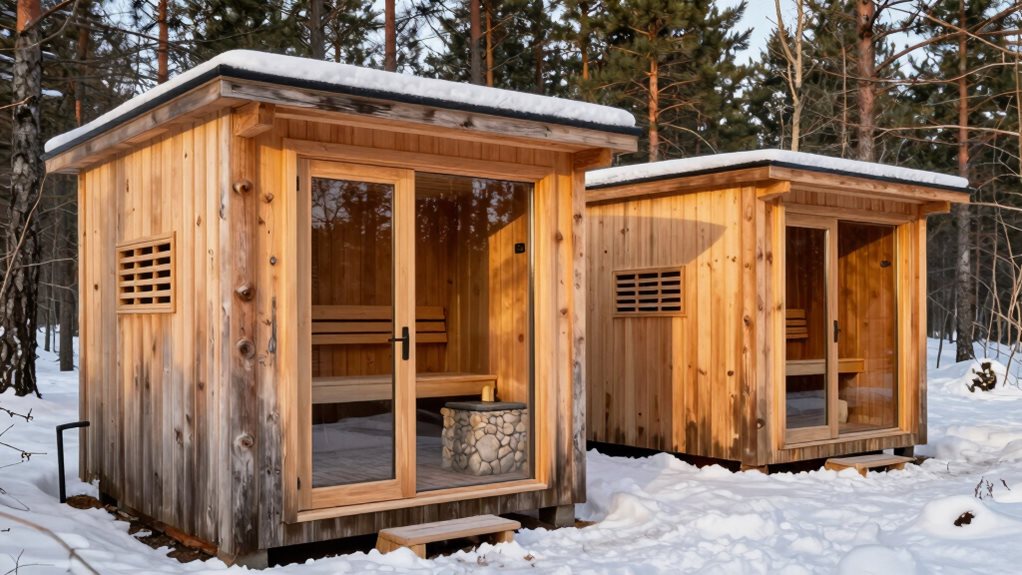
When designing a sauna for your home or property, choosing the right materials based on your local climate is essential for longevity and performance.
Climate-specific material selection is the foundation of a durable, high-performing sauna that withstands local environmental challenges.
In humid areas, you’ll want to select moisture-resistant woods like cedar or thermowood to prevent rot and fungal growth. Western Red Cedar is particularly effective thanks to its natural oils that resist humidity while providing pleasant aromatics during your sauna sessions.
For coastal locations, you’ll need corrosion-resistant hardware since salt exposure accelerates metal deterioration. Stainless steel and marine-grade components will withstand the repeated heating and cooling cycles without degrading.
Don’t forget about your foundation design—elevated structures with proper drainage prevent water accumulation that could damage your sauna’s structure.
Proper insulation choices, like sheep’s wool or cork, offer excellent thermal properties while resisting mold and mildew in humid environments. These non-toxic insulation materials contribute to a healthier indoor environment by avoiding harmful chemicals found in conventional options.
Thermally modified wood is an excellent choice for regions with extreme temperature fluctuations as it provides exceptional stability regardless of the climate conditions.
Adapting Insulation Strategies for Regional Weather Patterns
Your sauna’s insulation needs will vary dramatically depending on your local climate, with vapor barriers playing an essential role in preventing moisture damage.
In frigid northern regions, you’ll need R-13 or higher insulation values with properly installed vapor barriers on the warm side of walls to prevent condensation within the structure.
Hot climate saunas require less insulation for heat retention but still need moisture protection, while coastal areas demand special attention to preventing salt air from compromising your vapor barrier’s effectiveness. For optimal efficiency, consider using mineral wool insulation which maintains its thermal properties at extremely high temperatures and provides excellent R values for sauna applications.
Vapor Barrier Placement
Proper vapor barrier placement stands as the critical foundation of effective sauna insulation, especially when adapting your design to different climate conditions.
You’ll need to position your foil barrier on the warm side of your insulation to prevent moisture damage to your home’s structure.
For indoor saunas, install the foil facing inward, directly behind your interior cladding. This creates a moisture seal while reflecting heat back into your sauna.
In outdoor installations, where temperature differences can be extreme (from 210°F inside to -30°F outside), sealing becomes even more critical.
Add ½-inch furring strips over your foil for an air gap that improves heat reflection.
Always overlap seams by at least 6 inches and seal thoroughly with foil tape, eliminating any potential pathway for moisture to escape. The vapor barrier and sealing approach is supported by historical evidence showing properly insulated saunas remain moisture-free.
Regional R-Value Requirements
Different climate regions demand customized insulation strategies for your sauna, with R-values serving as your guide to proper heat retention and energy efficiency.
In cold climates, you’ll need higher protection with R-19 wall insulation and R-26 to R-30 ceiling values, especially for outdoor installations. Consider 6 inches of mineral wool for superior performance in freezing temperatures.
For mild regions, you can scale back slightly to the standard R-13 to R-15 for walls, while maintaining good ceiling insulation at R-22+.
Hot climates offer more flexibility, where foil-faced materials with reflective properties excel. Proper vapor barrier installation on the warm side of walls is essential to prevent moisture migration into the insulation. Properly sealing all seams with high-temperature aluminum tape creates an effective moisture barrier that prevents condensation issues common in humid environments.
No matter your location, remember that traditional saunas require more insulation than infrared models, and ceilings always need higher R-values than walls because heat naturally rises.
Ventilation Requirements Across Different Environments
You’ll need to contemplate humidity control systems based on your local climate, as humid environments require improved airflow to prevent mold and moisture damage.
For effective cross-airflow placement, position your intake vent near the floor by the heater and your exhaust vent on the opposite wall about 6-12 inches below the ceiling.
Your sauna’s ventilation should achieve 4-6 air changes per hour, which keeps oxygen levels healthy while maintaining the heat you’ve worked so hard to generate. Implementing adjustable vent louvers allows precise airflow control during different phases of your sauna session. In colder climates, proper ventilation is especially crucial to prevent condensation buildup that can damage wooden interiors and compromise structural integrity.
Humidity Control Systems
When designing a sauna, ventilation requirements stand as one of the most critical factors affecting both comfort and safety.
You’ll need to maintain 5-8 air changes per hour in your residential sauna to balance fresh air supply with proper humidity levels.
To create effective airflow, position your intake vent 4-12 inches above floor level near the heater, while placing the exhaust vent 6-12 inches below the ceiling on the opposite wall.
This diagonal configuration creates a natural circulation pattern that removes moist, hot air while drawing in fresher air. Ensure that vents are not installed on the same wall as this creates short air loops that significantly reduce ventilation efficiency.
For smaller saunas, a ventilation rate of 30-40 CFM works well, but you’ll need to scale up for larger spaces.
Climate considerations significantly impact ventilation needs, with high-humidity regions requiring active ventilation systems to prevent excess moisture buildup and potential mold issues.
Cross-Airflow Placement Techniques
Cross-airflow placement represents the cornerstone of effective sauna ventilation, creating a balanced environment across various sauna types.
Whether you’re designing a traditional or infrared sauna, the diagonal flow pattern guarantees heat circulates evenly throughout the space. In warmer climates, you’ll need larger vents to manage excess humidity, while colder environments benefit from smaller, adjustable openings to maintain heat.
For ideal cross-ventilation results:
- Position intake vents low on walls near the heater, with exhaust vents high on opposite walls to utilize the natural stack effect.
- Maintain a 2-3 foot height difference between vents to improve circulation without creating uncomfortable drafts.
- Include adjustable louvers or chutes that allow you to modify airflow based on seasonal temperature variations.
This balanced approach promotes comfort while preventing the stuffiness that can occur in poorly ventilated spaces.
Heating System Options Based on Local Climate Conditions
Selecting the right heating system for your sauna depends greatly on the climate where you live, as temperature extremes directly impact both performance and efficiency.
For frigid regions, wood-burning heaters deliver intense heat that works well below zero temperatures, offering independence during power outages.
Electric heaters suit moderate climates, providing precise control between 150-190°F and can even connect to your smartphone.
If you live somewhere with mild or variable weather, consider infrared heaters that operate at lower temperatures (120-150°F) and consume less energy.
For areas with dramatic seasonal changes, hybrid systems offer the best of both worlds, though they’ll cost more initially.
Remember to properly size your heater – cold regions need higher output ratings (8-12 kW for medium saunas), while undersized units simply won’t maintain comfortable temperatures.
Structural Design Elements for Climate Resilience
Building a climate-resilient sauna requires careful attention to structural design elements that can withstand whatever Mother Nature throws their way. Your sauna’s durability depends largely on wall construction, material selection, and foundation systems that match your local conditions.
When designing your sauna for climate resilience, consider:
- Wall thickness and insulation – Choose 58-70mm walls for extreme cold climates, with double or triple-pane tempered glass windows to prevent heat loss.
- Material selection – Opt for thermowood or cedar, which offer superior moisture resistance and maintain structural integrity during temperature fluctuations.
- Foundation systems – Select concrete slabs for freeze-thaw zones, crushed stone for wet climates, or pier foundations for flood-prone areas.
The roof design matters too – metal roofs excel in snowy regions by allowing snow to slide off efficiently, while composite materials provide better insulation in extreme temperatures.
Energy Efficiency Approaches for Various Climate Zones
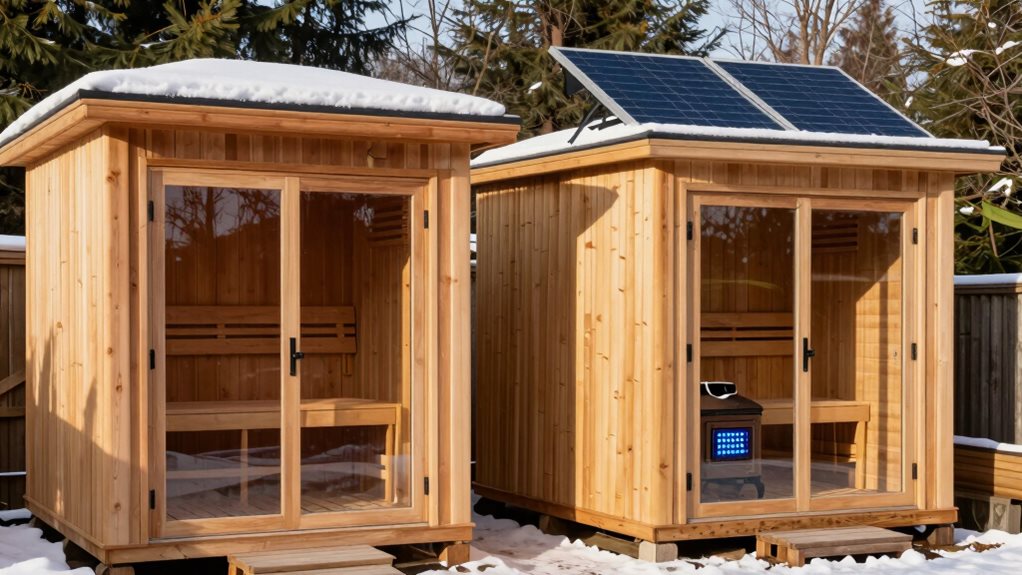
While structural design creates the foundation for your sauna’s durability, energy efficiency determines how comfortably and economically you’ll enjoy it across seasons. Your climate dictates your ideal approach.
Smart sauna design starts with structure, but energy efficiency makes it sustainable for your specific climate.
In cold regions, you’ll need larger 8-12 kW heaters and thorough insulation to maintain heat against sub-zero temperatures.
For humid environments, stainless steel heaters paired with proper vapor barriers prevent moisture damage while preserving efficiency.
If you’re in warmer climates like Southern California, electric or infrared options give precise control without wasting energy.
Variable climate dwellers benefit from hybrid solutions that adapt to changing conditions.
Consider infrared models that use just 0.5-0.8 kWh per session, or explore solar power options to reduce costs.
Frequently Asked Questions
How Does Humidity Affect Sauna Bathing Experience and Health Benefits?
Humidity affects your sauna experience by altering heat perception and comfort. You’ll find moderate humidity (20-40%) creates gentler conditions for your skin and lungs while still delivering cardiovascular and stress-reduction benefits.
Can Traditional Saunas Be Converted for Different Climate Conditions?
Yes, you can convert traditional saunas for different climates by modifying heating systems, upgrading insulation, adjusting ventilation, and controlling humidity levels to suit local conditions and your personal comfort preferences.
What Maintenance Schedule Changes Are Needed in Extreme Climates?
You’ll need more frequent maintenance in extreme climates: clean after each use, deep clean monthly, inspect rocks regularly, test electrical connections biannually, and treat wooden surfaces yearly with preservatives.
How Do Outdoor Saunas Differ From Indoor Designs Climatically?
Your outdoor sauna faces climate challenges your indoor one doesn’t – it’ll need stronger insulation, weather-resistant materials, and can take hours to heat in freezing temperatures, while naturally dissipating humidity.
Does Sauna Placement Within a Property Impact Climate Adaptations?
Yes, your sauna’s placement dramatically affects climate adaptations. You’ll need windbreaks in cold regions, shade in hot areas, and moisture management in humid locations to optimize performance and longevity.
Final Thoughts
As you plan your sauna, remember that climate should guide your choices every step of the way. Your local weather patterns will determine the best materials, insulation thickness, ventilation design, and heating system for peak performance. By adapting these elements to your specific environment, you’ll create a more energy-efficient, comfortable, and durable sauna that works in harmony with nature, not against it.