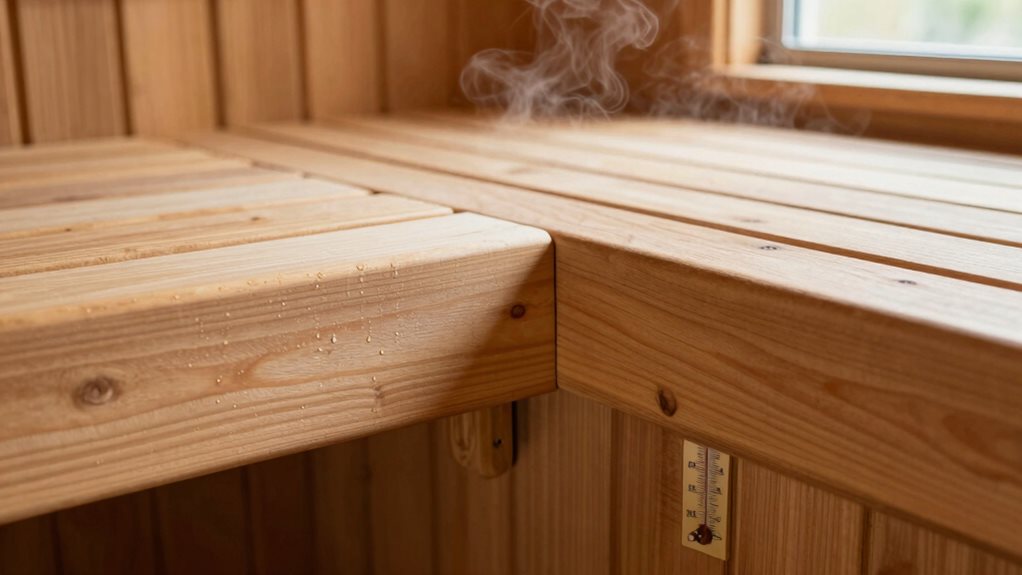

For ideal sauna durability, choose thermally modified aspen or western red cedar for benches and wall cladding—they’re low in heat conductivity and resist moisture. Confirm proper insulation with aluminum-backed mineral wool and include a continuous vapor barrier to prevent structural damage. Use stainless steel grade 316 hardware that won’t corrode, and install slatted wood or textured porcelain tile flooring with adequate drainage. These material choices will extend your sauna’s life while improving your bathing experience.
Woods for Interior Benches: Comfort and Longevity
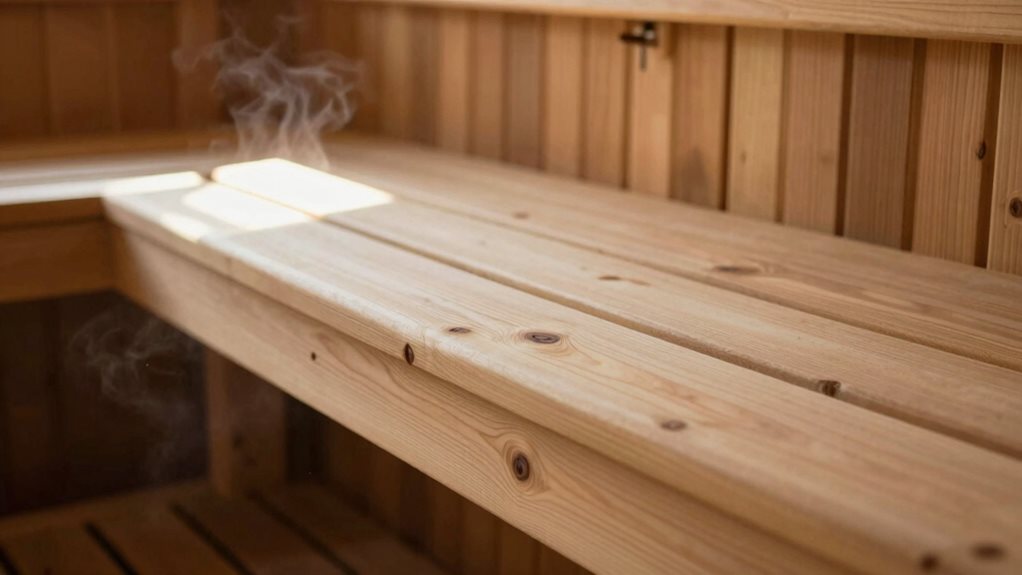
When selecting materials for your sauna benches, choosing the right wood is crucial for both comfort and longevity. Aspen and thermo-aspen stand out for their exceptional low heat conductivity, guaranteeing you won’t burn yourself when sitting down.
Selecting the proper wood for sauna benches ensures both comfort and durability, with aspen varieties offering superior heat protection.
Cedar offers excellent heat resistance while providing that classic sauna aroma many enthusiasts love. Thermally modified wood provides superior moisture resistance compared to regular cedar, making it an excellent choice for humid sauna environments.
For those concerned about splinters, aspen and basswood deliver outstanding splinter resistance, even after years of use. Basswood’s soft texture is particularly gentle on skin. Traditional Finnish saunas typically feature aspen wood benches for their superior comfort and performance qualities.
If you’re looking for stability, thermo-aspen’s thermal treatment dramatically reduces warping and cracking in high humidity environments.
Consider alder if you want a wood that develops a beautiful patina over time, or thermo-aspen for its elegant dark brown color that doesn’t require staining.
Both options maintain their appearance for years.
Wall Cladding Materials: Balancing Aesthetics and Heat Resistance
You’ll find that selecting the right wood for your sauna walls involves balancing beauty with performance, as thermally modified aspen and alder offer cooler touch temperatures than denser softwoods.
Managing moisture through proper installation techniques, including ventilation behind panels and avoiding sealed finishes, prevents long-term damage and extends your sauna’s lifespan.
When installing wall cladding, choose tongue-and-groove connections, maintain proper air gaps, and select clear or tight-knot grades to avoid uncomfortable hot spots and resin leakage. Western Red Cedar stands out for its natural antiseptic effects that help maintain a hygienic environment by repelling bacteria and fungi.
Wood Types Compared
Four key factors determine which wood will perform best in your sauna: thermal comfort, dimensional stability, moisture resistance, and visual appeal.
Woods with lower density, like aspen, alder, and western red cedar, conduct less heat, making them more comfortable for benches and backrests.
You’ll appreciate fine-grained species that won’t splinter over time. Thermally modified woods offer excellent stability, reducing the shrinking and swelling that leads to warping during temperature cycles.
For longevity, choose naturally decay-resistant species like western red cedar or thermally modified alternatives.
These woods resist moisture and fungal growth without chemical treatments that might off-gas in high heat.
Aesthetically, thermally modified woods maintain consistent golden-brown tones, while alder and aspen develop a beautiful patina with age – perfect for creating that authentic sauna atmosphere you’re seeking.
Moisture Management Essentials
The moisture balance within your sauna directly impacts both material longevity and bathing comfort, making wall cladding selection vital for long-term performance.
Thermally modified woods like Thermo-Aspen and Thermo-Spruce offer superior moisture resistance compared to traditional options, reducing humidity absorption by up to 25%. This helps maintain comfortable surface temperatures while preventing warping.
Cedar walls provide natural water repellency and release a pleasant aroma that improves your sauna experience.
For minimal maintenance, consider Thermo-Aspen with its even, splinter-resistant texture that stands up to moisture fluctuations without special finishes.
Alder’s water-repellent properties prevent overheating while its attractive reddish tones develop a beautiful patina over time.
Installation Best Practices
When choosing wall cladding for your sauna, proper installation makes all the difference between a durable, beautiful space and one that quickly deteriorates.
Select tongue-and-groove profiles for that seamless fit that prevents warping and moisture intrusion between panels.
You’ll want to guarantee all materials are kiln-dried to approximately 8% moisture content before installation, which greatly reduces post-installation shrinkage.
For visual appeal, consider balancing lighter woods like thermo-aspen with darker trim for striking contrast.
Avoid high-resin woods when possible, as they can “bleed” when exposed to sauna heat, creating sticky surfaces and maintenance headaches.
For the best long-term performance, thermally modified options like thermo-spruce or thermo-aspen offer superior stability and resistance to humidity fluctuations.
These modified woods maintain their beauty and structural integrity far longer than their untreated counterparts.
Exterior Shell Construction for Weather Protection
Building a sauna that withstands nature’s harshest elements requires careful selection of exterior materials, as your shell construction serves as the first line of defense against weather damage.
For outdoor saunas, Thermowood offers superior protection with its thermal modification process, giving you 20-35 years of use with minimal maintenance.
Unlike cedar, which needs annual sealing to prevent moisture damage, Thermowood won’t crack during freeze-thaw cycles.
Cedar provides a warm aromatic appeal but requires more diligent maintenance to maintain its protective properties in exterior applications.
If you’re combining wood with other materials, engineered wood shells paired with double-pane glass provide excellent durability in humid or snowy environments.
For finishing, you’ve got two solid options: wood wax oil preserves natural texture but needs yearly reapplication, while PU varnish creates a more refined finish that lasts 3-5 years between treatments.
Both finishes are non-toxic and low in VOCs.
Insulation Systems for Maximum Heat Retention
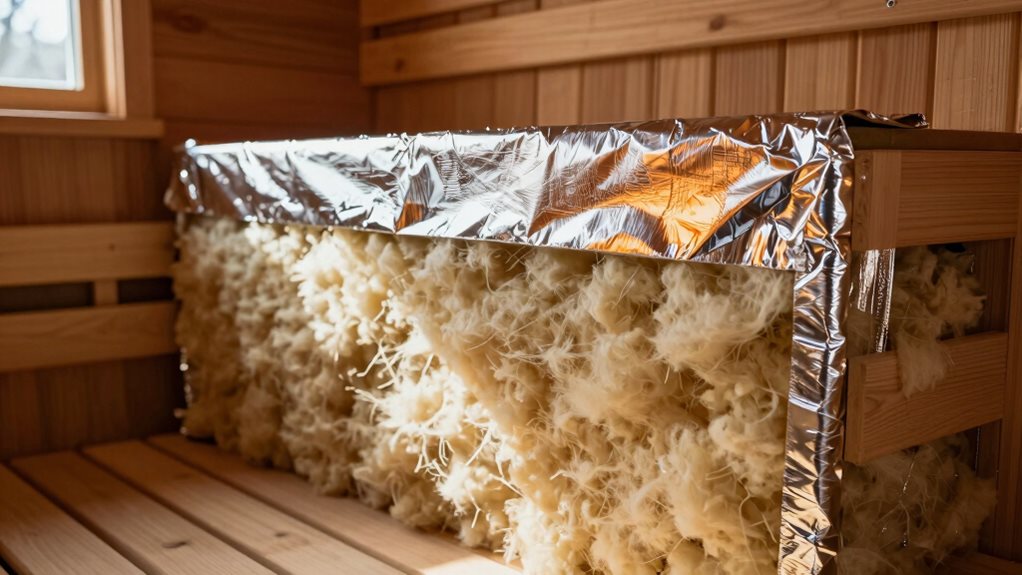
Properly insulating your sauna creates the foundation for efficient heat retention, turning an ordinary hot room into a luxurious thermal experience that performs consistently year after year.
For walls, aim for R-13 to R-15 ratings, while ceilings need thicker insulation at R-26 to R-30 since heat rises.
Mineral wool excels with its fire resistance and soundproofing qualities, typically installed at 4 inches thick (6 inches for colder climates).
Don’t overlook reflective barriers—aluminum foil reflects radiant heat back into your sauna, dramatically improving efficiency.
Install insulation continuously without gaps, and seal all connections carefully. For outdoor saunas, additional weatherproofing measures are necessary to withstand external elements and temperature fluctuations. Regular inspection of insulation materials helps prevent mold and deterioration that can compromise your sauna’s performance.
Your reward? A sauna that heats faster, maintains consistent temperatures, costs less to operate, and protects both your heating elements and surrounding structure from excessive wear.
Vapor Barriers and Moisture Management
Vapor barriers serve as the invisible guardians of your sauna’s structural integrity, protecting it from the potentially destructive effects of steam and moisture. Installing these barriers on the warm side of your insulation prevents condensation from damaging your walls and framing over time.
Vapor barriers: silent sentinels that shield your sauna from moisture damage and preserve its structural longevity.
Aluminum foil is an excellent choice, reflecting heat back into your sauna while providing superior moisture protection. Ensure the wall materials are completely dry before applying the foil to prevent trapping moisture that could damage your structure. Your vapor barrier must cover all insulated surfaces with properly sealed overlapping seams to ensure complete protection.
When installing your vapor barrier, remember these critical points:
- Seal all seams with high-temperature foil tape to prevent moisture paths
- Pay extra attention to ceiling installation, as rising steam makes this area vulnerable
- Create an air gap between the vapor barrier and interior wood using furring strips
Avoid using plastic sheets as they can soften or off-gas at high temperatures, compromising both performance and air quality.
Heater Types and Stone Selection Criteria
Selecting the right heater for your sauna, along with appropriate stones, directly impacts your bathing experience, durability, and maintenance requirements.
Electric heaters like the Harvia Virta Wi-Fi offer reliability in cold climates and convenient control, but they’ll increase your energy bills.
If you’re building in a rural setting, wood-burning options like the Harvia M3 provide that authentic aroma and softer heat, though you’ll need to chop wood and clean ashes.
For larger saunas with frequent use, gas heaters offer cost-efficiency with fewer replacements.
Meanwhile, infrared panels heat your body directly, saving energy but sacrificing the traditional steam experience.
Steam heaters create a humid environment that can help with sinusitis and various skin problems, though they require more intensive maintenance.
When selecting stones, consider capacity—models like HUUM and Cilindro allow you to customize your steam from gentle mist to full vapor, improving your sauna’s longevity. Regular maintenance of these stones is essential as it enhances heater performance and extends the life of your sauna system.
Hardware and Fastener Selection for High-Temperature Environments
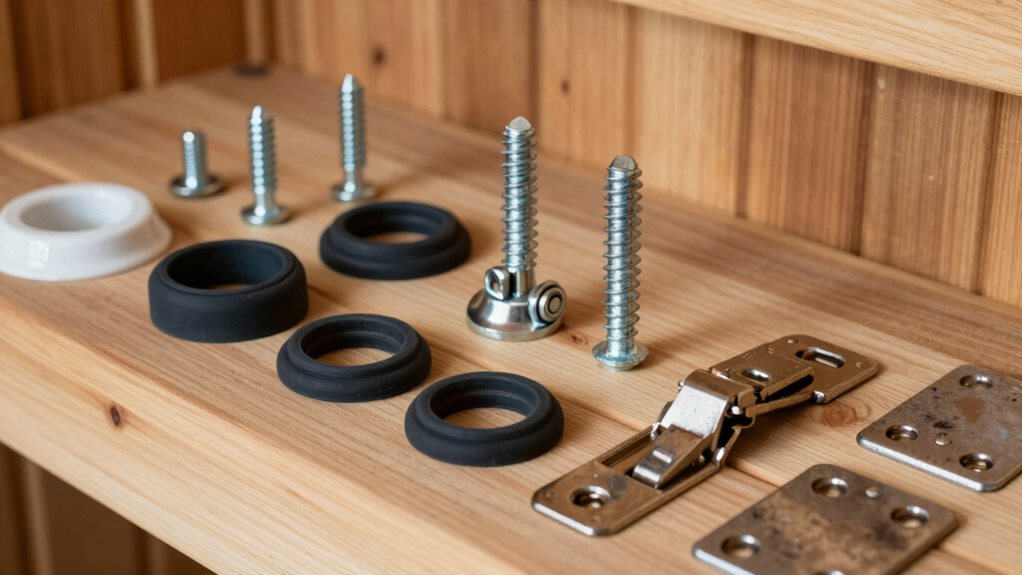
When building a sauna that will last for years, you’ll need to choose the right hardware that can withstand intense heat and moisture.
Stainless steel fasteners (particularly grades 316 or 304) offer excellent corrosion resistance for most sauna applications, while specialized nickel alloys might be necessary for areas directly surrounding the heater.
You can minimize visible hardware by using hidden mounting systems that accommodate wood’s natural expansion and contraction during heating cycles, creating both a cleaner appearance and reducing the risk of loosening over time.
Corrosion-Resistant Fastener Options
The durability of your sauna ultimately depends on the often-overlooked hardware that holds everything together. In the harsh conditions of high heat and humidity, choosing the right fasteners prevents premature failure and costly repairs.
Grade 316 stainless steel offers superior protection in chloride-exposed environments, while specialized coatings like Rothoblaas C4 EVO and RUSPERT create effective barriers against moisture.
For maximum longevity in your sauna, consider these options:
- SCI HCR super austenitic alloy screws for extreme conditions, preventing stress corrosion cracking
- Marine-grade 316SS hardware sets (bolts, nuts, washers) for complete protection in wet installations
- Stainless screws with locking patches to prevent loosening from temperature fluctuations
Heat Cycle Expansion Solutions
Sauna environments subject your wooden components to extreme temperature fluctuations, causing them to expand and contract with each heating cycle. To manage this movement, select wood species with ideal thermal properties.
Western Red Cedar and thermally modified woods like thermo-aspen show minimal dimensional changes, while hardwoods like alder provide more uniform responses to heat.
For hardware, choose materials that can withstand high temperatures without compromising structural integrity. Austenitic stainless steel (304 or 316) works well for structural components, while brass and bronze are excellent for decorative elements.
Consider high-temperature polymers for non-structural connectors to reduce noise from wood movement.
Install fasteners thoughtfully by using slotted or oversized holes for horizontal members, allowing 1-3 mm movement per board. This prevents stress buildup and splitting, guaranteeing your sauna maintains its integrity through countless heating cycles.
Hidden Mounting Systems
Hidden mounting systems play a crucial role in preserving your sauna’s aesthetic appeal while guaranteeing structural integrity throughout years of heat cycling.
When selecting fasteners, you’ll need materials that withstand both heat and moisture. Stainless steel hardware offers excellent corrosion resistance and strength, making it ideal for most sauna applications up to 200°C.
For specialized needs, consider these options:
- PEEK or PTFE polymer fasteners provide lightweight alternatives where metal might conduct too much heat
- Silicone sealants like Makroflex TA145 can withstand temperatures up to 260°C for joining components near heat sources
- Aluminum fixing clips accelerate panel installation while remaining hidden from view
Ventilation and Airflow Design Elements
When designing a sauna that’ll stand the test of time, proper ventilation isn’t just helpful—it’s absolutely essential.
You’ll want to position your intake vent low near the heater (about 100-300mm from the floor) to draw cool air across heating elements, while placing the exhaust vent on the opposite wall, higher up (600-900mm from floor).
Size matters too—your intake should be 50-100 cm² and your exhaust slightly larger at 75-150 cm².
For material choices, always use non-corroding metals or heat-rated ducting that can withstand the intense conditions.
Consider whether gravity ventilation will work for your space, or if you’ll need mechanical assistance with high-temperature-rated fans.
The goal is creating a circular airflow that heats evenly without leaving you with hot head/cold feet syndrome.
Flooring Materials for Safety and Drainage
The three most important elements of sauna flooring involve proper drainage, slip resistance, and material durability—all working together to create a safe, long-lasting foundation for your heat sanctuary.
A sauna’s foundation requires masterful drainage, slip-proof surfaces, and lasting materials to protect your wellness retreat for years to come.
Your flooring choice impacts both comfort and maintenance requirements.
For peak performance, consider these flooring options:
- Slatted hardwood decking (cedar or teak) offers natural warmth underfoot with gaps of about 1/2 inch for proper drainage.
- Textured porcelain tiles with slip-rated finishes provide excellent durability when installed over cement board with waterproof underlayment.
- Perforated PVC or rubber safety matting creates superior wet-grip while allowing water to drain quickly underneath.
When installing your flooring, slope it toward a drain at 1-2% grade to prevent water pooling.
Commercial saunas require drains by code, while they’re optional but recommended for residential installations.
Structural Framing Options for Long-Term Stability
When you’re building a sauna, your choice of framing materials directly affects how well it’ll withstand years of heat-moisture cycles.
Cedar offers natural rot resistance that makes it ideal for sauna construction, while engineered lumber provides exceptional dimensional stability to prevent warping and guarantee your benches remain level.
You’ll want to incorporate flexible connection details where different materials meet, allowing for natural expansion and contraction as temperatures fluctuate during sauna use.
Framing Materials Comparison
Selecting the right framing material for your sauna establishes the foundation for its structural integrity and longevity. Each option offers distinct advantages for your sauna’s framework, with Scandinavian Spruce serving as the gold standard due to its balanced strength and thermal properties.
Cedar provides excellent moisture resistance with its pleasant aroma, while Hemlock offers a budget-friendly alternative that won’t warp in high heat.
- Thermal performance – Spruce and Cedar insulate naturally, while Engineered C24 lumber provides up to 30% better heat retention
- Moisture resistance – Cedar excels in humid conditions, complemented by foil-backed vapor barriers that control moisture migration
- Structural support – Engineered lumber guarantees precision for complex designs, while traditional woods offer proven reliability over decades
Consider your climate and budget when selecting your framing material for optimal durability.
Movement Accommodation Techniques
Building a sauna that withstands years of extreme temperature fluctuations requires thoughtful attention to how materials naturally expand and contract.
You’ll want to incorporate diagonal bracing between corner posts and top plates using pressure-treated timber (at least 50mm x 100mm) to resist moisture while preventing racking during humidity cycles.
For uneven terrain, consider adjustable foundation posts with steel bases that allow 50-100mm height variations.
These raised foundations improve airflow and reduce rot risk by 40%.
Don’t forget to include expansion joints—cross-battening with 5-10mm gaps behind cladding accommodates thermal movement, while thermo-treated pine battens (20mm thick, 45mm wide) minimize warping.
To prevent thermal bridging, use mineral wool insulation instead of fiberglass, as it’s 25% more effective in high-heat environments.
Factory-assembled frames with 44mm thick insulated walls maintain performance even at temperatures reaching 100°C.
Frequently Asked Questions
Can I Use Reclaimed Wood for My Sauna Interior?
No, you shouldn’t use reclaimed wood for your sauna interior due to hidden chemicals, metals, mold, and structural issues that become dangerous when exposed to extreme heat and humidity.
How Do Sauna Materials Perform in Different Climate Zones?
In humid zones, you’ll need cedar or thermally modified wood with vapor barriers. Cold climates require thicker insulation (R-13+) while coastal areas demand stainless steel hardware to resist corrosion.
What’s the Environmental Impact of Various Sauna Building Materials?
You’ll find FSC-certified and reclaimed woods have minimal impact, while bamboo and thermally treated woods offer sustainable alternatives to chemically-treated options. Electric saunas consume more energy than wood-burning ones if poorly insulated.
Are There EMF Considerations With Electric Sauna Heater Installations?
Yes, electric heaters emit EMF. You’ll need proper wiring (twisted pairs), adequate distance between elements and benches, and grounded shielding to minimize your magnetic and electric field exposure.
Can Infrared Panels Be Combined With Traditional Sauna Materials?
Yes, you can install infrared panels on your existing cedar sauna walls. They’re designed for retrofitting and work especially well with Western Red Canadian Cedar, which stays stable at high temperatures.
Final Thoughts
You’ll find that creating a durable, high-performing sauna requires careful material selection at every stage. From heat-resistant woods like cedar and aspen for your benches to proper vapor barriers and corrosion-resistant hardware, each choice affects your sauna’s longevity and enjoyment. By investing in quality materials for insulation, ventilation, and structural elements, you’re guaranteeing your sauna will provide relaxing, therapeutic experiences for many years to come.