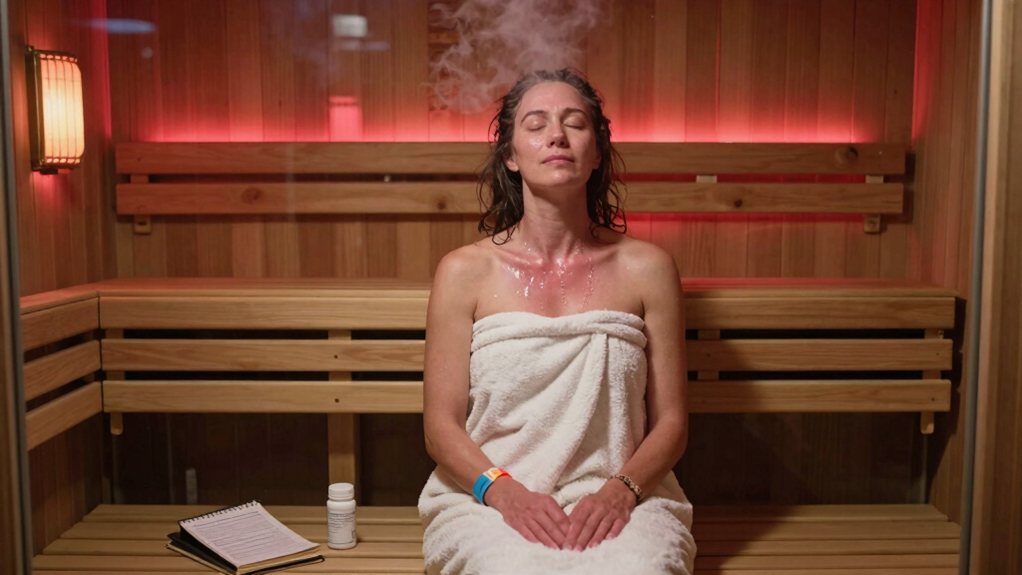

You can use an infrared sauna with Hashimoto’s, and it might help you feel better in ways that actually matter day-to-day. Many people with this condition report more energy, less muscle pain, and improved mood after regular sessions.
The gentle heat works like sunlight warming your skin through a window, making it easier to handle than traditional saunas when you’re already dealing with fatigue. Just don’t expect it to fix your thyroid levels or replace your medication.
There’s more to know about safety, timing with your pills, and who should skip it entirely.
What Is Infrared Sauna: and Why Do Hashimoto’s Patients Try It?
If you’re living with Hashimoto’s thyroiditis, you’ve probably spent some time searching for gentle ways to feel better, and that’s exactly where infrared saunas enter the picture.
Unlike traditional saunas that blast hot air, infrared saunas use special heaters that send warm light directly to your skin, like sunlight warming your face through a window. The air stays cooler, usually between 100–150°F, making sessions feel milder and easier to handle. Many Hashimoto’s patients are drawn to this gentler heat because intense temperatures can feel overwhelming when you’re already managing fatigue and sensitivity.
You’re likely hoping for stress relief, better blood flow, and maybe even help with that sluggish feeling. While some claims about “detoxing” aren’t well proven, the appeal of a calmer, longer session without steamy, stifling heat makes infrared saunas worth considering for your wellness toolkit. Many users find these lower temperatures allow for longer, more comfortable sessions that can support relaxation and recovery goals without the intensity of traditional heat therapy. The technology behind this approach actually dates back to 1891, when John Harvey Kellogg invented the use of radiant heat saunas with his incandescent electric light bath, later patenting the concept as the Radiant Heat Bath in 1896.
What Symptoms Do Hashimoto’s Patients Actually Report Improving?
When you step into an infrared sauna, you’re likely hoping for real, noticeable changes in how you feel day to day. Hashimoto’s patients who use saunas most often report improvements in three key areas: their energy levels, pain and mobility, and mood or sleep quality.
These self-reported benefits, while not from clinical trials, suggest the warmth and relaxation may help you manage some of the most frustrating daily symptoms. In a survey of over 2000 people with Hashimoto’s, 52% reported more energy and 41% noted improvements in skin health and pain levels, with 74% experiencing a mood boost after sauna use. Beyond these subjective improvements, infrared sauna use may also support thyroid function through its unique combination of heat and light therapy.
Energy and Fatigue
Many Hashimoto’s patients find themselves dragging through the day, fighting a tiredness that coffee can’t touch, so you’re probably wondering if an infrared sauna could actually put some spring back in your step.
The numbers look promising. In a survey of over 2,000 Hashimoto’s patients, 52% of sauna users reported more energy afterward. Even better, 57% felt notably better overall, suggesting benefits stretch beyond just waking up easier.
Here’s how it might work: heat therapy improves sleep quality, and better rest means more daytime fuel. The warmth also relaxes tight muscles and stiff joints that often tag along with thyroid fatigue, like unloading a heavy backpack you’ve forgotten you’re wearing. This aligns with clinical findings where repeated far-infrared therapy reduced fatigue scores in patients with chronic fatigue syndrome, a condition that frequently overlaps with thyroid dysfunction. Additionally, mitochondrial ATP production may explain why some patients experience sustained energy improvements rather than just temporary relief.
Just remember, you’re treating symptoms, not fixing the underlying thyroid issue itself.
Pain and Mobility
Hashimoto’s doesn’t just drain your energy, it can leave your body feeling like it’s been through a workout you never signed up for.
Joint and muscle pain plague many patients, turning simple movements into daily challenges.
Survey data offers hope: about 41% of Hashimoto’s sauna users report pain relief, with 57% feeling markedly better overall.
Think of infrared heat as a gentle, warming hug for your inflamed tissues, it opens blood vessels, boosts circulation, and helps muscles unclench.
The proposed mechanism? Reduced inflammation.
Since Hashimoto’s is fundamentally inflammatory, sauna therapy may lower those troublesome pro-inflammatory chemicals.
While no clinical trials specifically measure improved mobility, the combination of better blood flow, relaxed muscles, and decreased pain suggests you’ll likely move more comfortably.
Mood and Sleep
If you’ve ever felt like Hashimoto’s turned your emotions into a rollercoaster and your sleep into a distant memory, you’re far from alone. In a survey of over 2,300 Hashimoto’s readers, 74% reported sauna use boosted their overall mood, while 57% felt “significantly better” afterward. Think of it as pressing a reset button on a stormy day inside your head.
Sleep improvements are frequently described too. Heat exposure nudges your nervous system toward relaxation, like switching from a racing engine to a gentle idle. This calmer state can make falling asleep easier and help align your body’s natural rhythms. The parasympathetic activation triggered by sauna use specifically helps shift your body from “fight or flight” into “rest and digest” mode, supporting deeper relaxation.
While these benefits are self-reported rather than from clinical trials, they’re consistent themes. Many Hashimoto’s patients find infrared saunas offer genuine relief where it matters most: feeling better and resting well.
Can Sauna Reduce Hashimoto’s Pain and Inflammation?
When you’re dealing with Hashimoto’s, pain and inflammation can feel like uninvited guests that just won’t leave, whether it’s achy joints, stiff muscles, or that overall sluggishness that weighs you down.
Infrared saunas might help show them the door.
Infrared saunas might help show them the door.
Research suggests real promise here.
A Japanese study found chronic pain patients experienced nearly 70% pain reduction after their first sauna session, with benefits sticking around.
Among Hashimoto’s sufferers, about 41% report less pain from regular sauna use.
The heat works like a gentle massage for your blood vessels, increasing flow and oxygen delivery to sore spots.
Imagine your circulation as a sluggish stream becoming a steady river.
Saunas also appear to dial down inflammation throughout your body while lowering stress hormones like cortisol.
While this won’t cure your autoimmune condition, it can meaningfully ease the daily discomfort that makes Hashimoto’s so draining.
Does Infrared Sauna Change Your Thyroid Hormone Levels?

You’re probably wondering if all that relaxing heat does more than just soothe your sore muscles: it makes sense to ask whether infrared sauna sessions can actually shift your thyroid numbers in a meaningful way.
Research shows saunas can cause short-term changes, but don’t expect a magic fix. A classic study found that 30 minutes of sauna time bumps up your TSH and reverse T3 levels temporarily. Think of it like your body’s quick reaction to heat stress, not a lasting repair. Notably, eating glucose beforehand made the TSH jump even bigger, while higher blood sugar actually dampened the reverse T3 response.
Here’s the reality check: no solid evidence proves infrared sauna consistently normalizes T4, T3, or lowers those troublesome thyroid antibodies. The changes you see right after stepping out? They’re acute responses, not permanent improvements. Your hydration status and stress hormones shift during heat exposure, which can muddy lab results if you test too soon.
While 57% of Hashimoto’s patients in one survey felt better with regular sauna use, their symptoms improved, not necessarily their actual hormone levels. Fatigue and mood got a boost, but your thyroid gland itself? That’s a different story.
Who Should (And Shouldn’t) Try Sauna With Hashimoto’s?
So, who actually gets the green light for sauna time with Hashimoto’s, and who needs to pump the brakes? If your thyroid levels are stable and your doctor says it’s okay, you’re in the clear.
Sauna sessions can help with fatigue, muscle pain, poor circulation, and stress, like a warm hug for your overworked body. Infrared heat therapy has been described as helping alleviate excess inflammation in the body, which may be particularly relevant since Hashimoto’s is characterized as a chronic inflammatory state.
A warm hug for your overworked body—sauna therapy melts away fatigue, muscle pain, and stress while boosting circulation.
Start slow: 15 minutes, a few times weekly, and drink water like it’s your job.
But hold up if you’re pregnant, have heart issues, blood pressure problems, or take certain medications.
Active hyperthyroidism, recent illness, or dehydration risk also mean waiting.
Think of it like a swimming pool: check the depth before diving in.
When in doubt, ask your doctor.
Your thyroid path deserves smart, safe choices.
Can Sauna Sessions Improve Mood and Sleep With Hashimoto’s?
You might be wondering if sitting in a warm sauna can actually lift your spirits and help you sleep better when you’re living with Hashimoto’s.
The good news is that many people with this condition report real improvements in how they feel emotionally, and there’s some interesting evidence behind those experiences.
Let’s look at what the research says about mood, relaxation, and getting a good night’s rest.
Mood Improvement Data
When you’re living with Hashimoto’s, even small mood shifts can feel like major victories, and many people wonder if infrared sauna sessions might help brighten their outlook. Survey data offers some encouraging clues.
Among 2,332 readers with Hashimoto’s, 74% reported sauna use boosted their overall mood, while 57% felt notably better afterward. About half noticed more energy, which often walks hand-in-hand with improved spirits when you’re battling fatigue.
These benefits likely work through multiple pathways. Pain relief plays a big role: 41% of surveyed readers experienced less pain, and one study showed chronic pain patients had nearly 70% reduction in pain scores after just one session.
Better sleep and lower stress hormones may also lift your mood, though the evidence comes from self-reported surveys rather than clinical trials.
Sleep and Relaxation
Because sleep can feel elusive when Hashimoto’s keeps you wired and weary, many people turn to infrared saunas hoping for a gentler path to rest. You might find that the warmth helps your muscles unclench like a knot loosening in soft rope, making it easier to drift off.
Research links sauna use to better sleep in people with insomnia, mostly through relaxation and parasympathetic activation: your body’s “rest and digest” mode.
In one survey, 74% of Hashimoto’s readers reported mood boosts, which can indirectly improve sleep by lowering stress.
Try 15–20 minute sessions, 3–4 times weekly, but schedule them earlier in the day if you feel energized afterward.
Stay hydrated, and take your thyroid medication 30–60 minutes before stepping in.
Track your response, as some feel fatigued instead.
Do Detox Claims About Sauna Hold Up for Hashimoto’s?
How exactly does sitting in a hot box flush toxins from your thyroid? The truth is, it probably doesn’t, not in the way marketers claim.
Three things to know about detox hype:
- “Detox” is mostly marketing, not medicine. No solid studies show infrared saunas remove specific toxins from people with Hashimoto’s.
- Sweating isn’t special here. Your liver and kidneys handle detox; sweat mainly cools you down.
- Real benefits are simpler. Surveys show 57% of Hashimoto’s patients feel better after sauna use, but that’s likely from reduced stress and inflammation, not toxin flushing.
The real wins? Better sleep, less pain, more energy.
These come from relaxing your nervous system and boosting circulation, not mysterious cleansing.
Skip the detox drama, and enjoy the sauna for what it actually offers.
Is Sauna Safe With Thyroid Medication?

Now that we’ve cleared up the detox myths, let’s tackle a question that actually matters for your daily routine: can you safely step into a sauna while taking thyroid medication?
You can, but timing matters. Take your levothyroxine at least four hours before sauna use, or wait 30–60 minutes after dosing. Think of your medication like a sponge, it absorbs best on an empty stomach, and heat can change how your gut works.
Your thyroid medication may also make you more sensitive to heat, so start with short 5–10 minute sessions. Stay hydrated, watch for dizziness or rapid heartbeat, and stop if you feel off. Sauna use should complement, not replace, your ongoing medical treatment for hypothyroidism.
While saunas temporarily raise TSH in studies, there’s no proven harm with stable thyroid treatment. Research also shows that sauna exposure increases plasma rT3 alongside TSH, though this effect can vary based on individual metabolic factors. Keep your medication routine consistent, and you’re good to go.
How Often Should You Use Sauna: and When to Ask Your Doctor?
Once you’ve figured out the timing with your medication, you’ll probably wonder how often you should actually be sweating it out. Most Hashimoto’s-friendly guidance suggests starting with 15–20 minute sessions, 3–4 times weekly****. Think of it like building a exercise habit, consistency beats intensity, and your body needs time to adapt to the heat.
Here’s your quick-start checklist:
- Hydrate like it’s your job, drink water before and after, because dehydration hits harder with thyroid issues
- Start low, go slow, begin at shorter durations and increase gradually as your tolerance builds
- Track your response, note energy, mood, and symptoms to find your personal sweet spot
Check with your doctor first if you have heart problems, blood pressure swings, unstable symptoms, or take multiple medications.
Stop immediately if you feel dizzy, faint, or notice heart palpitations, your body’s waving a red flag you shouldn’t ignore.
Frequently Asked Questions
Can Infrared Sauna Cure Hashimoto’s Disease?
No, infrared sauna cannot cure your Hashimoto’s disease. You may find symptom relief through reduced inflammation and improved energy, but you’ll need to continue standard medical treatment.
Always consult your doctor before starting.
Should Children With Hashimoto’s Use Saunas?
You should approach sauna use cautiously for your child with Hashimoto’s. Pediatric evidence is limited, so consult their endocrinologist first, make sure stable thyroid levels, prioritize hydration, and monitor closely for overheating or fatigue.
Does Sauna Help With Hashimoto’s Weight Gain?
Sauna use may help you feel more energetic and less stressed, which could support your weight management efforts, but there’s no strong proof it directly causes fat loss in Hashimoto’s.
Can Pregnant Women With Hashimoto’s Use Infrared Saunas?
You should avoid infrared saunas during pregnancy, even with Hashimoto’s. Overheating risks to your baby outweigh any potential symptom relief.
Always consult your obstetrician before considering any exceptions.
What’s the Best Sauna Temperature for Hashimoto’s Patients?
Start at 120, 130°F for 15 minutes, 3, 4 times weekly. You’ll gradually increase heat and duration while tracking your energy, sleep, and symptoms over 4, 6 weeks.
Stay well-hydrated and avoid sauna use right after taking your thyroid medication.
Final Thoughts
Infrared saunas won’t cure your Hashimoto’s, but they might ease your pain, lift your mood, and help you sleep better. You’ll want to stay hydrated, watch for overheating, and check with your doctor first, especially if your thyroid medication needs adjusting.
Start slow, listen to your body, and remember: sauna sessions work best as a sidekick to your medical treatment, not a replacement. Your comfort and safety always come first.