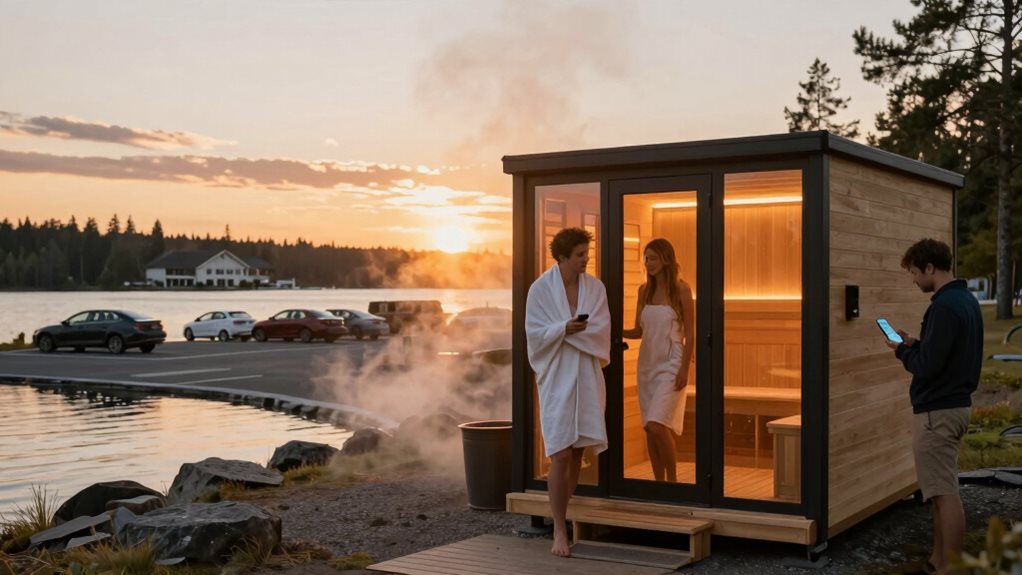

Mobile saunas are indeed disrupting the wellness industry, transforming exclusive spa luxuries into everyday health practices. You can now enjoy professional-grade heat therapy in your living room with units that set up in minutes. The market is booming, projected to grow from $935.9 million to $2.5 billion by 2035, as prices drop and technology advances. These portable wellness solutions are breaking down barriers of cost and space, making sauna benefits accessible to more people than ever before.
The Rise of Portable Wellness Solutions in a Digital Age
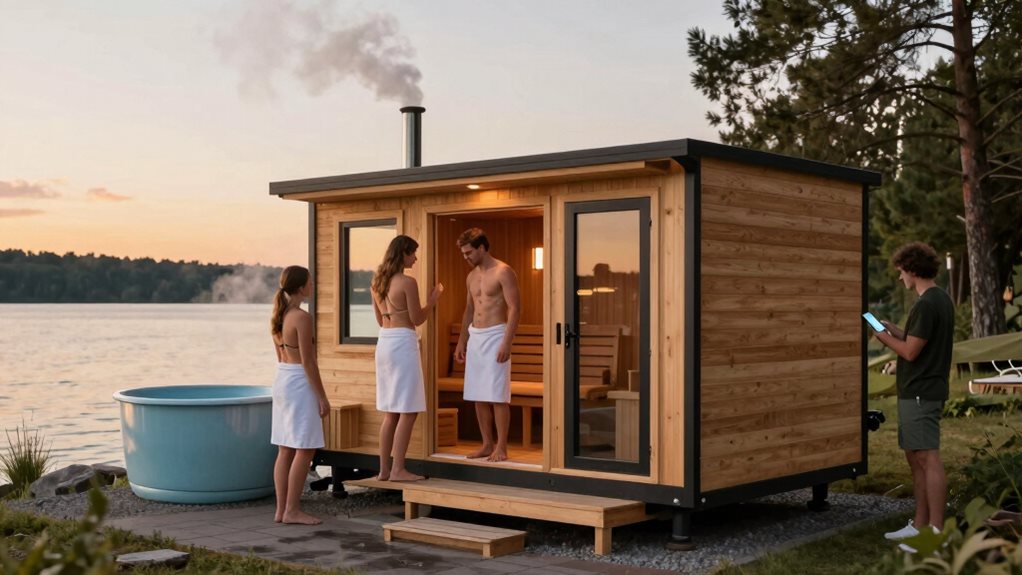
How did portable wellness technology emerge as a modern solution for today’s fast-paced lifestyles? As our digital world accelerated, the need for accessible wellness tools grew alongside it.
Portable saunas evolved from simple tents to sophisticated infrared units that can be set up anywhere with a power outlet in just 10-15 minutes.
From humble beginnings to high-tech portability, today’s infrared saunas bring wellness to any space in minutes.
You’ll find these mobile wellness solutions particularly appealing if you’re juggling a busy schedule but still prioritize health. They’ve gained popularity among biohackers, athletes, and frequent travelers who want consistent therapy without commitment to permanent installations.
With their plug-and-play design, you can fold them away when not in use, making them perfect for small living spaces. They’ve effectively removed barriers like space requirements and high costs, democratizing access to regular sauna therapy.
Market Growth Trends: From Luxury to Mainstream Accessibility
You’re witnessing a remarkable shift as portable saunas move from luxury status symbols to mainstream wellness tools, with the global market projected to more than double to $2.5 billion by 2035.
This transformation is fueled by more affordable options, including entry-level portable models and infrared tents that cost considerably less than traditional built-in saunas.
E-commerce expansion and direct-to-consumer sales have further democratized access, allowing more people to experience sauna benefits regardless of space constraints or budget limitations.
Expanding Accessibility Trajectory
While once considered a luxury reserved for high-end spas and wellness retreats, mobile saunas are now experiencing a remarkable shift toward mainstream accessibility.
You’ll find portable saunas growing from a $935.9 million market in 2024 to an impressive $2,500 million by 2035, driven by a strong 9.3% annual growth rate.
This accessibility revolution isn’t happening by chance. E-commerce channels have made purchasing more convenient, while technological advances have created more affordable, compact designs.
You’re part of a growing trend where home wellness is becoming standard rather than exceptional. The industry’s transformation from exclusive to inclusive means you can enjoy sauna benefits without the premium price tag or dedicated space requirements, reflecting the broader shift of wellness products from luxury indulgence to everyday self-care.
Affordability Drives Adoption
The dramatic price compression in mobile saunas has become a primary catalyst for their widespread adoption across diverse consumer segments.
You’re now seeing more affordable options thanks to standardized manufacturing processes replacing handcrafted builds, with manufacturers using modular designs and mass-market materials.
E-commerce platforms have eliminated retail markups while offering flexible payment options, making these wellness amenities accessible to budget-conscious buyers.
- Entry-level models and portable pop-up formats provide lower-cost alternatives to traditional trailer-style saunas, opening the market to first-time owners.
- DIY conversion kits and detailed plans let hobbyists build their own units at a fraction of pre-built prices.
- Second-hand marketplaces connect buyers with pre-owned saunas, creating affordable pathways to ownership without compromising quality.
Democratizing Wellness Culture
As market barriers fall and production scales up, mobile saunas have rapidly transformed from exclusive luxuries into mainstream wellness products available to nearly everyone.
You’re witnessing a remarkable democratization of wellness culture, with the portable sauna market expected to grow from $1,023 million in 2025 to $2,500 million by 2035.
This shift isn’t just about affordability; it’s about accessibility.
With a 9.3% annual growth rate, these compact wellness spaces are finding their way into apartments and small homes where traditional saunas couldn’t fit.
The rise of infrared technology, growing at 7.5% annually through 2033, has made the experience more comfortable with lower temperatures and improved energy efficiency.
What was once reserved for high-end spas is now part of everyday self-care routines, bringing wellness benefits to millions of new users.
Regional Adoption Patterns and Consumer Behavior Shifts
You’ll notice stark differences in how mobile saunas have been welcomed between urban centers, where space constraints and fast-paced lifestyles drive demand for compact wellness solutions, and rural areas, where adoption remains slower but steadier.
North American and European markets show greater maturity with established consumer awareness, while Asia Pacific regions represent the frontier of explosive growth potential.
These regional adoption patterns reflect more than economic factors but also cultural attitudes toward wellness, with urban consumers typically leading the shift from viewing saunas as luxury items to regarding them accessible wellness necessities.
Urban Vs Rural Adoption
Notable differences emerge when comparing mobile sauna adoption between urban and rural settings, with each environment fostering unique patterns of use and consumer preferences.
Urban dwellers, particularly millennials and Gen Z, are drawn to compact, portable designs that fit limited spaces, often choosing infrared options for pain relief after busy workdays.
Meanwhile, rural users prefer traditional wood-burning saunas that complement their lifestyle, with the strongest growth in freezing-winter states like Minnesota.
- You’ll find women aged 30-45 leading urban adoption, while older demographics maintain rural sauna traditions.
- Your location determines preferred features – city users want smart, app-controlled units; rural owners prioritize privacy and authenticity.
- You’re part of a growing trend regardless of location, with annual adoption rates increasing 5% in the US over the past decade.
Market Maturity Differences
While North America currently dominates the mobile sauna terrain, regional adoption patterns reveal stark differences in market maturity worldwide, creating a patchwork of growth opportunities and consumer behaviors.
Europe maintains a strong position with nearly 37% of the global market share, backed by well-established wellness infrastructure.
You’ll find Asia-Pacific regions gaining momentum as disposable incomes rise and wellness preferences evolve.
Meanwhile, South America and Africa represent smaller but emerging opportunities that savvy businesses are beginning to explore.
Consumer preferences are shifting too.
You’re part of a movement that’s bringing wellness home, with residential use claiming over 57% of the market.
You’re increasingly demanding eco-friendly materials, smart features, and space-saving designs that fit your lifestyle, whether you’re in an urban apartment or rural retreat.
How Mobile Saunas Compare to Traditional Spa Experiences
The differences between mobile saunas and traditional spa experiences extend far beyond their physical structures.
Portable saunas revolutionize wellness by redefining relaxation beyond the confines of conventional spa limitations.
While traditional saunas demand permanent installation and professional setup, you can assemble portable options in under 30 minutes with minimal tools.
You’ll notice temperature variations too – mobile units reach 40-60°C, focusing on direct body heating, while traditional saunas create intense environments of 70-100°C.
- Your wallet feels the difference – portable saunas cost considerably less to purchase and operate, using as little as 0.5-1 kW compared to 6-8 kW for traditional models.
- Your schedule benefits from faster heating times – mobile saunas warm up in 10-15 minutes versus 30-45 minutes for traditional options.
- Your body experiences different benefits – infrared portables penetrate deeper for joint relief while traditional models excel in cardiovascular exertion.
Traditional sauna users enjoy the authentic Finnish experience with the ability to create humidity by pouring water over hot rocks.
Investment Potential: Commercial vs. Residential Applications
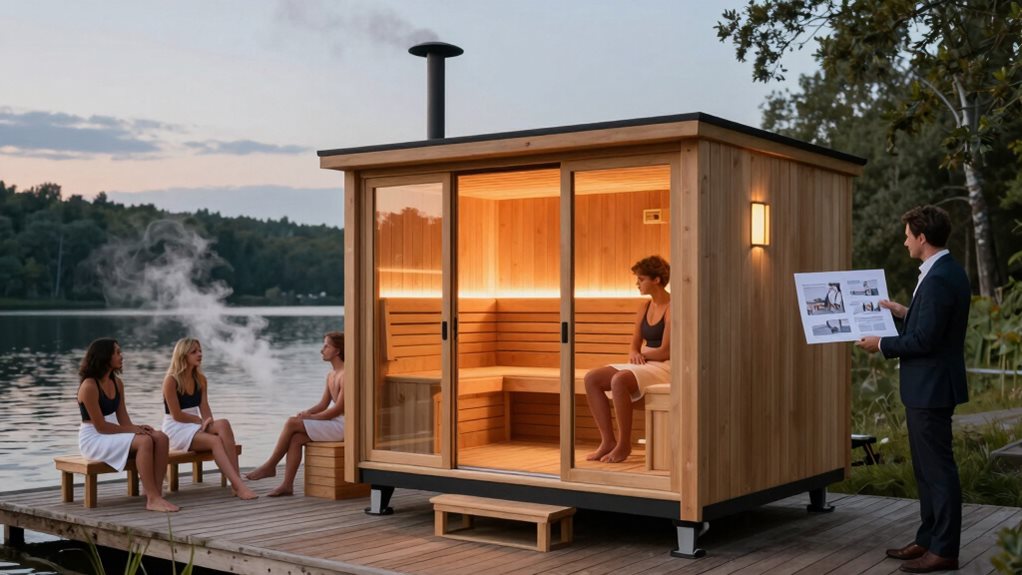
Investment potential in the mobile sauna market splits into two distinct paths: commercial ventures and residential applications.
If you’re eyeing the commercial space, you’ll find hotels leading the charge with a strong growth trajectory through 2029. Wellness tourism is adding a healthy 1.2% to the market’s CAGR, while urban pop-up saunas are gaining traction across North America and Europe.
The commercial sector benefits from corporate wellness programs and luxury real estate trends, boosting growth by 0.8%.
For residential investors, the portable sauna market offers compelling numbers – valued at $935.9M in 2024 and projected to reach $2,500M by 2035 with a robust 9.3% CAGR.
Home wellness trends continue to drive demand, particularly in North America where the segment could reach $850M by 2035.
Future Forecast: Technology Innovations Reshaping Sauna Culture
Technological advancements are rapidly transforming mobile saunas from simple sweat boxes into sophisticated wellness sanctuaries.
You’ll soon control your portable sauna experience with just your voice or smartphone, adjusting temperature and humidity from anywhere. Smart saunas are learning your preferences too, with AI analyzing your health data to create personalized sessions that adapt to your body’s needs. The integration of low-EMF technology provides safer experiences by reducing exposure to potentially harmful electromagnetic radiation. Machine learning algorithms now enable real-time adjustments to optimize your sauna settings based on your unique patterns and preferences.
- Hybrid heating systems combining traditional and infrared technologies will give you deeper therapeutic benefits while using less energy.
- Portable designs using lightweight materials mean you can take your wellness routine anywhere, from your apartment to outdoor adventures.
- Multi-sensory experiences with aromatherapy, chromotherapy, and sound healing will transform your sauna time into complete mind-body restoration.
Frequently Asked Questions
What Health Conditions Might Prohibit Sauna Use?
You shouldn’t use saunas if you have uncontrolled hypertension, recent heart attacks, unstable angina, severe heart failure, acute infections, epilepsy, open wounds, pregnancy without medical clearance, or kidney problems.
How Much Electricity Do Portable Saunas Consume Monthly?
Your portable sauna will consume 24-120 kWh monthly, depending on usage patterns. With three weekly one-hour sessions, you’ll use 24 kWh, while daily 40-minute sessions require 120 kWh.
Can Mobile Saunas Be Used Outdoors in Extreme Weather?
Yes, you can use mobile saunas outdoors in extreme weather if they’re properly equipped with high-R insulation, weatherproof materials, appropriate heating systems, and proper anchoring to withstand wind, snow, and rain.
Are There Rental Options Before Purchasing a Portable Sauna?
Yes, you’ll find numerous rental options before buying. Many companies offer daily, weekend, and weekly rates with delivery services, letting you test different models in your own space.
What Certifications Should Consumers Look for in Quality Portable Saunas?
Look for ETL/CE certifications for electrical safety, ROHS/REACH for non-toxic materials, EMF/VOC certifications for health protection, and ENERGY STAR for efficiency. Don’t forget FCC certification for electronics.
Final Thoughts
You’re witnessing a wellness revolution as mobile saunas transform the industry from exclusive spa experiences to accessible everyday rituals. They’re breaking down barriers of cost and location, making health benefits available to more people than ever before. As technology continues to advance, expect these portable solutions to become smarter, more efficient, and increasingly mainstream. Your wellness path no longer requires a spa membership—it might just arrive at your doorstep instead.